BIBLE VERSE STUDY
1 Chronicles 21:23 — Ornan's Generous Offer to David
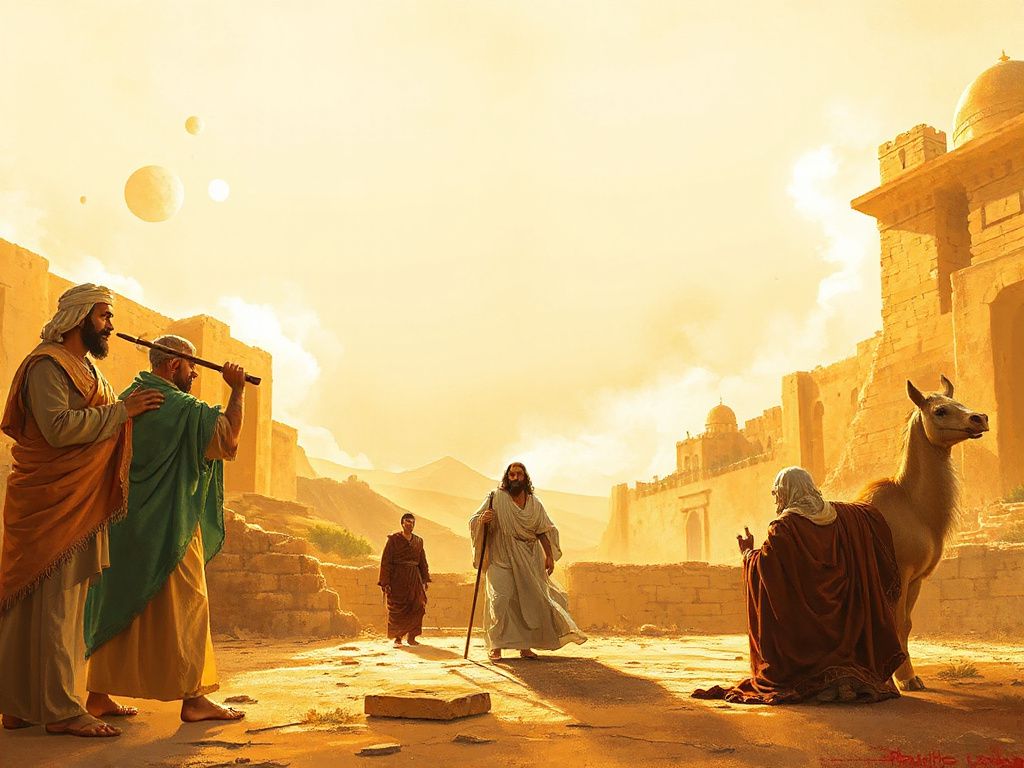
Ornan the Jebusite, after seeing the angel, freely offers David everything needed for the altar — oxen, threshing instruments, and wheat — at the threshing-floor where the plague was halted.
Scripture
23And Ornan said unto David, Take it to thee, and let my lord the king do that which is good in his eyes: lo, I give thee the oxen for burnt-offerings, and the threshing instruments for wood, and the wheat for the meal-offering; I give it all.
What this passage means
Ornan responds to David's request for the threshing-floor by giving not only the land itself but also all the materials needed for the sacrifices: oxen for burnt-offerings, the wooden threshing implements for fuel, and wheat for the meal-offering. The verse assembles the three main categories of sacrifice described in the altar laws — burnt-offering (עֹלָה), meal-offering (מִנְחָה), and the wood for the fire — in a single offer.
The phrase 'that which is good in his eyes' shows Ornan yielding full discretion to the king; he is not negotiating but handing over control. Together with the verbs of repeated giving — 'I give thee,' 'I give it all' — the verse pictures a man whose heart has been seized by the gravity of what his eyes have just seen (the destroying angel in verse 20).
Though the text does not explain Ornan's motivation, it presents the gift as prompt and unconditional. In the flow of the chapter, this generosity precedes David's refusal in verse 24 to offer 'that which is thine … without cost,' setting up the exchange that becomes the purchase price of the future temple site.
Context
Chapter 21 opens with David's census, the resulting pestilence, and the appearance of the destroying angel at Ornan's threshing-floor (vv. 15–18). Verses 20–22 show Ornan seeing the angel, hiding with his sons, bowing to David, and then hearing David's request to buy the site so 'the plague may be stayed from the people.' The target verse is Ornan's answer to that request.
In the immediate aftermath (vv. 24–28) David refuses the free gift, insisting on paying 'the full price,' pays six hundred shekels of gold, builds the altar, and receives fire from heaven. The chapter ends by noting that the tabernacle was still at Gibeon while David sacrificed here — establishing the threshing-floor of Ornan as the chosen place of worship that 2 Chronicles 3:1 will later identify as the temple mount.
Common questions
What is significant about Ornan's offer being 'without cost'?
Ornan offers everything for free, but in the very next verse David refuses to offer to the LORD 'that which is thine … without cost.' The contrast turns the moment into the founding transaction of the temple site and frames true worship as a costly, voluntary offering rather than an opportunistic gift.
Does the verse mention sacrifice for sin or only for the altar?
The verse itself names only burnt-offerings and the meal-offering. The sin-offering is not listed here, but verse 26 adds peace-offerings, and verse 27 says the angel sheathed his sword 'at that time' — connecting these sacrifices to the halting of the plague.
Why does the text repeat 'I give' multiple times in one speech?
The repeated verbs of giving — 'I give thee … I give it all' — emphasize totality and unwillingness to negotiate, matching the unbounded 'all' of his offer. The repetition mirrors the gravity of having just seen the destroying angel stand on the very ground he is handing over.