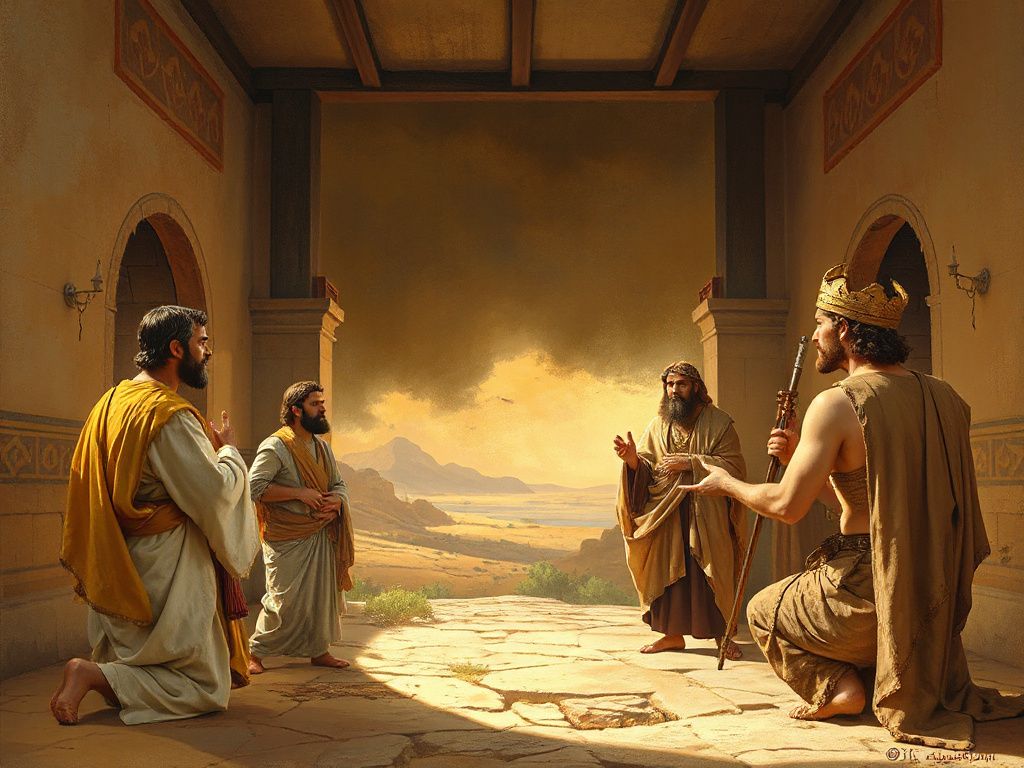
1 Samuel 20:21 — Jonathan's Signal of Safety
1 Samuel 20:21 records the first half of Jonathan's arrow-signal code: if he tells the boy the arrows are on David's side, David may come back safely by the life of Jehovah.
Scripture
21And, behold, I will send the lad, saying, Go, find the arrows. If I say unto the lad, Behold, the arrows are on this side of thee; take them, and come; for there is peace to thee and no hurt, as Jehovah liveth.
What this passage means
1 Samuel 20:21 is the first half of the coded plan Jonathan sets up in the field. He will shoot arrows and send a boy to retrieve them, and the words he shouts to the boy will carry a hidden message to David. The covenant just sealed (vv. 12–17, 23) needs an outward sign that can be acted on without the lad understanding what is happening, since the text itself notes that 'the lad knew not anything' (v. 39).
The verse lays out the safe condition precisely. If Jonathan says, 'Behold, the arrows are on this side of thee; take them, and come,' the phrasing signals David that it is safe to return. The motive clause 'for there is peace to thee and no hurt' defines what the signal means in plain terms. The oath 'as Jehovah liveth' binds the signal to the covenant just sworn 'in the name of Jehovah' (v. 42), so a casual phrase becomes a divinely witnessed pledge.
The negated pair 'and no hurt' is itself the hinge of the sign. Jonathan in v. 22 names the opposite case by saying 'Behold, the arrows are beyond thee... for Jehovah hath sent thee away,' so v. 21's 'no hurt' is not decorative optimism but the technical content of the code: 'on this side' equals safety, 'beyond you' equals departure. The verse thus turns a boy's arrow-collecting errand into a covenant signal grounded in the name of Jehovah.
Context
Verses 18–23 form a single setting block for v. 21. Jonathan anchors the time ('to-morrow is the new moon,' v. 18), the place (the stone Ezel, v. 19), and the action ('I will shoot three arrows on the side thereof, as though I shot at a mark,' v. 20) before giving the verbal key in v. 21. Verses 22–23 then state the negative branch of the code and seal it: 'Jehovah is between thee and me for ever.' The plan is acted out in 35–42, where Jonathan actually shoots beyond David and the two friends part in renewed covenant.
The wider chapter frames this signal against rising danger. Saul's intent to kill David has become known to Jonathan (vv. 12–13, 30–33), and the chapter ends with the king hurling a spear at his own son (v. 33). The 'peace to thee and no hurt' of v. 21 is therefore not routine news; it is the announced verdict of Jonathan's covert test of Saul's disposition, and its opposite case would have meant immediate flight for David.
Common questions
Why does Jonathan need an arrow code instead of sending a written message?
The chapter shows that David has already fled from Naioth in Ramah (v. 1), and any messenger heading to David could be watched or intercepted by Saul's agents. By hiding the message inside a boy's errand to find arrows, Jonathan can communicate the test's result while a third party sees only an ordinary retrieval task, as v. 39 confirms the lad understood nothing.
What is the difference between 'on this side of thee' and 'beyond thee' in the signal?
According to v. 21, 'on this side' is paired with 'there is peace to thee and no hurt,' meaning Saul's disposition toward David is not lethal and David may return. According to v. 22, 'beyond thee' is paired with 'Jehovah hath sent thee away,' meaning the danger is real and David must keep fleeing. The arrow's landing place, shouted to the boy, is the single switch that turns the errand into a verdict.
How does v. 21 fit into the covenant Jonathan and David just swore?
Verses 12–17 record the covenant itself, and v. 23 immediately after the arrow plan states 'Jehovah is between thee and me for ever.' The oath formula 'as Jehovah liveth' in v. 21 ties this particular signal into that covenant witness, so the arrow code is not a casual trick but a divinely witnessed channel of communication between the two covenant partners, later confirmed when they part in v. 42 with 'Jehovah shall be between me and thee.'