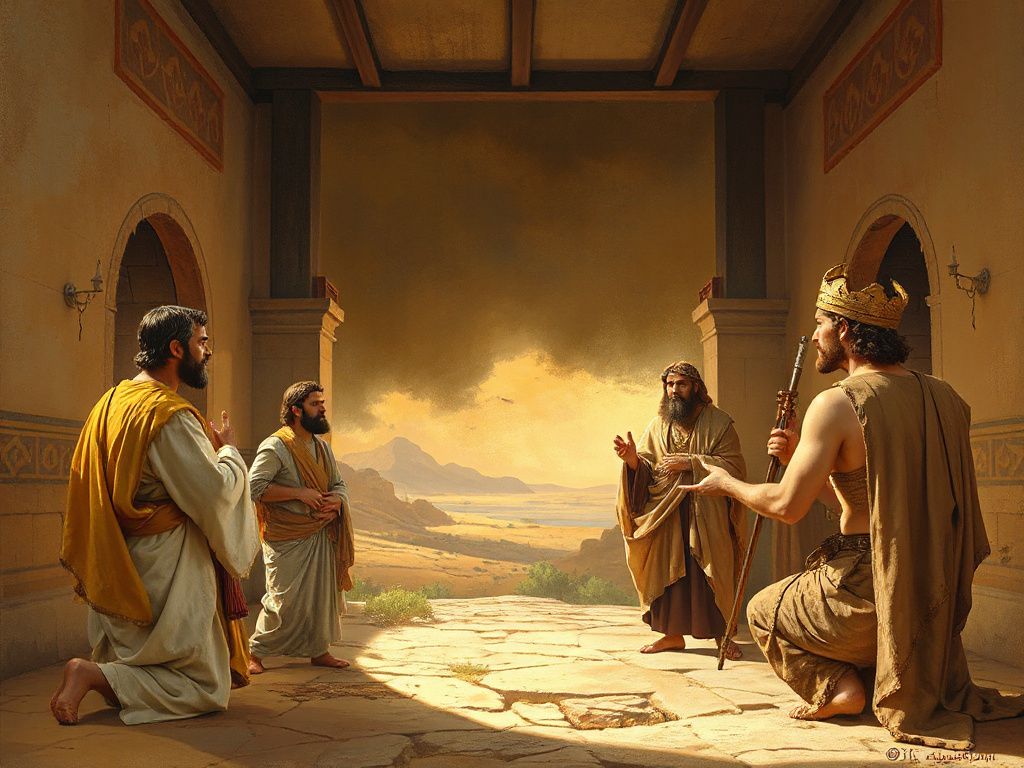
1 Samuel 26:4 — David Confirms Saul's Arrival
David sends out spies and confirms that Saul has indeed come into the wilderness of Ziph to pursue him.
Scripture
4David therefore sent out spies, and understood that Saul was come of a certainty.
What this passage means
1 Samuel 26:4 is a brief transitional verse that links the information David received from the Ziphites (vv. 1–3) to the action he takes in vv. 5–7. The verse notes that David sent out spies — a prudent military step — and that he understood, with certainty, that Saul had come. The wording emphasizes verification: David did not act on the Ziphites' report alone, but took steps to confirm the situation before responding.
The verb translated 'understood' indicates that David reached a settled conclusion, not a guess. The phrase 'of a certainty' (or 'certainly,' 'without fail') underlines the reliability of the intelligence. This matters because what follows is a high-stakes decision: David will approach Saul's camp by night (v. 7) and take the king's spear and water jug while he sleeps (v. 12). Such a move required confidence that Saul was indeed present and that the camp layout was as reported.
In the larger narrative, the verse also highlights a contrast between David and Saul. David relies on intelligence and careful scouting; Saul, by contrast, has marched three thousand chosen men (v. 2) based on a tip from the Ziphites. The contrast sets up the moral reversal that runs through the chapter: David, the pursued, acts with measured wisdom, while Saul, the pursuer, is depicted as needing protection from his own men (vv. 15–16).
Context
Verses 1–3 establish the situation: the Ziphites inform Saul that David is hiding on the hill of Hachilah, and Saul takes 3,000 chosen men into the wilderness of Ziph. David, while staying in the wilderness, observes that Saul has come after him. Verse 4 then sits between this reconnaissance and David's response in vv. 5–7, where he and Abishai enter Saul's camp by night and find Saul sleeping with his spear at his head.
The remainder of the chapter (vv. 8–25) develops the consequences of the intelligence confirmed in v. 4: Abishai offers to kill Saul, David refuses to harm 'Jehovah's anointed,' and David takes the spear and water jug as evidence. Saul later admits, 'I have sinned' (v. 21), and the chapter closes with Saul blessing David and returning home. The chapter as a whole parallels 1 Samuel 24, where David similarly spares Saul's life in a cave, presenting David as one who refuses to take the kingdom by force.
Common questions
Why did David send spies if he already knew Saul was coming?
Verse 3 says David 'saw that Saul came after him,' and v. 4 says he 'sent out spies and understood that Saul was come of a certainty.' The chapter presents David's action as a prudent step of verification — confirming Saul's exact location and the state of his camp before acting, which is what enables the nighttime approach in vv. 5–7.
What is the hill of Hachilah?
According to the chapter itself, the hill of Hachilah is described as 'before the desert' (vv. 1, 3). The Ziphites identified it as the place where David was hiding, and Saul encamped there in the wilderness of Ziph. The text does not provide further geographical detail beyond this.
How does 1 Samuel 26 relate to 1 Samuel 24?
Both chapters record an occasion when David refuses to kill Saul when he has the chance, and Saul acknowledges his sin. Chapter 26 takes place at the hill of Hachilah in the wilderness of Ziph, while chapter 24 takes place at En-gedi. The chapter itself does not explain the relationship between the two events, but the parallel presentation shows David consistently refusing to harm 'Jehovah's anointed.'