BIBLE CHAPTER STUDY
1 Samuel 3 — The Call of Samuel
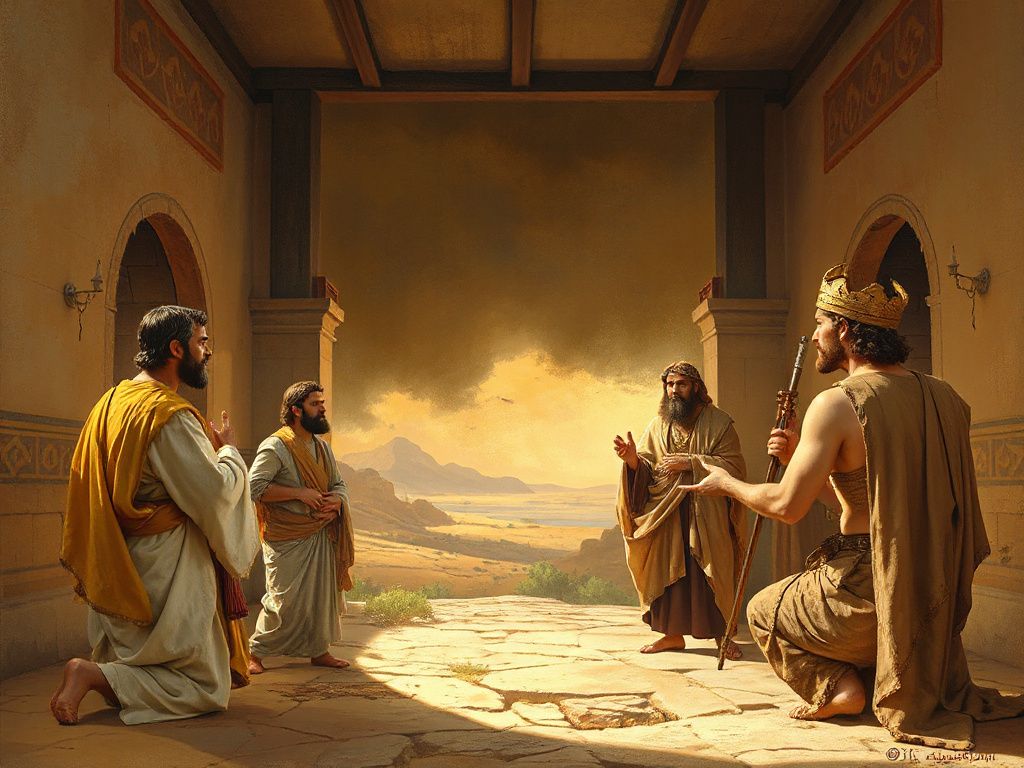
In a time when divine visions were scarce, the LORD calls young Samuel three times in the tabernacle at Shiloh; with Eli's guidance, Samuel learns to respond, and is then told that judgment will fall on Eli's house.
Scripture
1And the child Samuel ministered unto Jehovah before Eli. And the word of Jehovah was precious in those days; there was no frequent vision.
2And it came to pass at that time, when Eli was laid down in his place (now his eyes had begun to wax dim, so that he could not see),
3and the lamp of God was not yet gone out, and Samuel was laid down to sleep, in the temple of Jehovah, where the ark of God was;
4that Jehovah called Samuel; and he said, Here am I.
5And he ran unto Eli, and said, Here am I; for thou calledst me. And he said, I called not; lie down again. And he went and lay down.
6And Jehovah called yet again, Samuel. And Samuel arose and went to Eli, and said, Here am I; for thou calledst me. And he answered, I called not, my son; lie down again.
7Now Samuel did not yet know Jehovah, neither was the word of Jehovah yet revealed unto him.
8And Jehovah called Samuel again the third time. And he arose and went to Eli, and said, Here am I; for thou calledst me. And Eli perceived that Jehovah had called the child.
9Therefore Eli said unto Samuel, Go, lie down: and it shall be, if he call thee, that thou shalt say, Speak, Jehovah; for thy servant heareth. So Samuel went and lay down in his place.
10And Jehovah came, and stood, and called as at other times, Samuel, Samuel. Then Samuel said, Speak; for thy servant heareth.
11And Jehovah said to Samuel, Behold, I will do a thing in Israel, at which both the ears of every one that heareth it shall tingle.
12In that day I will perform against Eli all that I have spoken concerning his house, from the beginning even unto the end.
13For I have told him that I will judge his house for ever, for the iniquity which he knew, because his sons did bring a curse upon themselves, and he restrained them not.
14And therefore I have sworn unto the house of Eli, that the iniquity of Eli's house shall not be expiated with sacrifice nor offering for ever.
15And Samuel lay until the morning, and opened the doors of the house of Jehovah. And Samuel feared to show Eli the vision.
16Then Eli called Samuel, and said, Samuel, my son. And he said, Here am I.
17And he said, What is the thing that Jehovah hath spoken unto thee? I pray thee, hide it not from me: God do so to thee, and more also, if thou hide anything from me of all the things that he spake unto thee.
18And Samuel told him every whit, and hid nothing from him. And he said, It is Jehovah: let him do what seemeth him good.
19And Samuel grew, and Jehovah was with him, and did let none of his words fall to the ground.
20And all Israel from Dan even to Beer-sheba knew that Samuel was established to be a prophet of Jehovah.
21And Jehovah appeared again in Shiloh; for Jehovah revealed himself to Samuel in Shiloh by the word of Jehovah.
What this passage means
The chapter opens with two stark contrasts in verse 1: the child Samuel is 'ministering unto Jehovah before Eli,' yet 'the word of Jehovah was precious in those days; there was no frequent vision.' Service at the sanctuary continues, but direct revelatory speech from God has become rare. This sets the stage — what follows is God breaking into a period of silence.
The three-fold call in verses 4–10 is the literary heart of the chapter. Samuel, who 'did not yet know Jehovah, neither was the word of Jehovah yet revealed unto him' (v. 7), mistakes the divine voice for Eli's. Only after the third call does Eli 'perceive that Jehovah had called the child' (v. 8) and instruct him: 'Speak, Jehovah; for thy servant heareth.' The repetition both highlights Samuel's inexperience and models how hearing God depends on posture — he is told how to respond before the message arrives.
Verses 11–14 deliver the message itself: judgment on Eli's house for not restraining his sons. It then closes by grounding Samuel's prophetic vocation — 'Jehovah was with him, and did let none of his words fall to the ground' (v. 19), and 'all Israel … knew that Samuel was established to be a prophet of Jehovah' (v. 20). The chapter is about the transition of prophetic authority from the failing priest Eli to the young prophet Samuel.
Context
The provided materials situate this chapter at a moment when revelatory speech from God had become 'precious' and visions were not 'widespread' (v. 1). The condition of Eli's sons — that they 'knew not Jehovah' and 'did bring a curse upon themselves' — and Eli's failure to restrain them form the backdrop against which the LORD announces that no sacrifice or offering can atone for Eli's house (vv. 12–14). The chapter opens with Samuel sleeping in the temple where the ark of God was kept, the lamp still burning (v. 3), and closes with 'Jehovah appeared again in Shiloh … by the word of Jehovah' (v. 21).
The cross references supplied reinforce two themes of the chapter: periods when the word of the LORD is rare (Amos 8:11–12; Psalms 74:9) and the principle that genuine prophetic words do not fall to the ground (1 Kings 8:56; 1 Samuel 9:6). Together they frame 1 Samuel 3 as both an answer to a famine of hearing and the inauguration of a prophet whose words prove trustworthy.
Key words in the original
- H3368 The Hebrew word (yāqār, 'rare/precious') in verse 1 is used of things highly valued. Applied to 'the word of Jehovah,' it suggests the word was treasured precisely because it came so seldom — an unusual rendering that the cross reference in Amos 8:11–12 ('a famine of … hearing the words of Jehovah') echoes.
- H2377 The term ḥāzôn ('vision') in verse 1 names the specific form of revelation that had become unusual. Coupled with 'widespread' (H6555, nip̄rāṣ, 'to break out'), the verse contrasts a single bound vision with a flow of visions that was no longer 'breaking out.'
- H5288 The word nnaʿar ('boy') in verse 1 is used broadly for a youth from infancy through adolescence, here applied to Samuel. The unusually qualified 'the child Samuel' underscores that the one now being called is, by normal standards, unqualified to receive revelation.
Related verses
- Amos 8:11 Amos pictures a future 'famine … of hearing the words of Jehovah.' 1 Samuel 3 opens with that scarcity already realized ('the word of Jehovah was precious … there was no frequent vision'), so Amos clarifies what kind of famine the reader is being dropped into.
- 1 Samuel 9:6 Saul's servant describes a 'man of God … held in honor; all that he saith cometh surely to pass.' Verse 19 of 1 Samuel 3 grounds that reputation: 'Jehovah was with him, and did let none of his words fall to the ground.' The earlier chapter explains how Samuel earned such trust.
- 1 Samuel 2:12 The preceding chapter establishes the cause of the judgment announced in 3:11–14: 'the sons of Eli were base men; they knew not Jehovah.' Reading 2:12 alongside chapter 3 shows why the silencing of Eli's household is a moral, not merely a ritual, judgment.
Common questions
Why did Samuel keep running to Eli?
According to verse 7, 'Samuel did not yet know Jehovah, neither was the word of Jehovah yet revealed unto him.' He had grown up in the temple but had never personally experienced God speaking, so the only voice he could attribute the calls to was Eli's.
What was Eli supposed to do about his sons?
Verse 13 names the indictment: 'his sons did bring a curse upon themselves, and he restrained them not.' As high priest and father, Eli had authority to discipline them for their conduct at the sanctuary; the chapter frames his failure to do so as the ground for the unatoned judgment on his house.
Does 'for ever' (v. 14) mean Eli's house could never repent?
Verse 14 specifies what cannot atone — 'with sacrifice nor offering for ever.' The wording targets the sacrificial system: no further ritual can settle the debt already incurred. Whether this precludes any future mercy lies beyond what the chapter itself resolves.