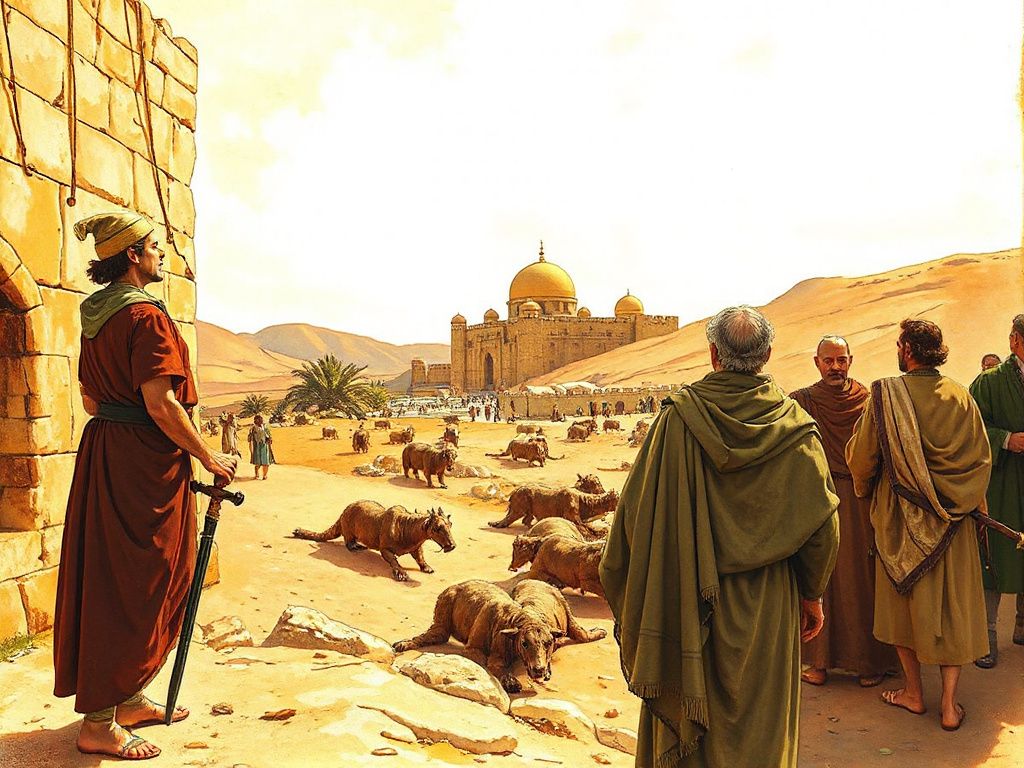
2 Chronicles 30:8 — Yield Yourselves, Not Stiffen Your Neck
Hezekiah's messengers call the northern tribes to repent, abandon the pattern of their fathers, yield to the Lord, enter His sanctuary, and serve Him so His fierce anger may turn away.
Scripture
8Now be ye not stiffnecked, as your fathers were; but yield yourselves unto Jehovah, and enter into his sanctuary, which he hath sanctified for ever, and serve Jehovah your God, that his fierce anger may turn away from you.
What this passage means
Verse 8 is the central command of Hezekiah's letter. The people are told not to repeat the pattern of their fathers: stubborn rebellion labeled as 'stiffnecked.' Instead, they are to 'yield themselves unto Jehovah,' presenting themselves to Him in willing submission rather than defiance.
The verse links three concrete actions to that yielding: entering the sanctuary which He has sanctified forever, and serving the Lord their God. The sanctuary is not presented as optional worship space but as the place the Lord Himself has set apart, and serving Him is framed as the natural expression of having entered it.
The motivation is explicitly stated: so that His fierce anger may turn away from them. The verse assumes that divine wrath is currently active against the people (as the surrounding context confirms) and that repentance, not ritual alone, is what reverses it. Yielding is the human action; the turning of anger is the divine response.
Context
The verse sits inside a royal proclamation sent throughout Israel and Judah (vv. 5–6). Hezekiah and his princes invite the remnant who escaped Assyrian hands to return to the God of Abraham, Isaac, and Israel, and warn them not to repeat the trespass of their fathers who were given over to desolation (v. 7). Verse 8 is the practical conclusion of that warning.
The chapter shows the mixed response: many northerners mocked the messengers (v. 10), but some from Asher, Manasseh, and Zebulun humbled themselves and came to Jerusalem (v. 11). Hezekiah later prays for those who ate the Passover uncleansed, and the Lord heals the people (vv. 18–20), showing that the invitation to yield is extended even to those whose obedience is imperfect.
Common questions
Why does the verse call the people 'stiffnecked'?
The phrase is a biblical picture of an ox that will not bow its neck to the yoke. In the surrounding context (v. 7) the fathers trespassed against the Lord and were given over to desolation, so 'stiffnecked' names that pattern of stubborn refusal to yield, which the hearers are told not to repeat.
What does 'yield yourselves unto Jehovah' mean here?
Within the verse it is set in opposition to being stiffnecked. Yielding is the willing act of placing oneself under the Lord's hand rather than resisting Him, and it is immediately tied to entering His sanctuary and serving Him.
Does this verse promise that God's anger will turn away if the people repent?
The verse states the condition plainly: yield yourselves, enter the sanctuary He has sanctified, and serve Him, so that His fierce anger may turn away. The following verse (v. 9) extends the promise further, stating that the Lord is gracious and merciful and will not turn His face from you if you return to Him.