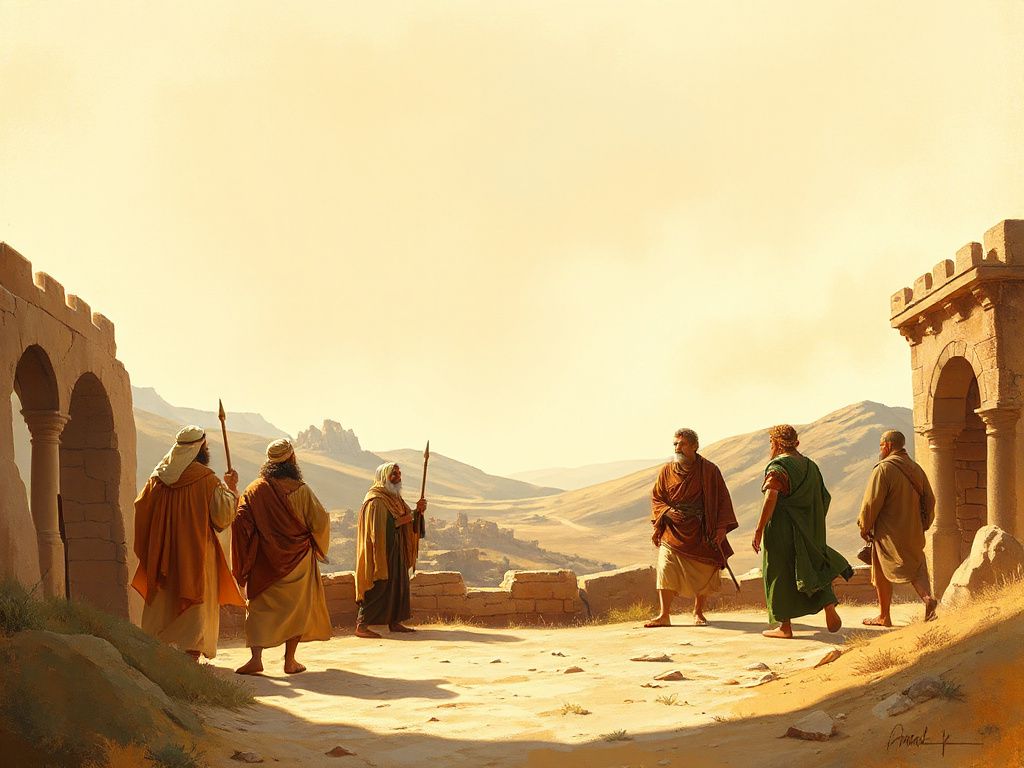
BIBLE CHAPTER STUDY
2 Kings 22 — Josiah's Discovery of the Book of the Law
Eight-year-old Josiah becomes king, repairs the temple, and is undone by the reading of a rediscovered book of the law; he sends to Huldah, who confirms coming judgment but grants him peace.
Scripture
1Josiah was eight years old when he began to reign; and he reigned thirty and one years in Jerusalem: and his mother's name was Jedidah the daughter of Adaiah of Bozkath.
2And he did that which was right in the eyes of Jehovah, and walked in all the way of David his father, and turned not aside to the right hand or to the left.
3And it came to pass in the eighteenth year of king Josiah, that the king sent Shaphan, the son of Azaliah the son of Meshullam, the scribe, to the house of Jehovah, saying,
4Go up to Hilkiah the high priest, that he may sum the money which is brought into the house of Jehovah, which the keepers of the threshold have gathered of the people:
5and let them deliver it into the hand of the workmen that have the oversight of the house of Jehovah; and let them give it to the workmen that are in the house of Jehovah, to repair the breaches of the house,
6unto the carpenters, and to the builders, and to the masons, and for buying timber and hewn stone to repair the house.
7Howbeit there was no reckoning made with them of the money that was delivered into their hand; for they dealt faithfully.
8And Hilkiah the high priest said unto Shaphan the scribe, I have found the book of the law in the house of Jehovah. And Hilkiah delivered the book to Shaphan, and he read it.
9And Shaphan the scribe came to the king, and brought the king word again, and said, Thy servants have emptied out the money that was found in the house, and have delivered it into the hand of the workmen that have the oversight of the house of Jehovah.
10And Shaphan the scribe told the king, saying, Hilkiah the priest hath delivered me a book. And Shaphan read it before the king.
11And it came to pass, when the king had heard the words of the book of the law, that he rent his clothes.
12And the king commanded Hilkiah the priest, and Ahikam the son of Shaphan, and Achbor the son of Micaiah, and Shaphan the scribe, and Asaiah the king's servant, saying,
13Go ye, inquire of Jehovah for me, and for the people, and for all Judah, concerning the words of this book that is found; for great is the wrath of Jehovah that is kindled against us, because our fathers have not hearkened unto the words of this book, to do according unto all that which is written concerning us.
14So Hilkiah the priest, and Ahikam, and Achbor, and Shaphan, and Asaiah, went unto Huldah the prophetess, the wife of Shallum the son of Tikvah, the son of Harhas, keeper of the wardrobe (now she dwelt in Jerusalem in the second quarter); and they communed with her.
15And she said unto them, Thus saith Jehovah, the God of Israel: Tell ye the man that sent you unto me,
16Thus saith Jehovah, Behold, I will bring evil upon this place, and upon the inhabitants thereof, even all the words of the book which the king of Judah hath read.
17Because they have forsaken me, and have burned incense unto other gods, that they might provoke me to anger with all the work of their hands, therefore my wrath shall be kindled against this place, and it shall not be quenched.
18But unto the king of Judah, who sent you to inquire of Jehovah, thus shall ye say to him, Thus saith Jehovah, the God of Israel: As touching the words which thou hast heard,
19because thy heart was tender, and thou didst humble thyself before Jehovah, when thou heardest what I spake against this place, and against the inhabitants thereof, that they should become a desolation and a curse, and hast rent thy clothes, and wept before me; I also have heard thee, saith Jehovah.
20Therefore, behold, I will gather thee to thy fathers, and thou shalt be gathered to thy grave in peace, neither shall thine eyes see all the evil which I will bring upon this place. And they brought the king word again.
What this passage means
The chapter frames Josiah as a paradigmatic reformer king: he is introduced at age eight with the standard genealogy, then immediately evaluated as one who 'did that which was right in the eyes of Jehovah' and 'walked in all the way of David his father' (v. 2). The clause 'turned not aside to the right hand or to the left' echoes Deuteronomy 5:32 and Joshua 1:7, marking Josiah as a covenantally faithful king whose reign will be tested by an event far older than his reign.
In his eighteenth year Josiah commissions Shaphan to take the temple contributions and pay the workers, explicitly trusting them without audit 'for they dealt faithfully' (v. 7). The repair narrative is interrupted when Hilkiah announces, 'I have found the book of the law in the house of Jehovah' (v. 8). The reading of the book fractures Josiah: he rends his clothes (v. 11), confesses that ancestral disobedience has kindled 'great... wrath,' and sends a delegation—including Hilkiah, Ahikam, Achbor, Shaphan, and Asaiah—to 'inquire of Jehovah' through Huldah the prophetess.
Huldah's oracle splits judgment and mercy: 'I will bring evil upon this place... all the words of the book' (v. 16) because the people 'have forsaken me' and burned incense to other gods (v. 17), a wrath 'that shall not be quenched.' Yet because Josiah's heart was tender and he humbled himself, weeping and rending his clothes, the Lord has heard him: he will 'be gathered to thy grave in peace' and will not see the coming disaster (vv. 19–20). The chapter thus juxtaposes unquenchable national judgment with personal, covenantal response.
Context
Within 2 Kings, chapter 22 sits at the opening of a Josiah narrative that continues through chapter 23. Because the surrounding full_chapter text was not supplied, the only framing provided here is the curated note 'Josiah reform,' which situates the passage as the launch of that reform. The chapter's chronology is anchored to 'the eighteenth year of king Josiah' (v. 3), and its central hinge is Hilkiah's discovery of 'the book of the law in the house of Jehovah' (v. 8).
The chapter supplies no internal geography or historical background beyond a brief note that Huldah 'dwelt in Jerusalem in the second quarter' (v. 14). All further historical, geographical, or comparative claims about Josiah's reform, the nature of the discovered book, or the identity of Huldah fall outside the provided text and are not asserted here.
Key words in the original
- H3477 Hebrew yāšār, 'right,' used here as 'that which was right in the eyes of Jehovah' (v. 2). The same root appears across the Deuteronomistic evaluation of kings; here it signals covenant conformity rather than mere political success.
- H6213 Hebrew ʿāsāh, 'did,' the general verb 'to do/make.' Combined with yāšār in v. 2, it forms the standard Deuteronomistic phrase 'did what was right,' defining Josiah's reign by covenantal deeds rather than by description.
- H1870 Hebrew derek, 'way,' in 'all the way of David his father' (v. 2). Beyond a literal path, 'way' denotes a course of life or pattern of allegiance; the phrase identifies Josiah's reign as a continuation of the Davidic pattern of covenant loyalty.
Related verses
- Deuteronomy 5:32 The phrase 'turned not aside to the right hand or to the left' in 2 Kings 22:2 directly mirrors this Deuteronomy command, linking Josiah's faithfulness to the Mosaic covenant standard rather than to autonomous royal policy.
- 1 Kings 21:29 Both passages pair humbling oneself before the Lord with a postponement rather than removal of judgment. Ahab's case prefigures Josiah's: covenantal humility deflects the worst within the prophet's own lifetime.
- Psalms 51:17 Josiah's rending of clothes and weeping (v. 11) and Huldah's note that his 'heart was tender' (v. 19) align with this psalm's description of a broken and contrite heart as the sacrifice God accepts. The chapter presents Josiah's response as that acceptable worship.
Common questions
What did Josiah do when he heard the book of the law?
He 'rent his clothes' (v. 11) and sent his officials to 'inquire of Jehovah' for himself and the people, declaring that 'great is the wrath of Jehovah that is kindled against us, because our fathers have not hearkened unto the words of this book' (v. 13). His response is repentance, not political reform, and it triggers Huldah's oracle.
Who is Huldah and why is she consulted?
Huldah is identified as 'the prophetess,' wife of Shallum, keeper of the wardrobe, dwelling 'in Jerusalem in the second quarter' (v. 14). Josiah's delegation goes to her to 'inquire of Jehovah,' and she delivers an oracle attributed to 'Jehovah, the God of Israel.' The text presents her as the legitimate prophetic voice to whom Josiah and the nation are directed at this moment.
Does Huldah's prophecy cancel the coming judgment?
No. The judgment on Judah and Jerusalem is confirmed and 'shall not be quenched' (vv. 16–17). What is granted is personal to Josiah: because he 'humbled thyself before Jehovah' and wept, the Lord has heard him, and he will 'be gathered to thy grave in peace, neither shall thine eyes see all the evil which I will bring upon this place' (vv. 19–20). The chapter distinguishes national judgment from individual covenantal response.