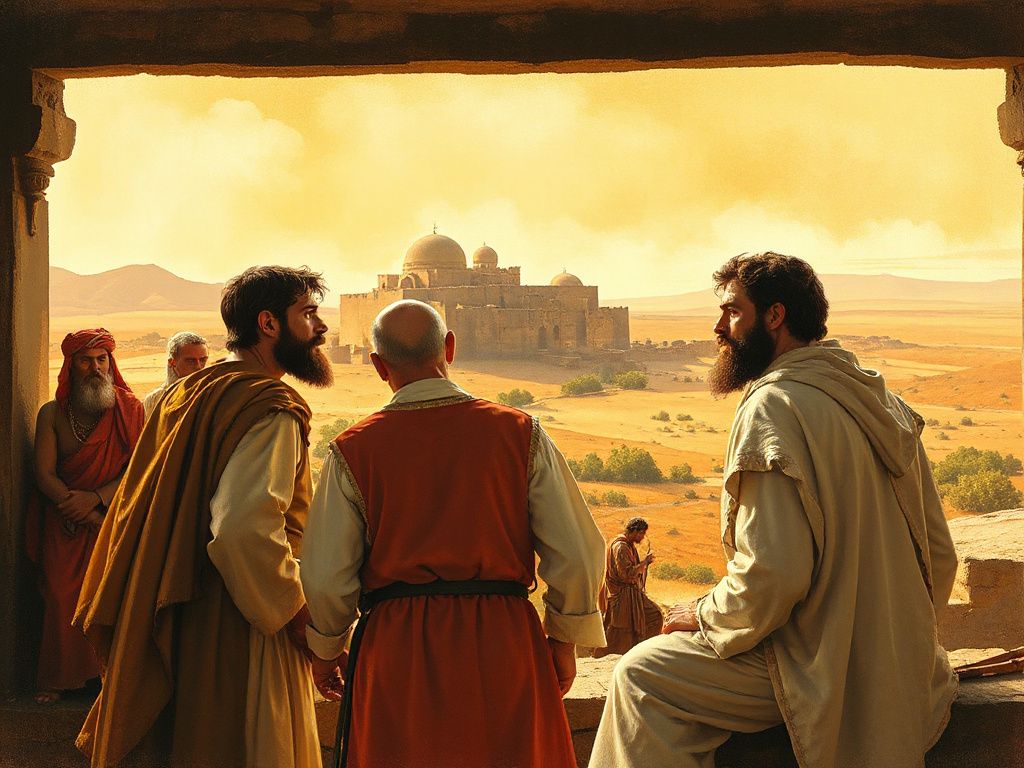
BIBLE CHAPTER STUDY
2 Samuel 7 — The Davidic Covenant
Nathan tells David that instead of David building God a house, God will establish David's house and an eternal kingdom through his offspring.
Scripture
1And it came to pass, when the king dwelt in his house, and Jehovah had given him rest from all his enemies round about,
2that the king said unto Nathan the prophet, See now, I dwell in a house of cedar, but the ark of God dwelleth within curtains.
3And Nathan said to the king, Go, do all that is in thy heart; for Jehovah is with thee.
4And it came to pass the same night, that the word of Jehovah came unto Nathan, saying,
5Go and tell my servant David, Thus saith Jehovah, Shalt thou build me a house for me to dwell in?
6for I have not dwelt in a house since the day that I brought up the children of Israel out of Egypt, even to this day, but have walked in a tent and in a tabernacle.
7In all places wherein I have walked with all the children of Israel, spake I a word with any of the tribes of Israel, whom I commanded to be shepherd of my people Israel, saying, Why have ye not built me a house of cedar?
8Now therefore thus shalt thou say unto my servant David, Thus saith Jehovah of hosts, I took thee from the sheepcote, from following the sheep, that thou shouldest be prince over my people, over Israel;
9and I have been with thee whithersoever thou wentest, and have cut off all thine enemies from before thee; and I will make thee a great name, like unto the name of the great ones that are in the earth.
10And I will appoint a place for my people Israel, and will plant them, that they may dwell in their own place, and be moved no more; neither shall the children of wickedness afflict them any more, as at the first,
11and as from the day that I commanded judges to be over my people Israel; and I will cause thee to rest from all thine enemies. Moreover Jehovah telleth thee that Jehovah will make thee a house.
12When thy days are fulfilled, and thou shalt sleep with thy fathers, I will set up thy seed after thee, that shall proceed out of thy bowels, and I will establish his kingdom.
13He shall build a house for my name, and I will establish the throne of his kingdom for ever.
14I will be his father, and he shall be my son: if he commit iniquity, I will chasten him with the rod of men, and with the stripes of the children of men;
15but my lovingkindness shall not depart from him, as I took it from Saul, whom I put away before thee.
16And thy house and thy kingdom shall be made sure for ever before thee: thy throne shall be established for ever.
17According to all these words, and according to all this vision, so did Nathan speak unto David.
18Then David the king went in, and sat before Jehovah; and he said, Who am I, O Lord Jehovah, and what is my house, that thou hast brought me thus far?
19And this was yet a small thing in thine eyes, O Lord Jehovah; but thou hast spoken also of thy servant's house for a great while to come; and this too after the manner of men, O Lord Jehovah!
20And what can David say more unto thee? for thou knowest thy servant, O Lord Jehovah.
21For thy word's sake, and according to thine own heart, hast thou wrought all this greatness, to make thy servant know it.
22Wherefore thou art great, O Jehovah God: for there is none like thee, neither is there any God besides thee, according to all that we have heard with our ears.
23And what one nation in the earth is like thy people, even like Israel, whom God went to redeem unto himself for a people, and to make him a name, and to do great things for you, and terrible things for thy land, before thy people, whom thou redeemest to thee out of Egypt, from the nations and their gods?
24And thou didst establish to thyself thy people Israel to be a people unto thee for ever; and thou, Jehovah, becamest their God.
25And now, O Jehovah God, the word that thou hast spoken concerning thy servant, and concerning his house, confirm thou it for ever, and do as thou hast spoken.
26And let thy name be magnified for ever, saying, Jehovah of hosts is God over Israel; and the house of thy servant David shall be established before thee.
27For thou, O Jehovah of hosts, the God of Israel, hast revealed to thy servant, saying, I will build thee a house: therefore hath thy servant found in his heart to pray this prayer unto thee.
28And now, O Lord Jehovah, thou art God, and thy words are truth, and thou hast promised this good thing unto thy servant:
29now therefore let it please thee to bless the house of thy servant, that it may continue for ever before thee; for thou, O Lord Jehovah, hast spoken it: and with thy blessing let the house of thy servant be blessed for ever.
What this passage means
Verses 1–7 set up a deliberate reversal. David, settled in a cedar palace, proposes to build a permanent dwelling for the ark (v. 2). Nathan initially approves (v. 3), but that very night God corrects the plan: from the exodus onward God has moved in a tent and tabernacle, and never commanded any Israelite leader to build a cedar house (vv. 4–7). The point is not that temples are wrong, but that God's initiative, not David's piety, sets the agenda.
Verses 8–17 contain the substance of what is later called the Davidic covenant. God recounts David's past (taken from shepherding, vv. 8–9), promises Israel a secure place (v. 10), and then announces three escalating gifts: a house for David (a dynasty, v. 11), a seed who will build the temple and whose kingdom God will establish forever (vv. 12–13), and a father-son relationship in which discipline, not rejection, follows disobedience (vv. 14–15). The 'for ever' language (vv. 13, 16) is the chapter's theological center.
Verses 18–29 are David's prayer of response. He enters, sits before the Lord, and asks 'Who am I?' (vv. 18–19)—a humility echoed in several cross references. He praises God's greatness (vv. 22–24), then asks God to confirm the promised word 'for ever' (vv. 25–29). The prayer's logic is striking: David grounds his request in God's own promise, treating divine speech itself as the basis for further prayer.
Context
The chapter sits at a structural hinge in 2 Samuel. The preceding chapters narrate David's wars and consolidation of power; the chapters that follow trace the covenant's tragic shadow through David's sin with Bathsheba and Absalom's revolt. Chapter 7 is therefore the theological peak from which the rest of the book's decline is measured. Within the canon, 1 Chronicles 17 records the same scene, confirming its importance, and the chapter's 'everlasting throne' language is quoted and reapplied in the Psalms and the prophets.
The only contextual note supplied is the label 'Davidic covenant.' The chapter itself grounds this title in the repeated promise that David's house, kingdom, and throne will be established 'for ever' before the Lord (vv. 11, 13, 16), and that this endurance is grounded in God's steadfast love rather than in the dynasty's moral perfection (vv. 14–15). No external historical or political claims about authorship or dating are stated in the provided material.
Key words in the original
- H1004 Hebrew bayit ('house') is the chapter's key word and is deliberately played against itself. David offers to build a 'house' for God (a building, vv. 2, 5, 7); God answers by promising to build David a 'house' (a dynasty, vv. 11–12), and that his 'seed' will build God's 'house' (the temple, v. 13). The same physical word thus expands to mean building, family, dynasty, and eventually the people of God.
- H3427 Hebrew yashav ('dwell, sit') frames the chapter. In v. 1 David is 'settled' in his palace, in v. 2 he 'dwells' in a cedar house while the ark 'dwells' within curtains. The verb thus poses the question of the chapter: where does God truly 'sit/dwell'? God's answer (vv. 6–7) is that He has walked in a tent, while promising to give David's dynasty a permanently 'established' throne (vv. 11, 16).
Related verses
- 1 Chronicles 17:16 Chronicles records the same prayer of David in response to the same covenant, confirming that 2 Samuel 7 is the literary source for the Davidic promise and that the 'Who am I?' response is part of the canonical shape of the episode.
- Psalms 8:4 David's 'Who am I?' in v. 18 echoes the psalmist's question about humanity's significance before God. Both passages pair the unworthiness of the creature with the unexpected generosity of the Creator.
- Genesis 32:10 Jacob's earlier 'I am not worthy of the least' provides an OT pattern for the unworthiness confession that David rehearses in vv. 18–19. The link suggests that receiving covenant promises produces gratitude expressed as self-abasement.
Common questions
Why does God forbid David from building the temple?
The text gives two reasons, both stated by God himself. First, He never asked for a cedar house; He has moved with Israel in a tent and tabernacle since the exodus (vv. 6–7). Second, the agenda belongs to God: it is God who will 'make' David a house (v. 11). The chapter reframes David's noble impulse within God's larger purpose rather than rejecting piety itself.
What does 'for ever' (le'olam) mean in this chapter?
In vv. 13, 16 the word is applied to David's throne, house, and kingdom. The chapter itself does not specify whether this is fulfilled in Solomon alone, in the continuing Davidic line, or in a future figure; it only insists that God's promise outlasts the dynasty's moral failures (vv. 14–15). Interpreters differ on the exact referent, and the provided material does not resolve the question.
Is 2 Samuel 7 the same event as 1 Chronicles 17?
Yes, the two chapters narrate the same covenant speech and David's response. 1 Chronicles 17:16 reproduces David's 'Who am I?' prayer verbatim from 2 Samuel 7:18, indicating that Chronicles draws on the Samuel account as its source.