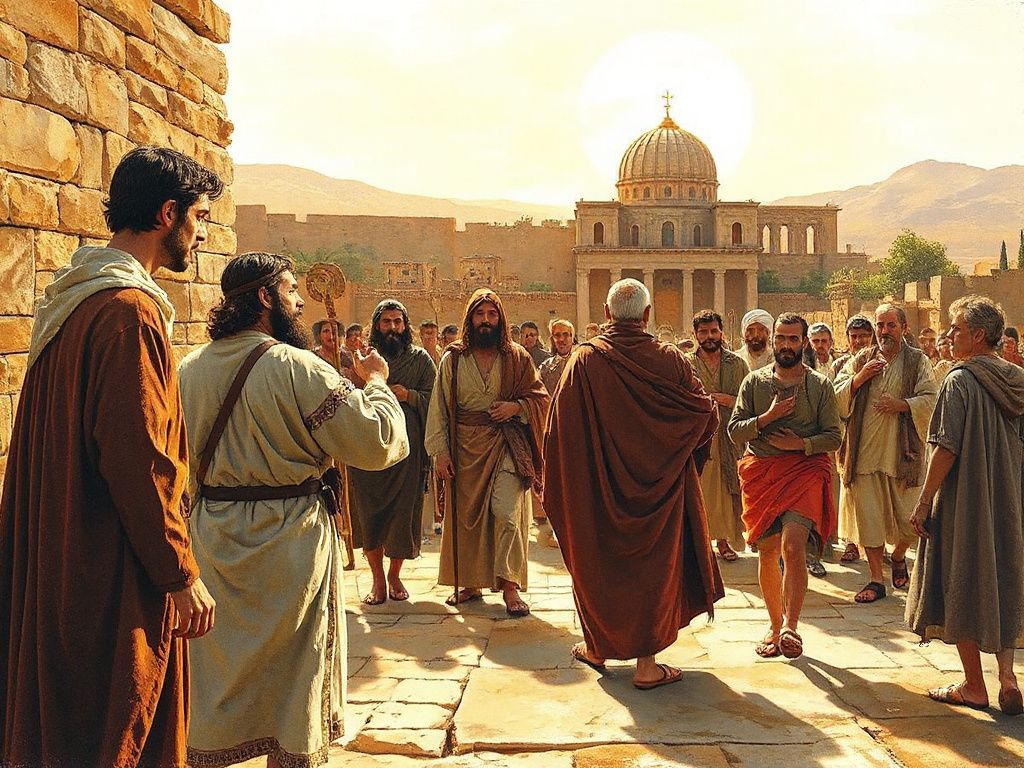
BIBLE VERSE STUDY
Acts 1:8 — The Mission of Witness by the Spirit
Acts 1:8 announces that the coming Holy Spirit will empower the disciples to be Christ's witnesses, extending from Jerusalem outward to the ends of the earth.
Scripture
8But ye shall receive power, when the Holy Spirit is come upon you: and ye shall be my witnesses both in Jerusalem, and in all Judaea and Samaria, and unto the uttermost part of the earth.
What this passage means
Acts 1:8 is a single sentence with two coordinated clauses joined by a contrast: 'Ye shall receive power' and 'ye shall be my witnesses.' The first clause identifies the source of the disciples' ability; the second clause identifies their task. The power and the witness are not two separate gifts but two aspects of one calling — the Spirit enables the witness. Without the Spirit, the task is impossible; without the task, the Spirit has no stated purpose here.
The verse is structured around a geography. The mission expands in concentric circles: Jerusalem, then all Judaea, then Samaria, then the uttermost part of the earth. The order is not incidental. It mirrors the way the book of Acts itself unfolds — the gospel begins in Jerusalem (chs. 2–7), spreads through Judaea and Samaria (chs. 8–9), reaches the Gentile world through Paul (chs. 10–28). The geography is therefore a narrative program as much as a missionary strategy.
The verse also contrasts what the disciples asked about with what Christ actually promised. In the preceding verses the disciples asked about the restoration of the kingdom to Israel, and Jesus answered that the timing belongs to the Father alone. He does not rebuke them further; instead, He redirects their attention to what they will receive and what they will do. The kingdom question is left unanswered in its political form, and a Spirit-given, witness-shaped mission is given in its place.
Context
Acts 1:8 sits in the hinge between the resurrection appearances of Jesus and His ascension. The preceding verses record Jesus' instruction to wait in Jerusalem for 'the promise of the Father' (v. 4) and the prediction that they will be baptized in the Holy Spirit 'not many days hence' (v. 5). Verse 8 specifies the purpose of that baptism: power for witness. The verses that follow (vv. 9–11) narrate the ascension itself, the cloud that receives Jesus out of sight, and the two men in white apparel who announce His return.
The chapter then turns to the gap between the promise and its fulfillment. The disciples return to the upper room, devote themselves to prayer together with the women, Mary, and Jesus' brothers (v. 14), and address the vacancy left by Judas by selecting Matthias (vv. 15–26). The church waits in Jerusalem — exactly the starting point named in v. 8 — for the Spirit that v. 8 has just promised.
Common questions
Why is Acts 1:8 often called the theme verse of the book of Acts?
Because the verse supplies the central terms that structure the rest of the book. Acts unfolds as the promised Holy Spirit (chs. 2, 10, 19) empowers the disciples to carry witness outward from Jerusalem (chs. 2–7), through Judaea and Samaria (chs. 8–9), and to the ends of the earth (chs. 10–28). The chapters that follow consistently trace this expansion, making v. 8 the programmatic statement of the book.
What does 'power' mean in this verse?
The verse does not define the term further. It pairs 'power' directly with 'witness,' indicating that the ability to testify is the immediate effect. The connection is reinforced by the surrounding context, which speaks of the promised Holy Spirit (v. 4) and the coming baptism in the Spirit (v. 5). The power is therefore the Spirit's enabling, oriented toward the task of speaking about Jesus.
Why does Jesus mention Jerusalem, Judaea, Samaria, and the ends of the earth in this order?
The order traces a geographic expansion that the book of Acts itself follows. The gospel begins in Jerusalem at Pentecost, spreads through the surrounding regions, and reaches the Gentile world by the end of the book. The sequence is therefore both a description of the disciples' immediate sphere and a preview of the book's narrative trajectory.