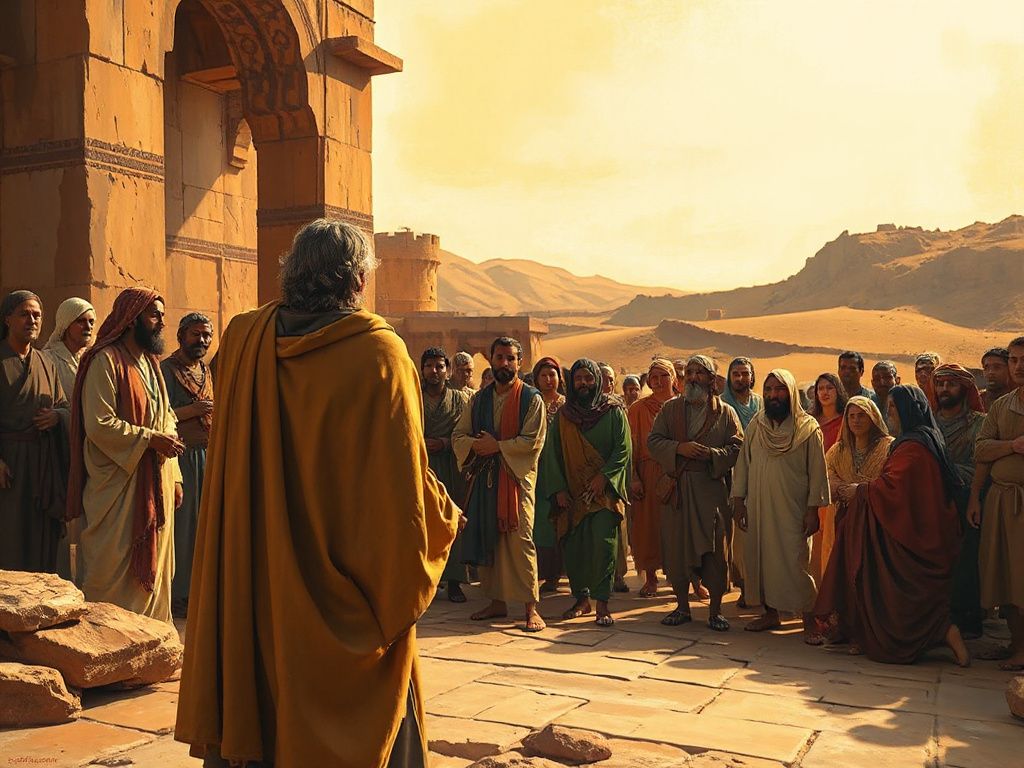
Deuteronomy 30:9 — God's Rejoicing Over His Restored People
God promises to make Israel abundantly fruitful and to rejoice over them for good, as He rejoiced over their fathers, when they return to Him with all their heart and soul.
Scripture
9And Jehovah thy God will make thee plenteous in all the work of thy hand, in the fruit of thy body, and in the fruit of thy cattle, and in the fruit of thy ground, for good: for Jehovah will again rejoice over thee for good, as he rejoiced over thy fathers;
What this passage means
Deuteronomy 30:9 promises covenant prosperity across four domains: the work of the hands, the fruit of the body (children), the fruit of the cattle (livestock), and the fruit of the ground (crops). The phrase 'for good' clarifies that the multiplication is not raw abundance but blessing directed toward Israel's well-being. The verse lists the same categories of blessing found in the earlier covenant texts, showing that the consequence of returning to the Lord is a restoration of the original covenant gifts.
The second half of the verse shifts from material blessing to the emotional disposition of God Himself: 'Jehovah will again rejoice over thee for good, as he rejoiced over thy fathers.' The repetition of 'again' locates the promise in a renewed moment — Israel's restoration triggers a fresh experience of God's delight. The echo of God's joy 'over thy fathers' ties the future blessing to the patriarchs, anchoring the promise in the earlier history of the covenant relationship.
Verse 9 is embedded in a conditional structure. The preceding context (vv. 6–8) speaks of the circumcision of the heart, the removal of curses from enemies, and obedience to the Lord's voice. The following verse (v. 10) then states the condition explicitly: 'if thou shalt obey… if thou turn unto Jehovah thy God with all thy heart, and with all thy soul.' Thus the abundance and divine rejoicing are promised to the obedient, repentant community, not as automatic outcomes.
Context
Deuteronomy 30 forms part of Moses' final covenant renewal address before Israel enters the land. The chapter opens with the scenario of exile (v. 1) and the call to return to the Lord 'with all thy heart, and with all thy soul' (v. 2). Verses 3–5 promise that God will gather scattered Israel from the farthest places, bring them back into the ancestral land, and multiply them above their fathers. Verse 6 then escalates from external restoration to internal transformation: the circumcision of the heart to love the Lord.
Verse 9 sits at the midpoint of this passage, linking the inward renewal of verse 6 and the external obedience of verse 8 to the material and relational blessings that follow. The chapter continues past the target verse with the famous declaration that the commandment is not in heaven or beyond the sea (vv. 11–14), and closes with the climactic choice set before Israel: life and good, or death and evil (vv. 15–20).
Common questions
What are the four fruits mentioned in Deuteronomy 30:9?
The verse mentions the fruit of the hand (work and labor), the fruit of the body (children and descendants), the fruit of the cattle (livestock and herds), and the fruit of the ground (crops and agricultural produce). Together they cover the full scope of covenant prosperity in the Israelite setting provided in the chapter.
Why does God say He will 'again rejoice' over Israel?
The word 'again' indicates a renewed experience of God's delight. Because the context of chapter 30 begins with exile and scattering, the promise signals that Israel's return to the Lord triggers a fresh outpouring of divine joy, paralleling the joy God had over the patriarchs in earlier generations.
Is the blessing of Deuteronomy 30:9 unconditional?
No. As the surrounding verses make clear, the abundance and divine rejoicing are promised to Israel 'if thou shalt obey the voice of Jehovah thy God' and 'if thou turn unto Jehovah thy God with all thy heart, and with all thy soul' (v. 10). The blessing is thus covenantal and conditioned on heartfelt obedience and return.