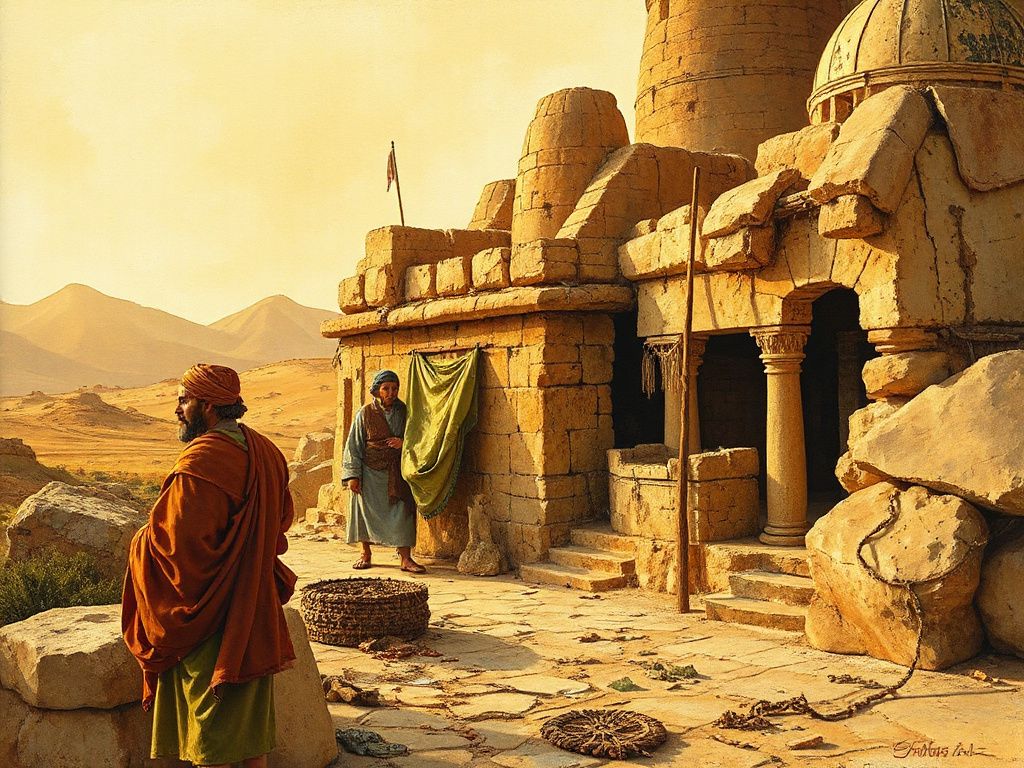
Ecclesiastes 3:18 — Humans Tested as Beasts
Qoheleth states that God tests humanity so that people may recognize that they, like beasts, share a common fate under the sun.
Scripture
18I said in my heart, It is because of the sons of men, that God may prove them, and that they may see that they themselves are but as beasts.
What this passage means
Ecclesiastes 3:18 is a conclusion reached in Qoheleth's heart (לִבִּי, H3820). It reports a thought-experiment: the reason God tests (בָרָ, H1305, 'testing') the sons of men (בְּנֵי הָאָדָם, H1121 + H0120) is so that they 'may see that they themselves are but as beasts.' The verse is explanatory (כִּי — 'because of,' H5921, 'with') rather than final; it tells the reader why God allows the testing described in the surrounding passage.
The construction 'that they may see' (לִרְאוֹת, H7200, 'see') frames the divine action as pedagogical. Humans are not left to guess at their own nature; God opens their eyes to the brute fact that, in the realm 'under the sun,' their situation resembles that of the animals (בְּהֵמָה, H0929). The reflexive pronoun הֶם (H1992, 'themselves') underscores personal recognition — each individual is to see this about themselves.
Importantly, the verse does not deny human distinction; it states the purpose of the test. The wording 'they themselves are but as beasts' (כַּבְהֵמָה הֵמָּה) is a simile of equivalence in one domain (death, dust, shared fate) rather than a flat denial of humanity. Qoheleth's point is that the test exposes this likeness so people will take account of it.
Context
Ecclesiastes 3 opens with the poem of times and seasons (vv. 1–8) and moves to the puzzle that 'God hath set eternity in their heart, yet so that man cannot find out the work that God hath done' (v. 11). Verses 14–17 introduce Qoheleth's reflection: God's works endure forever (v. 14), past and future already exist (v. 15), and yet 'under the sun, in the place of justice, … wickedness was there' (v. 16). Verse 17 affirms that 'God will judge the righteous and the wicked.' Verse 18 follows immediately: the present evil state of affairs is, in Qoheleth's reckoning, a test.
Verses 19–21 then unpack the test's content: humans and beasts share one breath, die alike, return to dust (vv. 19–20), and the question 'Who knoweth the spirit of man, whether it goeth upward?' (v. 21) hangs open. Verse 18 is therefore the hinge: it names the divine purpose behind the puzzling scene of v. 16, just before vv. 19–21 describe what humanity is being made to see.
Key words in the original
- H3820 לֵב (lēb), 'heart,' is the seat of thinking as well as feeling. Qoheleth's 'I said in my heart' (v. 18) marks an inner reasoned conclusion, not a passing emotion.
- H1305 The gloss 'testing' from בָּרַר (bārar) sits within the clause 'that God may test them.' Qoheleth frames the present painful state of affairs as divine examination whose purpose is revelation, not punishment.
- H0929 בְּהֵמָה (bəhēmāh), 'animals/beasts,' denotes living creatures in general. The simile 'they themselves are but as beasts' uses this term to highlight shared creaturely limits under the sun.
Related verses
- Psalms 73:22 Asaph confesses he was 'as a beast before' God. Like Ecclesiastes 3:18, the comparison is about self-recognition of creaturely folly rather than a permanent identity claim.
- Psalms 49:12 'Man being in honor abideth not: he is like the beasts that perish.' This psalm supplies the same honor-vs-fate contrast that Qoheleth presses in 3:18–20.
- Hebrews 9:27 'It is appointed unto men once to die, and after this cometh judgment.' This verse pairs the shared mortality Qoheleth notes in 3:19 with the coming judgment he affirms in 3:17, clarifying the trajectory beyond the 'beast' comparison.
Common questions
Does Ecclesiastes 3:18 say humans are literally animals?
The verse uses a simile ('they themselves are but as beasts,' כַּבְהֵמָה), not a literal identity claim. It draws a comparison in the domain Qoheleth is probing — shared fate under the sun — not a denial of humanity.
Is 'God may prove them' describing punishment or discipline?
Within Qoheleth's stated purpose, the testing is pedagogical: 'that they may see.' The result in view is recognition (v. 18) and, in the wider argument, the awareness that judgment is coming (v. 17). The text frames it as disclosure, not as retribution.
How does v. 18 relate to vv. 19–21?
Verse 18 names the purpose of the divine test; verses 19–20 then specify what is being tested (shared breath, shared death, dust to dust), and v. 21 raises the open question about the human spirit. Verse 18 is the hinge that explains why vv. 19–21 matter.