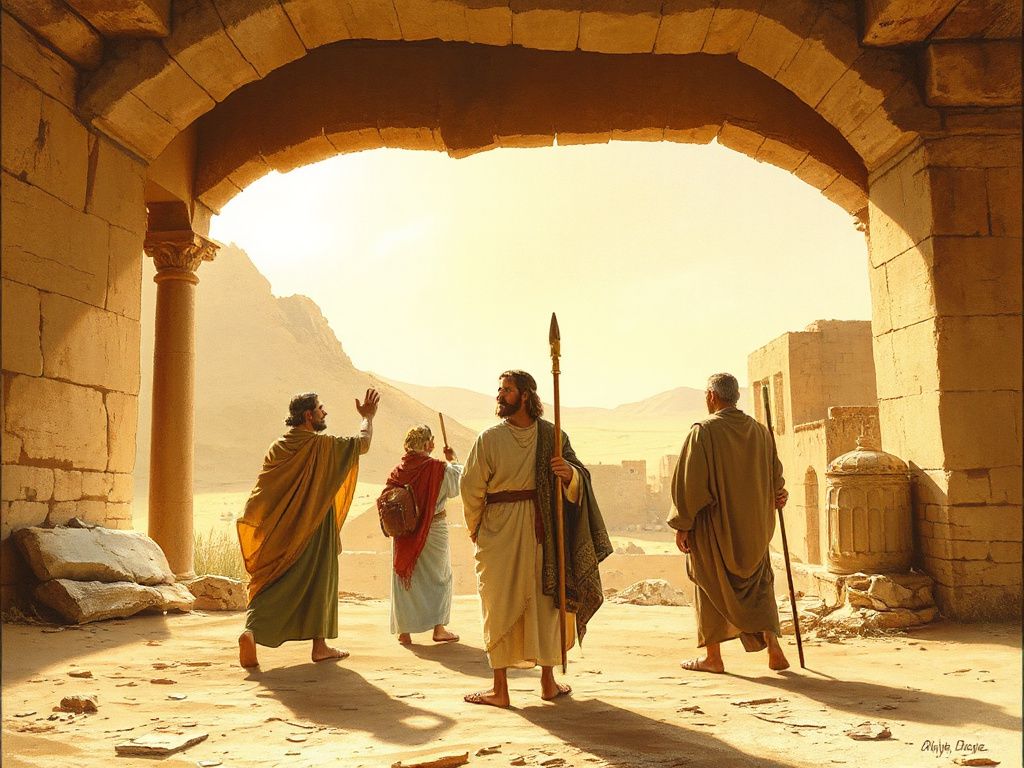
BIBLE CHAPTER STUDY
Exodus 11 — The Announcement of the Final Plague
God tells Moses that one final plague remains: at midnight every firstborn in Egypt will die, from Pharaoh's heir to the lowest servant, yet Israel will be untouched, proving that the LORD distinguishes between Egypt and His people.
Scripture
1And Jehovah said unto Moses, Yet one plague more will I bring upon Pharaoh, and upon Egypt; afterwards he will let you go hence: when he shall let you go, he shall surely thrust you out hence altogether.
2Speak now in the ears of the people, and let them ask every man of his neighbor, and every woman of her neighbor, jewels of silver, and jewels of gold.
3And Jehovah gave the people favor in the sight of the Egyptians. Moreover the man Moses was very great in the land of Egypt, in the sight of Pharaoh's servants, and in the sight of the people.
4And Moses said, Thus saith Jehovah, About midnight will I go out into the midst of Egypt:
5and all the first-born in the land of Egypt shall die, from the first-born of Pharaoh that sitteth upon his throne, even unto the first-born of the maid-servant that is behind the mill; and all the first-born of cattle.
6And there shall be a great cry throughout all the land of Egypt, such as there hath not been, nor shall be any more.
7But against any of the children of Israel shall not a dog move his tongue, against man or beast: that ye may know how that Jehovah doth make a distinction between the Egyptians and Israel.
8And all these thy servants shall come down unto me, and bow down themselves unto me, saying, Get thee out, and all the people that follow thee: and after that I will go out. And he went out from Pharaoh in hot anger.
9And Jehovah said unto Moses, Pharaoh will not hearken unto you; that my wonders may be multiplied in the land of Egypt.
10And Moses and Aaron did all these wonders before Pharaoh: and Jehovah hardened Pharaoh's heart, and he did not let the children of Israel go out of his land.
What this passage means
Exodus 11 stands as the climactic announcement of the tenth plague. Verse 1 sets the frame: 'Yet one plague more will I bring upon Pharaoh, and upon Egypt; afterwards he will let you go hence.' The statement is both prediction and warning, and the doubled language ('when he shall let you go, he shall surely thrust you out hence altogether') emphasizes that Pharaoh's eventual surrender will be total and final, not partial or negotiated.
Verses 4–7 form the heart of the chapter. At midnight, every firstborn in Egypt will die — 'from the first-born of Pharaoh that sitteth upon his throne, even unto the first-born of the maid-servant that is behind the mill; and all the first-born of cattle.' Against this universal loss, Israel is explicitly exempt: 'against any of the children of Israel shall not a dog move his tongue, against man or beast: that ye may know how that Jehovah doth make a distinction between the Egyptians and Israel.' The contrast — wailing in one household, complete silence in the next — is the theological point: the LORD Himself is the one who draws the line between judgment and salvation.
Verse 8 pictures Pharaoh's own officials coming to bow before Moses and demanding Israel's departure. The chapter closes by noting that Pharaoh's heart remained hardened despite 'all these wonders,' so that God's signs would be multiplied in Egypt. Exodus 11 thus prepares for Passover: judgment falls, but it falls in such a way that God's people are marked off and kept safe.
Context
Exodus 11 is the immediate pivot between the ninth plague (the darkness of Exodus 10) and the Passover narrative of Exodus 12. The chapter itself contains no formal setting markers, but it records the final divine speech to Moses before the death of the firstborn. The repeated refrain that Pharaoh will not listen (v. 9) and that God hardens his heart (v. 10) links back to earlier plagues (see the parallels in Exodus 7:3, 8:15, 9:12, 10:1, 10:20, 10:27) and forward to the events of Exodus 12:29, when the predicted midnight death is fulfilled.
Key words in the original
- H1644 Used twice in verse 1 (gārēš 'to drive out' and yəḡārēš 'he will drive out'). The word denotes expelling from a possession and is the same verb used throughout the Exodus narrative for Israel's departure from Egypt.
- H3617 The adverbial form kālāh 'completely' intensifies the verb of driving out in verse 1, signaling that Pharaoh's eventual expulsion of Israel will be total rather than partial.
- H5061 The noun neḡaʿ 'plague/blow' introduces the chapter's controlling image: a single, decisive blow that will at last break Pharaoh's resistance.
Related verses
- Exodus 12:29 Fulfills the prediction of Exodus 11:4–5. At midnight, every firstborn in Egypt dies from Pharaoh's heir to the captive in the dungeon, exactly as Moses had warned.
- Exodus 9:4 Connects the death-of-firstborn threat to earlier plagues. The principle that the LORD 'makes a distinction' between Israel and Egypt is already at work in the cattle plague.
- Malachi 3:18 Echoes the language of Exodus 11:7. Just as Israel and Egypt are distinguished at the Passover, so the righteous and the wicked are discerned in the final day.
Common questions
Why does God announce the plague to Pharaoh in advance instead of striking suddenly?
The advance warning is part of the chapter's theology: it gives Pharaoh one more chance to release Israel and lets the full scope of the coming blow be known so that the distinction between Egypt and Israel will be unmistakable when it falls.
What is the significance of 'not a dog moving his tongue' against Israel?
It is a vivid image of complete protection and absence of any threat or sound of harm against God's people. The chapter uses it to declare that the LORD Himself draws the line between Egypt, which will wail, and Israel, which will be untouched.
How does Exodus 11 set up the Passover in Exodus 12?
It provides the announced terms of judgment — midnight, every firstborn — that Exodus 12:29 then reports as fulfilled. The request for silver and gold jewelry (vv. 2–3) also fulfills the earlier promise of Exodus 3:21–22 that Israel will leave Egypt with substance. Israel's exemption in verse 7 sets up the protective logic that the Passover blood will carry forward in chapter 12.