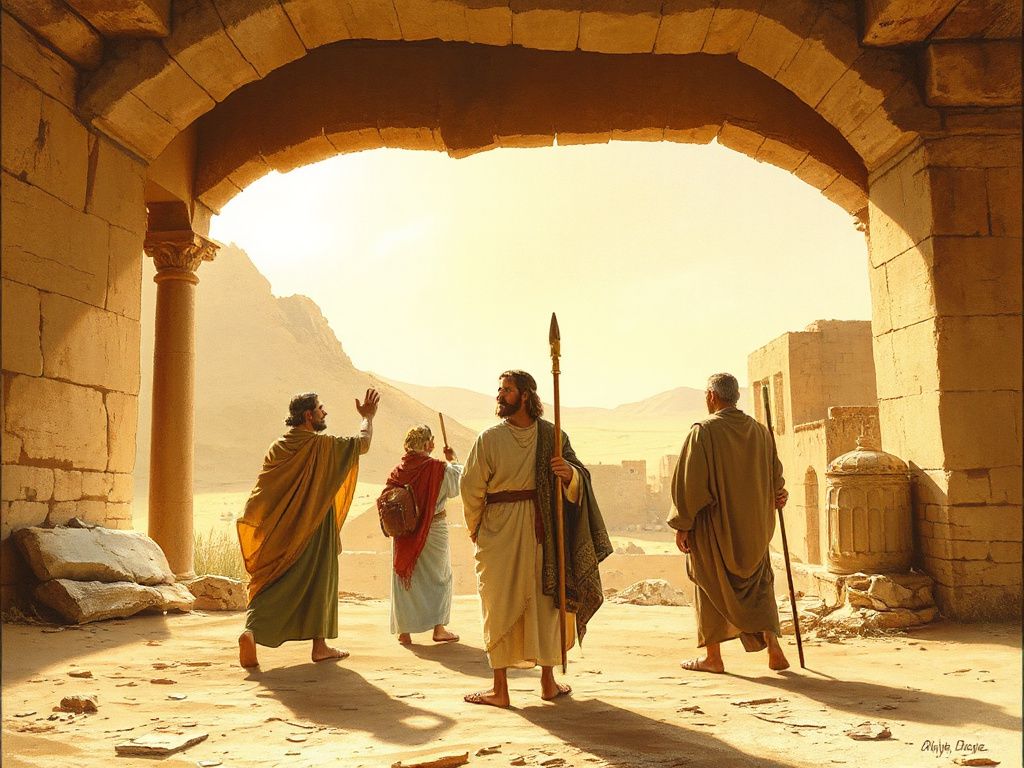
BIBLE CHAPTER STUDY
Exodus 19: Israel at Sinai — Covenant and Consecration
Israel arrives at Sinai, YHWH proposes a covenant making them a treasured possession, kingdom of priests, and holy nation; the people agree, are sanctified, and witness the theophany on the third day.
Scripture
1In the third month after the children of Israel were gone forth out of the land of Egypt, the same day came they into the wilderness of Sinai.
2And when they were departed from Rephidim, and were come to the wilderness of Sinai, they encamped in the wilderness; and there Israel encamped before the mount.
3And Moses went up unto God, and Jehovah called unto him out of the mountain, saying, Thus shalt thou say to the house of Jacob, and tell the children of Israel:
4Ye have seen what I did unto the Egyptians, and how I bare you on eagles' wings, and brought you unto myself.
5Now therefore, if ye will obey my voice indeed, and keep my covenant, then ye shall be mine own possession from among all peoples: for all the earth is mine:
6and ye shall be unto me a kingdom of priests, and a holy nation. These are the words which thou shalt speak unto the children of Israel.
7And Moses came and called for the elders of the people, and set before them all these words which Jehovah commanded him.
8And all the people answered together, and said, All that Jehovah hath spoken we will do. And Moses reported the words of the people unto Jehovah.
9And Jehovah said unto Moses, Lo, I come unto thee in a thick cloud, that the people may hear when I speak with thee, and may also believe thee for ever. And Moses told the words of the people unto Jehovah.
10And Jehovah said unto Moses, Go unto the people, and sanctify them to-day and to-morrow, and let them wash their garments,
11and be ready against the third day; for the third day Jehovah will come down in the sight of all the people upon mount Sinai.
12And thou shalt set bounds unto the people round about, saying, Take heed to yourselves, that ye go not up into the mount, or touch the border of it: whosoever toucheth the mount shall be surely put to death:
13no hand shall touch him, but he shall surely be stoned, or shot through; whether it be beast or man, he shall not live: when the trumpet soundeth long, they shall come up to the mount.
14And Moses went down from the mount unto the people, and sanctified the people; and they washed their garments.
15And he said unto the people, Be ready against the third day: come not near a woman.
16And it came to pass on the third day, when it was morning, that there were thunders and lightnings, and a thick cloud upon the mount, and the voice of a trumpet exceeding loud; and all the people that were in the camp trembled.
17And Moses brought forth the people out of the camp to meet God; and they stood at the nether part of the mount.
18And mount Sinai, the whole of it, smoked, because Jehovah descended upon it in fire; and the smoke thereof ascended as the smoke of a furnace, and the whole mount quaked greatly.
19And when the voice of the trumpet waxed louder and louder, Moses spake, and God answered him by a voice.
20And Jehovah came down upon mount Sinai, to the top of the mount: and Jehovah called Moses to the top of the mount; and Moses went up.
21And Jehovah said unto Moses, Go down, charge the people, lest they break through unto Jehovah to gaze, and many of them perish.
22And let the priests also, that come near to Jehovah, sanctify themselves, lest Jehovah break forth upon them.
23And Moses said unto Jehovah, The people cannot come up to mount Sinai: for thou didst charge us, saying, Set bounds about the mount, and sanctify it.
24And Jehovah said unto him, Go, get thee down; and thou shalt come up, thou, and Aaron with thee: but let not the priests and the people break through to come up unto Jehovah, lest he break forth upon them.
25So Moses went down unto the people, and told them.
What this passage means
Exodus 19 has two halves: the covenant proposal (vv. 3–8) and the Sinai theophany with its preparatory instructions (vv. 10–25). In vv. 4–6, YHWH grounds the offer in what he has already done for Israel—carrying them 'on eagles' wings' (v. 4)—and then sets a conditional promise: obedience and covenant-keeping will make them his 'own possession from among all peoples' (v. 5). The reason given is universal: 'for all the earth is mine.' From that treasured status flows a vocation: 'a kingdom of priests, and a holy nation' (v. 6), a people set apart to represent YHWH to the nations.
Verses 7–8 record the people's response. Moses relays YHWH's words to the elders; the people answer collectively, 'All that Jehovah hath spoken we will do.' The unanimity is striking. So far obedience is expressed as readiness; the binding force of this pledge becomes visible when, in the next chapters, Israel breaks the very commands they here affirm. Israel's 'Yes' at Sinai is foundational both for the blessings the Torah promises and for the later prophetic indictment that the people did not keep what they vowed.
The second half shifts from word to event. A thick cloud, thunder, lightning, an exceedingly loud trumpet, smoke, and quaking mark YHWH's descent upon Sinai (vv. 16–19). Access is barred by 'bounds' (vv. 12–13), and even priests who 'come near to Jehovah' must sanctify themselves (v. 22). The repeated concern—whether man or beast—that 'toucheth the mount shall be surely put to death' (v. 13) emphasizes the absolute holiness of the divine presence and the distance sin creates between people and God.
Context
Exodus 19 marks the arrival of the people at Sinai (vv. 1–2), building on the prior events at Rephidim, a stopover named in the text. The chapter functions as the hinge between the exodus narrative (chs. 1–18) and the giving of the law at Sinai (chs. 20–40). The note provided for the chapter does not add interpretive claims beyond identifying it as part of the Exodus material.
Because the provided context_before and context_after lists are empty and full_chapter is empty, this section relies solely on the 25 verses of Exodus 19 and the cross-references supplied. The chapter's structure is self-contained: covenant offer, people's consent, sanctification, bounds, theophany, and final charge.
Key words in the original
- H2320 חֹדֶשׁ (ḥōḏeš), 'month.' The phrase 'the third month' (v. 1) anchors the Sinai events within Israel's calendar journey from Egypt, marking three lunar cycles since the Exodus.
- H2583 חָנָה, 'to camp/encamp.' Used twice in v. 2 to describe Israel setting up at Sinai, the root implies pitching a tent; theological commentators note the verb creates continuity with the wilderness-tabernacle theme that dominates the rest of Exodus.
- H5048 נֶגֶד (neḡeḏ), 'in front of / opposite' (v. 2). Israel 'encamped before the mount,' a spatial positioning that sets up the confrontation-meeting pattern of the rest of the chapter.
Related verses
- Deuteronomy 7:6 Mirrors Exodus 19:5–6 verbatim, repeating Israel's identity as 'a holy people' and 'a people for his own possession.' The repetition shows how Deuteronomy anchors Israel's vocation in the Sinai covenant.
- 1 Peter 2:9 Picks up the Exodus 19:6 triad ('kingdom of priests, holy nation, own possession') and applies it to the church, showing how the Sinai vocation is reoriented to a multi-ethnic people of God.
- Deuteronomy 32:11 The 'eagles' wings' image of Exodus 19:4 is paralleled in Moses' song, where it describes YHWH's protective carrying of Israel—tying the Exodus imagery to the covenant context.
Common questions
What does 'kingdom of priests and a holy nation' (v. 6) mean?
The phrases describe Israel's role before YHWH and the nations: a 'kingdom of priests' pictures them as a realm whose function—like priests—mediates between God and the world; 'holy nation' marks them as set apart for that purpose. The chapter does not detail how this is fulfilled; it frames the vocation that later priestly and prophetic texts develop.
Why are bounds set around the mountain (vv. 12–13)?
The bounds express that YHWH's holiness is not to be casually approached. Touching the mount means death by stoning or arrows—'no hand shall touch him,' a phrasing the chapter uses for both man and beast. The repetition underscores the seriousness of encountering the divine presence apart from authorized mediation.
Did Israel truly 'do all that Jehovah spoke' (v. 8)?
Exodus 19:8 records their stated willingness, not their performance. The agreement recorded here becomes the standard against which Israel's later failures—beginning in Exodus 32—are measured. The verse shows the people's affirmative response at Sinai, while leaving the question of lasting obedience for the rest of the book.