BIBLE CHAPTER STUDY
Exodus 33: God's Presence Withdrawn and Restored
After the golden-calf crisis, God offers to send an angel but withholds His personal presence; the people mourn, Moses pitches a tent of meeting outside the camp, and pleads until God promises His presence and grants a glimpse of His glory.
Scripture
1And Jehovah spake unto Moses, Depart, go up hence, thou and the people that thou hast brought up out of the land of Egypt, unto the land of which I sware unto Abraham, to Isaac, and to Jacob, saying, Unto thy seed will I give it:
2and I will send an angel before thee; and I will drive out the Canaanite, the Amorite, and the Hittite, and the Perizzite, the Hivite, and the Jebusite:
3unto a land flowing with milk and honey: for I will not go up in the midst of thee; for thou art a stiffnecked people; lest I consume thee in the way.
4And when the people heard these evil tidings, they mourned: and no man did put on him his ornaments.
5And Jehovah said unto Moses, Say unto the children of Israel, Ye are a stiffnecked people; if I go up into the midst of thee for one moment, I shall consume thee: therefore now put off thy ornaments from thee, that I may know what to do unto thee.
6And the children of Israel stripped themselves of their ornaments from mount Horeb onward.
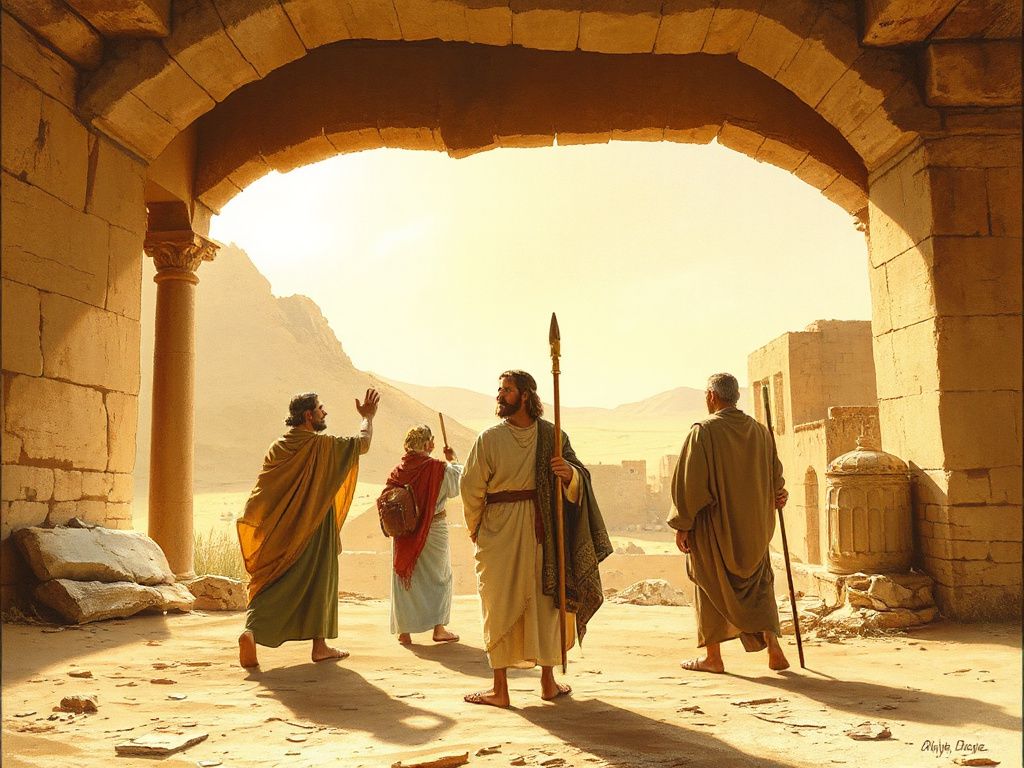
7Now Moses used to take the tent and to pitch it without the camp, afar off from the camp; and he called it, The tent of meeting. And it came to pass, that every one that sought Jehovah went out unto the tent of meeting, which was without the camp.
8And it came to pass, when Moses went out unto the Tent, that all the people rose up, and stood, every man at his tent door, and looked after Moses, until he was gone into the Tent.
9And it came to pass, when Moses entered into the Tent, the pillar of cloud descended, and stood at the door of the Tent: and Jehovah spake with Moses.
10And all the people saw the pillar of cloud stand at the door of the Tent: and all the people rose up and worshipped, every man at his tent door.
11And Jehovah spake unto Moses face to face, as a man speaketh unto his friend. And he turned again into the camp: but his minister Joshua, the son of Nun, a young man, departed not out of the Tent.
12And Moses said unto Jehovah, See, thou sayest unto me, Bring up this people: and thou hast not let me know whom thou wilt send with me. Yet thou hast said, I know thee by name, and thou hast also found favor in my sight.
13Now therefore, I pray thee, if I have found favor in thy sight, show me now thy ways, that I may know thee, to the end that I may find favor in thy sight: and consider that this nation is thy people.
14And he said, My presence shall go with thee, and I will give thee rest.
15And he said unto him, If thy presence go not with me, carry us not up hence.
16For wherein now shall it be known that I have found favor in thy sight, I and thy people? is it not in that thou goest with us, so that we are separated, I and thy people, from all the people that are upon the face of the earth?
17And Jehovah said unto Moses, I will do this thing also that thou hast spoken; for thou hast found favor in my sight, and I know thee by name.
18And he said, Show me, I pray thee, thy glory.
19And he said, I will make all my goodness pass before thee, and will proclaim the name of Jehovah before thee; and I will be gracious to whom I will be gracious, and will show mercy on whom I will show mercy.
20And he said, Thou canst not see my face; for man shall not see me and live.
21And Jehovah said, Behold, there is a place by me, and thou shalt stand upon the rock:
22and it shall come to pass, while my glory passeth by, that I will put thee in a cleft of the rock, and will cover thee with my hand until I have passed by:
23and I will take away my hand, and thou shalt see my back; but my face shall not be seen.
What this passage means
Verses 1–6 frame the chapter with a conditional withdrawal: God will fulfill the patriarchal promise and dispossess the Canaanite peoples (vv. 1–2), but will not personally accompany Israel because they are a 'stiffnecked people' whom He might consume on the way (vv. 3, 5). The people's response is not repentance through mourning rites but the visible stripping of ornaments 'from mount Horeb onward' (vv. 4, 6), marking a sustained, not momentary, recognition of distance from God.
Verses 7–11 show Moses mediating this gap. He pitches a 'tent of meeting' outside the camp, and whenever he enters, the pillar of cloud descends at its door and 'Jehovah spake with Moses' (vv. 8–9). The vocabulary is striking: 'face to face, as a man speaketh unto his friend' (v. 11). Joshua, as 'his minister,' remains at the tent, anchoring a pattern of continual access that runs ahead of the later tabernacle.
Verses 12–23 are Moses' negotiation. He insists that an unnamed 'angel' is insufficient and asks God to 'show me thy ways' (v. 13; cf. vv. 15–16). God concedes: 'My presence shall go with thee, and I will give thee rest' (v. 14). Moses then asks for God's glory (v. 18). God proclaims His name, declares the freedom of His mercy (v. 19), and permits Moses to see His 'back' from a cleft in the rock while shielding him from His 'face' (vv. 20–23). The chapter ends with proximity granted but vision still bounded.
Context
The chapter stands in the aftermath of the golden-calf apostasy (Exodus 32). Because the context_before and context_after fields in the provided material are empty, the reading here relies on the chapter's own internal movement: the people's mourning (v. 4) and the 'stripping of ornaments from mount Horeb onward' (v. 6) presuppose a prior breach that the text itself does not retell. Two structural markers in the chapter separate the conditional promise of land (vv. 1–3) from Moses' mediation (vv. 7–23): the relocation of the tent 'without the camp, afar off' (v. 7) and the people's rising to worship when the cloud descends (v. 10).
The provided cross_references extend the chapter's vocabulary outward: 'I will give thee rest' (v. 14) is read against Joshua 21:44, Joshua 22:4, Psalms 95:11, and Hebrews 4:8, where 'rest' becomes a theological category reaching beyond the wilderness; 'speak mouth to mouth' echoes Numbers 12:8; 'the angel of his presence saved them' (Isaiah 63:9) parallels the contrast between the angel offered in v. 2 and the presence secured in v. 14; and 'I will have mercy on whom I have mercy' (v. 19) is taken up in Romans 9:15, 18.
Key words in the original
- H3068 The covenant name Jehovah (יְהוָה) appears repeatedly in this chapter as the speaker who both threatens withdrawal and promises presence. In verse 11 it frames 'face to face' speech, and in verse 19 it is the name God says He will 'proclaim' before Moses.
- H5927 The root עָלָה (go up) governs the chapter's first command: 'go up hence' toward the promised land (v. 1). The same root underlies 'brought up out of the land of Egypt,' binding exodus and entry into one continuous ascent.
- H7650 The verb שָׁבַע in the form 'I sware' (v. 1) names the oath to Abraham, Isaac, and Jacob that grounds the land promise even while God's personal presence is conditionally withheld in the same verse.
Related verses
- Numbers 12:8 Where Exodus 33:11 says Jehovah spoke to Moses 'face to face, as a man speaketh unto his friend,' Numbers 12:8 sharpens the privilege: 'mouth to mouth... manifestly, and not in dark speeches.' Together they distinguish Moses' access from ordinary prophetic mediation.
- Isaiah 63:9 Isaiah 63:9 names 'the angel of his presence' as the one who saved Israel. In Exodus 33:2 God offers an unnamed angel, then in v. 14 promises His own presence; the Isaiah passage retrospectively clarifies what was at stake in Moses' refusal of the lesser option.
- Romans 9:15 God's declaration in Exodus 33:19, 'I will be gracious to whom I will be gracious, and will show mercy on whom I will show mercy,' is quoted almost verbatim in Romans 9:15 to ground Paul's argument that God's mercy is not exhausted by human effort or ethnicity, but remains His sovereign prerogative.
Common questions
Why does God say He will not go with Israel (v. 3) and then say He will (v. 14) in the same chapter?
The chapter presents both as divine speech, not a contradiction. Verses 1–6 set a conditional posture: the promise of land stands, but intimate presence is withheld because Israel is 'stiffnecked.' Verses 12–23 record Moses' intercession, after which God grants what He had withheld. The structure is: announcement of distance → mediation → restoration of presence, not a reversal of God's character.
What is the relationship between the 'tent of meeting' in Exodus 33:7 and the tabernacle built later in Exodus 35–40?
Exodus 33:7–11 describes a provisional tent Moses pitched 'without the camp,' where the pillar of cloud descends when he enters. The provided material does not identify this tent as the constructed tabernacle of later chapters; it shows only that there was already an external locus of encounter with Jehovah, guarded by Joshua. Whether the two are identified or distinguished is a question the supplied text does not resolve.
What does it mean that Moses saw God's 'back' but not His 'face' (vv. 20, 23)?
The text uses spatial language to express a theological limit. 'Face' signifies God's full self-disclosure, which is here declared lethal for any human to behold (v. 20). 'Back' figures what remains after God has passed by: the afterglow, the trail, the permitted residue. God shelters Moses 'in a cleft of the rock' and 'covers' him with His hand (v. 22), allowing encounter with His glory precisely by limiting the encounter. The provided original_words list does not include entries for these specific Hebrew terms in vv. 20–23, so this explanation is drawn only from the verse text itself.