BIBLE VERSE STUDY
Ezra 6:15-16 — Completion and Dedication of the Temple
The Second Temple is finished on Adar 3 in Darius's sixth year, and the returned remnant dedicates it with joy.
Scripture
15And this house was finished on the third day of the month Adar, which was in the sixth year of the reign of Darius the king.
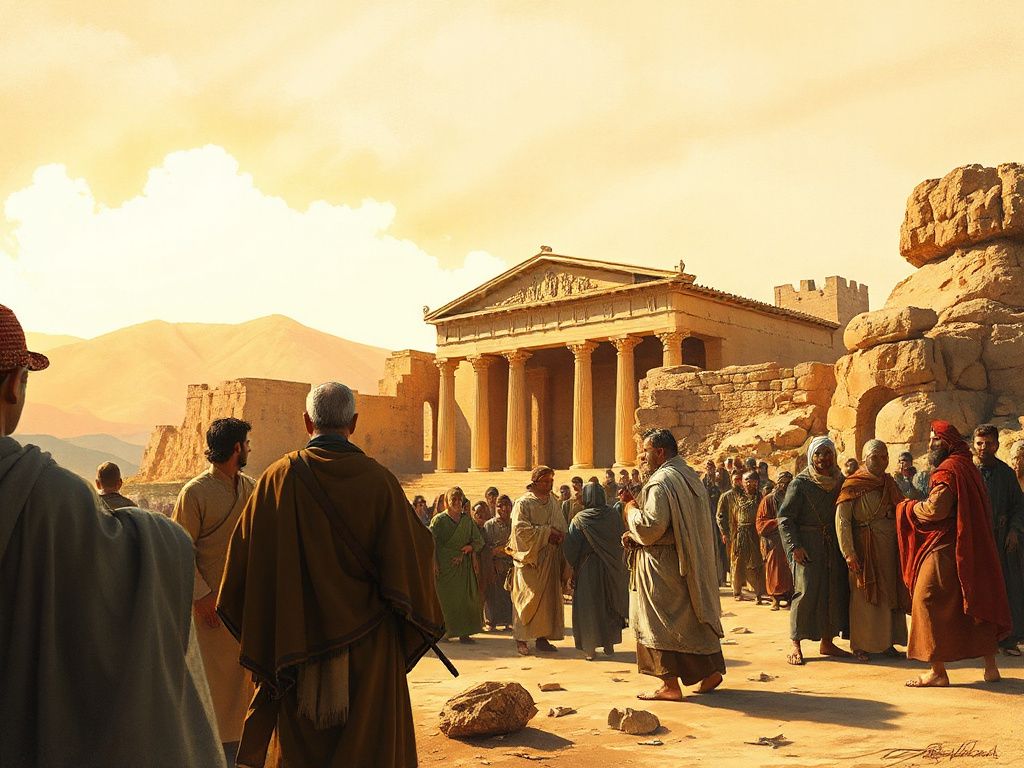
16And the children of Israel, the priests, and the Levites, and the rest of the children of the captivity, kept the dedication of this house of God with joy.
What this passage means
Ezra 6:15 gives a precise chronological marker for the completion of the house of God: the third day of the month Adar in the sixth year of Darius the king. The text does not name the year explicitly elsewhere but ties the completion to a specific Persian regnal year, anchoring the event in the imperial calendar that the post-exilic community lived under. The phrase "this house was finished" closes the rebuilding narrative that begins earlier in Ezra and shows the physical building project reaching its stated end.
Verse 16 immediately shifts from construction to worship. The dedication is performed by four named groups: "the children of Israel, the priests, and the Levites, and the rest of the children of the captivity." This fourfold listing distinguishes the lay returnees, the priestly line, the Levitical line, and the broader exilic community, presenting the dedication as a corporate act of the whole restored community rather than the work of a single class. The verse explicitly connects this dedication to the Passover celebration that follows in the surrounding context (v. 19), linking temple completion to renewed covenant worship.
The closing phrase "with joy" is theologically significant in Ezra's narrative. Joy accompanies the rebuilding throughout the chapter, where the elders "builded and prospered, through the prophesying of Haggai the prophet and Zechariah the son of Iddo" (v. 14). The dedication verse therefore reads as the culmination of prophetic support, Persian decree, and communal faithfulness, with joy marking the appropriate response to God's faithfulness in restoring the place of his name.
Context
Chapter 6 opens with Darius's search of the royal archives at Achmetha, where Cyrus's original decree is found (vv. 1-5). Darius then issues a new decree reinforcing the earlier permission and supplying funds and sacrifices from the royal treasury (vv. 6-12). The governor Tattenai and his companions comply (v. 13), and the Jewish elders complete the building through prophetic support and Persian authorization (v. 14). Verses 15-16 sit at the hinge between the building project and its liturgical aftermath: the dedication sacrifices (v. 17), the re-establishment of priestly divisions and Levitical courses (v. 18), and the Passover celebration in the following verses (vv. 19-22).
The dedication in 6:15-16 is therefore not isolated but embedded in a sequence: Persian decrees (Cyrus, Darius, Artaxerxes) enable the work, Haggai and Zechariah's prophecy sustains it, and the finished temple becomes the site for the reinstituted sacrificial system, the Passover, and the seven-day feast of unleavened bread. The mention of three Persian kings together in v. 14 frames the completion as the product of a long process rather than a single imperial act.
Common questions
When exactly was the temple finished according to Ezra 6:15?
According to the verse, the house was finished on the third day of the month Adar in the sixth year of the reign of Darius the king. The chapter itself does not cross-reference a parallel date in Haggai or Zechariah within the provided text.
Who participated in the dedication in Ezra 6:16?
Four groups are named: the children of Israel, the priests, the Levites, and the rest of the children of the captivity. The verse presents the dedication as a corporate act of the whole returned community.
Why is the phrase "with joy" emphasized in this verse?
Within the chapter, joy accompanies the rebuilding process and culminates here at the dedication. The preceding verse (v. 14) attributes the successful completion to the prophesying of Haggai and Zechariah and to Persian support, so the dedication marks the fitting response of the community to God's faithfulness in restoring the place of his name.