BIBLE CHAPTER STUDY
Genesis 49 — Jacob's Blessing of the Twelve Tribes
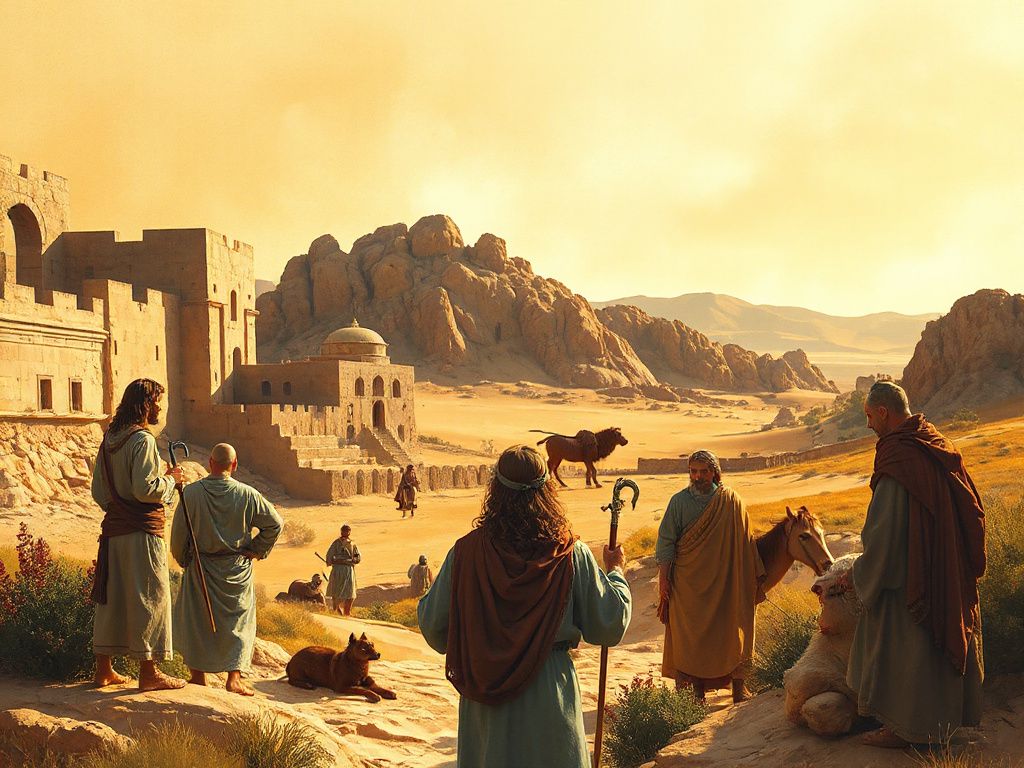
Jacob gathers his twelve sons to declare what will happen to them in the latter days, pronouncing blessings, judgments, and tribal destinies before his death and burial in the cave of Machpelah.
Scripture
1And Jacob called unto his sons, and said: Gather yourselves together, that I may tell you that which shall befall you in the latter days.
2Assemble yourselves, and hear, ye sons of Jacob; And hearken unto Israel your father.
3Reuben, thou art my first-born, my might, and the beginning of my strength; The pre-eminence of dignity, and the pre-eminence of power.
4Boiling over as water, thou shalt not have the pre-eminence; Because thou wentest up to thy father's bed; Then defiledst thou it: he went up to my couch.
5Simeon and Levi are brethren; Weapons of violence are their swords.
6O my soul, come not thou into their council; Unto their assembly, my glory, be not thou united; For in their anger they slew a man, And in their self-will they hocked an ox.
7Cursed be their anger, for it was fierce; And their wrath, for it was cruel: I will divide them in Jacob, And scatter them in Israel.
8Judah, thee shall thy brethren praise: Thy hand shall be on the neck of thine enemies; Thy father's sons shall bow down before thee.
9Judah is a lion's whelp; From the prey, my son, thou art gone up: He stooped down, he couched as a lion, And as a lioness; who shall rouse him up?
10The sceptre shall not depart from Judah, Nor the ruler's staff from between his feet, Until Shiloh come; And unto him shall the obedience of the peoples be.
11Binding his foal unto the vine, And his ass's colt unto the choice vine; He hath washed his garments in wine, And his vesture in the blood of grapes:
12His eyes shall be red with wine, And his teeth white with milk.
13Zebulun shall dwell at the haven of the sea; And he shall be for a haven of ships; And his border shall be upon Sidon.
14Issachar is a strong ass, Couching down between the sheepfolds:
15And he saw a resting-place that it was good, And the land that it was pleasant; And he bowed his shoulder to bear, And became a servant under taskwork.
16Dan shall judge his people, As one of the tribes of Israel.
17Dan shall be a serpent in the way, An adder in the path, That biteth the horse's heels, So that his rider falleth backward.
18I have waited for thy salvation, O Jehovah.
19Gad, a troop shall press upon him; But he shall press upon their heel.
20Out of Asher his bread shall be fat, And he shall yield royal dainties.
21Naphtali is a hind let loose: He giveth goodly words.
22Joseph is a fruitful bough, A fruitful bough by a fountain; His branches run over the wall.
23The archers have sorely grieved him, And shot at him, and persecuted him:
24But his bow abode in strength, And the arms of his hands were made strong, By the hands of the Mighty One of Jacob (From thence is the shepherd, the stone of Israel),
25Even by the God of thy father, who shall help thee, And by the Almighty, who shall bless thee, With blessings of heaven above, Blessings of the deep that coucheth beneath, Blessings of the breasts, and of the womb.
26The blessings of thy father Have prevailed above the blessings of my progenitors Unto the utmost bound of the everlasting hills: They shall be on the head of Joseph, And on the crown of the head of him that was separate from his brethren.
27Benjamin is a wolf that raveneth: In the morning he shall devour the prey, And at even he shall divide the spoil.
28All these are the twelve tribes of Israel: and this is it that their father spake unto them and blessed them; every one according to his blessing he blessed them.
29And he charged them, and said unto them, I am to be gathered unto my people: bury me with my fathers in the cave that is in the field of Ephron the Hittite,
30in the cave that is in the field of Machpelah, which is before Mamre, in the land of Canaan, which Abraham bought with the field from Ephron the Hittite for a possession of a burying-place.
31There they buried Abraham and Sarah his wife; there they buried Isaac and Rebekah his wife; and there I buried Leah—
32the field and the cave that is therein, which was purchased from the children of Heth.
33And when Jacob made an end of charging his sons, he gathered up his feet into the bed, and yielded up the ghost, and was gathered unto his people.
What this passage means
Chapter 49 is structured as a poetic testament in which Jacob speaks over each son in turn, blending recollection of past conduct with prophecy of the tribe's future. The chapter opens with an explicit 'latter days' framework (v. 1), signaling that the words are not merely a father's farewell but a revelation of covenant destiny for the twelve tribes.
The blessings are uneven in tone. Reuben, Simeon, and Levi receive rebukes that recall specific sins: Reuben's lost preeminence for defiling his father's couch, and Simeon and Levi for their violent attack at Shechem. The remaining sons receive images—an enthroned Judah, a fruitful Joseph, a ravening Benjamin—that shape Israel's later self-understanding and the literary tapestry of the rest of the Old Testament.
Most significant is the oracle over Judah in verses 8–12, particularly v. 10: 'The sceptre shall not depart from Judah... until Shiloh come; and unto him shall the obedience of the peoples be.' This verse underwrites the messianic expectation that runs through Israel's prophets and is later read as pointing to a coming king whose reign extends beyond Judah's tribal horizon.
Context
The chapter is set as Jacob's final act before death. After speaking over each son, Jacob instructs them to bury him with his fathers in the cave of Machpelah (vv. 29–32), the burial place previously associated with Abraham, Sarah, Isaac, Rebekah, and Leah. He then 'gathered up his feet into the bed, and yielded up the ghost, and was gathered unto his people' (v. 33), concluding the patriarchal narratives that began with Abraham's call.
The cross references connect this chapter to Israel's later prophetic and royal traditions. Numbers 24:17 and Isaiah 9:6 echo the Judah oracle's language of sceptre and kingly figure; Jeremiah 23:5–6 develops the promise of a righteous Branch from David; and Psalms 60:7 identifies Judah as the Lord's 'sceptre.' 1 Chronicles 5:1 and Genesis 35:22 supply the backstory for Reuben's forfeiture, tying Jacob's rebukes to specific recorded events.
Key words in the original
- H7121 Hebrew 'qara' (קָרא), 'called', used in v. 1 of Jacob summoning his sons. The same root appears in v. 1 ('what shall happen to you') with the meaning 'to encounter,' signaling that Jacob's speech is not only an address but a prophetic encounter.
- H8085 Hebrew 'shama' (שָׁמַע), 'to hear intelligently, often with implication of obedience.' Twice used in v. 2 ('hear' and 'listen'), it frames the oracle as requiring obedient hearing, not mere passive listening.
- H1060 Hebrew 'bekhor' (בְּכֹר), 'firstborn,' the legal status that Reuben held (v. 3) but lost through his offense (v. 4). The term anchors the chapter's attention to inheritance rights and their forfeiture, a theme later developed in 1 Chronicles 5:1.
Related verses
- Numbers 24:17 Balaam's oracle uses nearly identical imagery—'a star out of Jacob, and a sceptre shall rise out of Israel'—mirroring Genesis 49:10. The echo links Jacob's deathbed prophecy to a later non-Israelite seer, presenting a converging witness to Judah's royal destiny.
- 1 Chronicles 5:1 This passage explains Reuben's loss of birthright as a consequence of defiling his father's couch, the very offense Jacob names in Genesis 49:4. The Chronicler thereby interprets Jacob's deathbed words as an enacted transfer of primacy to the sons of Joseph.
- Jeremiah 23:5 Jeremiah's promise of a 'righteous Branch' raised unto David corresponds to the Judah oracle's anticipation of a ruler 'until Shiloh come.' The Davidic and patriarchal streams converge on a future king who executes justice and righteousness.
Common questions
Who is 'Shiloh' in Genesis 49:10?
The text simply says 'until Shiloh come; and unto him shall the obedience of the peoples be.' Interpreters have long debated whether 'Shiloh' is a place name (associated with the town in Ephraim), a personal name for the coming ruler, or a word constructed from Hebrew roots meaning 'peace' or 'to whom it belongs.' The verse itself does not resolve the matter; later biblical texts such as Ezekiel 21:27 and the Davidic psalms echo its language while leaving the figure unnamed.
Why are Simeon and Levi scattered but still counted among the tribes?
Jacob pronounces 'I will divide them in Jacob, and scatter them in Israel' (v. 7), recalling their violent attack. The verse itself does not explain how being scattered and being one of the twelve are reconciled; the chapter simply names the curse and the continuing tribal identity without resolving the tension. Later texts (Joshua 19, 1 Chronicles 4, 6) treat both as allotments or dwelling arrangements within Israel that match this twofold description.
What is the relationship between Genesis 49 and Israel's later tribal history?
The chapter supplies an originating literary portrait for each tribe that later biblical writers cite, expand, or reinterpret. Judah's lion imagery resurfaces in Numbers 24:9 and Revelation 5:5; Joseph's fruitful branch and Joseph's strength appear in Deuteronomy 33:13–17; and Reuben's loss of preeminence is explicitly retrodden in 1 Chronicles 5:1. Genesis 49 thus functions as a foundational catalog that Israel's subsequent literature continually returns to rather than as a literal geopolitical forecast.