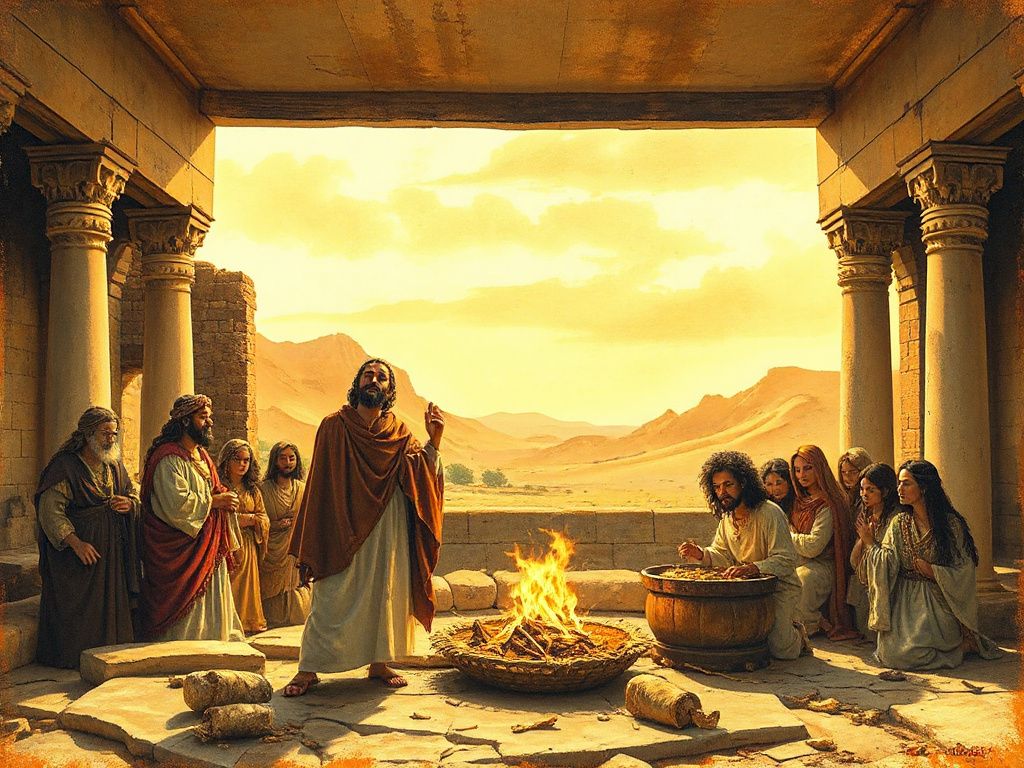
Hebrews 11:14 — Seeking a Homeland of Their Own
Hebrews 11:14 interprets the patriarchs' self-description as strangers and pilgrims as evidence that they were actively seeking a country of their own.
Scripture
14For they that say such things make it manifest that they are seeking after a country of their own.
What this passage means
Hebrews 11:14 is a comment by the author on the preceding verse, in which Abraham, Sarah, Isaac, Jacob, and the other patriarchs 'confessed that they were strangers and pilgrims on the earth.' The author argues that this confession is not a casual remark: by calling themselves strangers and sojourners, they implicitly showed that they were looking for something they did not yet possess — a homeland, or 'country,' that they could properly call their own.
The phrase 'country of their own' (Greek πατρίδα, patridā) points back to the land from which the patriarchs had set out and forward to the land of promise. The author reasons that if they had merely been homesick for Mesopotamia or Canaan, they could have returned; the very fact that they lived as resident aliens without going back demonstrates that what they sought was a different kind of country — one suited to permanent possession rather than pilgrimage.
Thus the verse functions as a hinge between the negative confession of v. 13 ('strangers and pilgrims') and the positive contrast of v. 16 ('a better country, that is, a heavenly'). It establishes that the patriarchs' exile language was not resignation but aspiration: their language revealed a forward-looking faith that looked beyond any earthly territory to a homeland yet to be received.
Context
Hebrews 11 catalogs a sequence of faith examples, beginning with Abel and Enoch and culminating in the prophets and martyrs of verses 32–38. Verses 8–12 specifically focus on Abraham and Sarah: by faith Abraham obeyed the call, lived as a sojourner in tents within the land of promise, and looked for 'the city which hath the foundations, whose builder and maker is God' (v. 10). Sarah received power to conceive past her age, and from them descended offspring as countless as the stars or the sand.
Verse 13 summarizes that 'these all died in faith, not having received the promises,' and verse 14 then interprets that summary: their self-identification as strangers and sojourners is read as the telltale sign of a homeland still being sought. The chapter closes with v. 16, which clarifies that the country they desired was 'a heavenly' one, and with vv. 39–40, which notes that these patriarchs received the promises only together with later believers, indicating a shared, future-oriented fulfillment.
Key words in the original
- G1718 ἐμφανίζουσιν (emphanizousin) — 'make manifest' or 'show clearly.' The author argues that the patriarchs' self-description, as a verbal disclosure, reveals an underlying reality: they are searching for a homeland.
- G3968 πατρίδα (patrida) — 'father-land,' native country. The same root as πατήρ (father). Here it denotes the homeland proper to one's lineage, which the patriarchs acknowledged they did not yet possess.
- G1934 ἐπιζητοῦσιν (epizētousin) — 'seek after,' 'search for,' with the prefix ἐπι- adding intensity or direction. The compound form emphasizes an active, directed quest, not a passive longing.
Related verses
- Hebrews 11:16 Provides the explicit identification of the 'country' the patriarchs sought: 'a better country, that is, a heavenly.' Their seeking, named in 11:14, is fulfilled in God's preparation of a city.
- Hebrews 13:14 Echoes the same confession from the chapter's parenetic close: 'we have not here an abiding city, but we seek after the city which is to come.' The temporal orientation is reversed — present non-possession and active seeking.
- 2 Corinthians 5:7 Pairs the 'walk by faith, not by sight' with the patriarchs' pilgrim stance: they lived toward what was unseen rather than toward a returnable homeland.
Common questions
Who are the 'they that say such things' in Hebrews 11:14?
In context, 'they' refers to the patriarchs named in the surrounding verses — Abraham, Sarah, Isaac, Jacob, and those connected to them — whose confession of being 'strangers and pilgrims on the earth' (v. 13) is the 'such things' being cited.
What does 'a country of their own' mean here?
The phrase indicates a homeland they could rightfully call theirs — distinct from Mesopotamia, which they had left, and from Canaan, in which they lived as sojourners. Hebrews 11:16 clarifies that this country is ultimately 'a heavenly' one.
Why does the author argue this from their self-confession?
The author's reasoning is conversational: if the patriarchs had truly been homesick for their former country, they could have gone back. The fact that they remained resident aliens proves they were seeking a different, more permanent homeland, not pining for a returnable one.