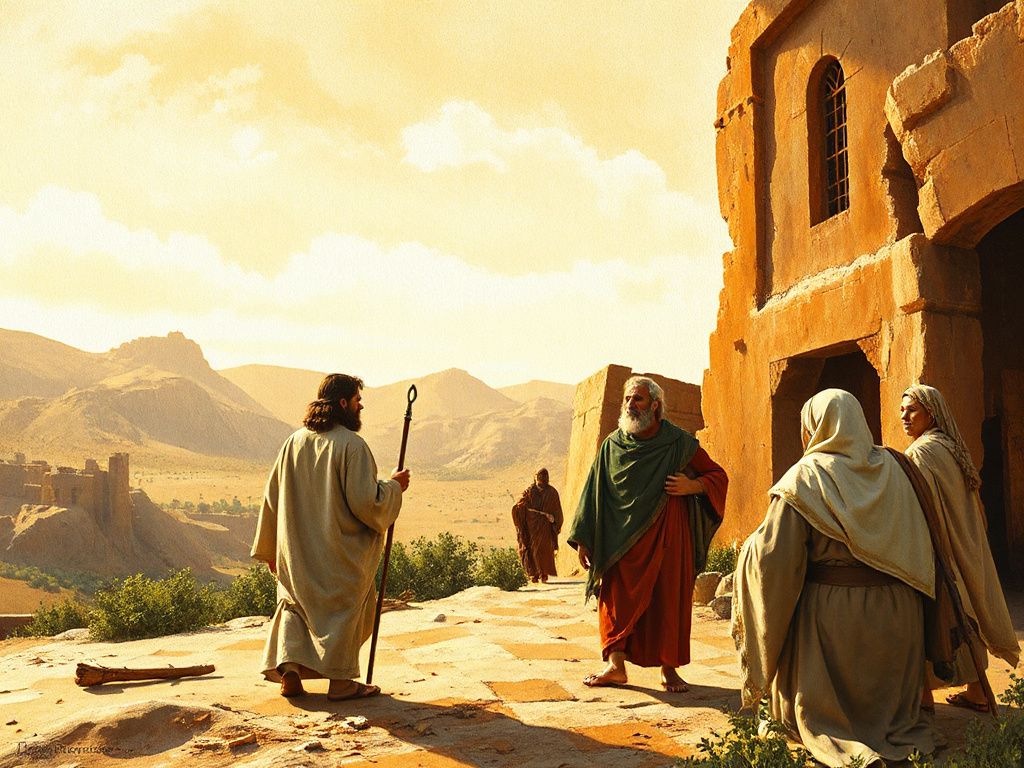
Jeremiah 48:15 — Moab's Cities Destroyed, Its Chosen Young Men Slain
Jeremiah 48:15 announces that Moab has been devastated, its cities occupied, and its finest young men killed, with the judgment pronounced by the King whose name is Jehovah of hosts.
Scripture
15Moab is laid waste, and they are gone up into his cities, and his chosen young men are gone down to the slaughter, saith the King, whose name is Jehovah of hosts.
What this passage means
Verse 15 condenses the entire judgment of Moab into a single announcement. Three parallel clauses move from the nation to its cities to its people: "Moab is laid waste," "they are gone up into his cities" (that is, the attackers have ascended into them), and "his chosen young men are gone down to the slaughter." The downward motion of the young men to death stands in deliberate contrast to the upward motion of the invaders into the cities, framing the totality of the defeat.
The verse attributes the declaration to a single speaker identified in a striking way: "the King, whose name is Jehovah of hosts." By naming YHWH as a King, the oracle sets a national-political claim against Moab's own royal and religious structures. The added title "of hosts" emphasizes cosmic and military scope — the ruler over all heavenly forces is the one pronouncing the fall of this nation and its god Chemosh (cf. v. 7, v. 13).
Theologically, the verse functions as the hinge between the indictment (vv. 11–14, where Moab trusted in works, treasures, and its own military, and trusted in Chemosh) and the execution of judgment (vv. 16ff., where the calamity "hastens fast" and the surrounding nations are summoned to mourn). Verse 15 is therefore not a description of a single battle but the formal verdict of the divine King against a nation that exalted itself.
Context
Jeremiah 48 is an extended oracle against Moab. Verses 11–14 indict Moab for complacency, false confidence in Chemosh, and boastful self-reliance: 'How say ye, We are mighty men, and valiant men for the war?' (v. 14). The chapter repeatedly connects the coming destruction to Moab's trust in 'works' and 'treasures' (v. 7) and to its national god Chemosh (vv. 7, 13, 35, 46).
Verse 15 sits between the indictment and the lament. Verse 16 announces that 'the calamity of Moab is near to come, and his affliction hasteth fast,' and verse 17 summons surrounding peoples to mourn 'the strong staff' and 'the beautiful rod.' The chapter concludes with the cause named in v. 42: 'Moab shall be destroyed from being a people, because he hath magnified himself against Jehovah,' followed by a closing word of future restoration in v. 47.
Common questions
Who is the King named Jehovah of hosts in Jeremiah 48:15?
The title identifies YHWH as a ruling King rather than only a deity or judge. The added 'of hosts' (Hebrew tzevaot) signals authority over all heavenly armies, and the chapter repeatedly grounds Moab's fall in YHWH's own declaration rather than in mere human warfare.
Why does the verse say the attackers have 'gone up into his cities'?
The phrasing reverses the expected flight. Instead of defenders holding the heights, enemies are said to have ascended into Moab's cities, while Moab's 'chosen young men' go down to death. The contrast of 'going up' by invaders and 'going down' by the slain underscores the completeness of the defeat stated earlier in the chapter.
How does verse 15 fit between the indictment and the lament that follows?
Verses 11–14 accuse Moab of self-trust and trust in Chemosh, ending with the taunt 'We are mighty men.' Verse 15 then delivers the formal verdict — laid waste, cities taken, young men slain — as the speech of the divine King. Verse 16 follows with 'the calamity of Moab is near to come,' and verse 17 summons surrounding nations to mourn. Verse 15 is thus the hinge that converts the accusation into an executed sentence.