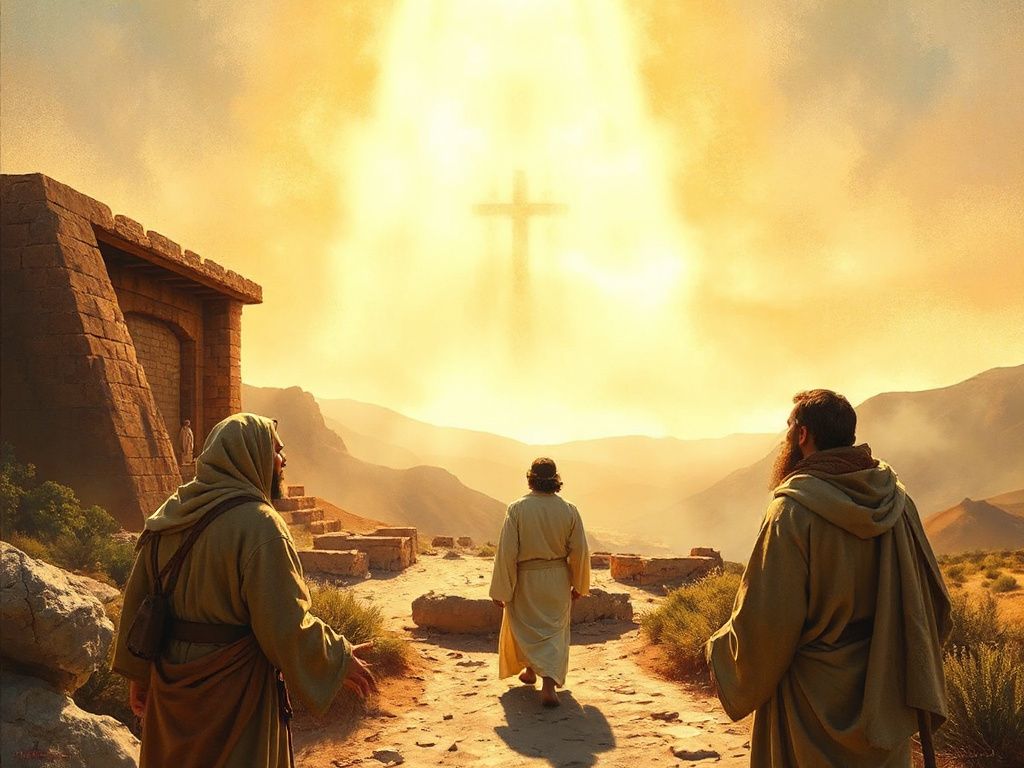
John 14:11 — Mutual Indwelling and the Witness of Works
Jesus presses Philip — and the disciples — to accept that He and the Father indwell one another; if the claim itself strains belief, then let the works settle it.
Scripture
11Believe me that I am in the Father, and the Father in me: or else believe me for the very works' sake.
What this passage means
Verse 11 is a two-clause appeal. The first clause repeats the affirmation of verse 10 — that Jesus is in the Father and the Father is in Him — and turns it into a direct call to faith: 'Believe me that I am in the Father, and the Father in me.' The repetition shows that the claim is not incidental but is the central point Jesus wants the disciples to grasp before He goes away.
The second clause is a pastoral concession. 'Or else believe me for the very works' sake' acknowledges that the disciples may not yet grasp the mystery of mutual indwelling. If the theological statement is too high, the observable works performed by Jesus are offered as an entry point — a lower rung that still leads to the same conviction. Belief is the goal; works are an alternative route to it, not a substitute for the truth itself.
The structure of the verse also connects forward to verse 12, where the same faith that accepts this mutual indwelling is said to result in the disciple doing 'greater works.' In other words, the works that authenticate Jesus in verse 11 become the pattern the believing disciple will continue. Faith grounded in Christ's works is faith that produces ongoing works.
Context
John 14:11 sits inside Jesus' farewell discourse, after Philip has asked, 'Lord, show us the Father, and it sufficeth us' (v. 8). Jesus responds by reframing the request: seeing Him is already seeing the Father (v. 9), because the Father abides in Him and does His works through Him (v. 10). Verse 11 is therefore the hinge that moves from explanation to demand — what has been stated must now be believed.
Verses 12–14 then build on this conviction. The acceptance that the Father is in the Son becomes the basis for asking 'in my name' and for the disciples' own participation in works. The surrounding chapter also anticipates the Spirit who will teach and remind (vv. 17, 26) and the peace that follows (v. 27), but verse 11 itself remains focused on a single point: faith in the mutual indwelling of Father and Son.
Key words in the original
- G4100 πιστεύω (pisteuō): to have faith, to entrust oneself. Jesus commands it twice in this verse — 'believe me' and again 'believe me for the very works' sake.' The doubled imperative underscores that faith, not sight, is the required response to the claim of mutual indwelling.
- G1722 ἐν (en): 'in.' This small preposition carries the theological weight of the verse. 'I am in the Father' and 'the Father in me' uses the same preposition twice, framing the relationship as reciprocal indwelling rather than mere association.
- G3962 πατήρ (patēr): 'father.' The verse places the term on both sides of the indwelling statement. Jesus does not say 'the Father is with me' but 'the Father is in me,' making the paternal relation one of intimate co-inherence rather than mere oversight.
Related verses
- John 10:38 John 10:38 voices the same argument from the other side of a controversy: if the works are not believed, the works themselves should still persuade that 'the Father is in me, and I in the Father.' It is the closest verbal parallel to John 14:11 outside the immediate context.
- John 5:36 John 5:36 widens the works-as-witness theme: the very works the Father gave Jesus to finish bear witness that the Father sent Him. The 'works' appealed to in 14:11 are therefore not random miracles but the Father-given mission accomplished through the Son.
- John 14:10 John 14:10 is the immediate source verse. It grounds 'I am in the Father and the Father in me' in the claim that the words Jesus speaks are not His own but the Father's, and the Father abiding in Him does the works. Verse 11 then presses the disciples to believe that very claim.
Common questions
Why does Jesus say 'or else believe me for the very works' sake'?
It is a pastoral concession to the disciples' limited grasp. Jesus acknowledges that the claim of mutual indwelling may not yet be intelligible to them, so He offers the observable works as an alternative ground for the same faith. The goal is belief itself, not a particular route to it.
What does it mean that the Father is in Jesus and Jesus is in the Father?
In John 14 the language pictures a relationship of mutual indwelling, not physical containment. The Father works through the Son, the Son speaks the Father's words, and seeing the Son is seeing the Father (v. 9). The exact metaphysical shape of this union is not spelled out in the passage; verse 11 simply presses for acceptance of the claim itself.
How does verse 11 connect to verse 12 and the promise of greater works?
Verse 12 builds directly on the faith that verse 11 demands. The one who believes that the Father is in the Son and does His works through Him is the one who will also do those works — and greater ones — because Jesus goes to the Father. The works that authenticate Jesus become the pattern and foundation for the disciples' own ministry.