BIBLE CHAPTER STUDY
Joshua 1 — God's Charge to a New Leader
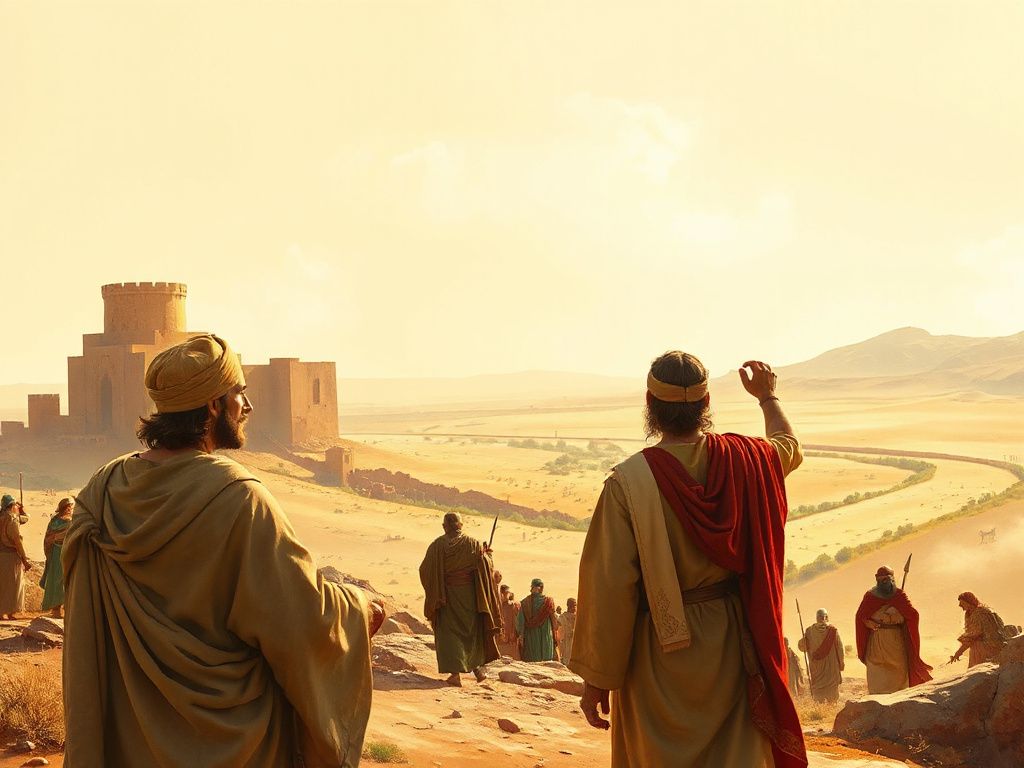
God commissions Joshua to lead Israel across the Jordan into the promised land, repeating the charge to be strong and courageous and to keep the law.
Scripture
1Now it came to pass after the death of Moses the servant of Jehovah, that Jehovah spake unto Joshua the son of Nun, Moses' minister, saying,
2Moses my servant is dead; now therefore arise, go over this Jordan, thou, and all this people, unto the land which I do give to them, even to the children of Israel.
3Every place that the sole of your foot shall tread upon, to you have I given it, as I spake unto Moses.
4From the wilderness, and this Lebanon, even unto the great river, the river Euphrates, all the land of the Hittites, and unto the great sea toward the going down of the sun, shall be your border.
5There shall not any man be able to stand before thee all the days of thy life: as I was with Moses, so I will be with thee; I will not fail thee, nor forsake thee.
6Be strong and of good courage; for thou shalt cause this people to inherit the land which I sware unto their fathers to give them.
7Only be strong and very courageous, to observe to do according to all the law, which Moses my servant commanded thee: turn not from it to the right hand or to the left, that thou mayest have good success whithersoever thou goest.
8This book of the law shall not depart out of thy mouth, but thou shalt meditate thereon day and night, that thou mayest observe to do according to all that is written therein: for then thou shalt make thy way prosperous, and then thou shalt have good success.
9Have not I commanded thee? Be strong and of good courage; be not affrighted, neither be thou dismayed: for Jehovah thy God is with thee whithersoever thou goest.
10Then Joshua commanded the officers of the people, saying,
11Pass through the midst of the camp, and command the people, saying, Prepare you victuals; for within three days ye are to pass over this Jordan, to go in to possess the land, which Jehovah your God giveth you to possess it.
12And to the Reubenites, and to the Gadites, and to the half - tribe of Manasseh, spake Joshua, saying,
13Remember the word which Moses the servant of Jehovah commanded you, saying, Jehovah your God giveth you rest, and will give you this land.
14Your wives, your little ones, and your cattle, shall abide in the land which Moses gave you beyond the Jordan; but ye shall pass over before your brethren armed, all the mighty men of valor, and shall help them;
15until Jehovah have given your brethren rest, as he hath given you, and they also have possessed the land which Jehovah your God giveth them: then ye shall return unto the land of your possession, and possess it, which Moses the servant of Jehovah gave you beyond the Jordan toward the sunrising.
16And they answered Joshua, saying, All that thou hast commanded us we will do, and whithersoever thou sendest us we will go.
17According as we hearkened unto Moses in all things, so will we hearken unto thee: only Jehovah thy God be with thee, as he was with Moses.
18Whosoever he be that shall rebel against thy commandment, and shall not hearken unto thy words in all that thou commandest him, he shall be put to death: only be strong and of good courage.
What this passage means
Joshua 1 opens the book by immediately placing Joshua into Moses' vacated role. Verse 1 calls Moses "the servant of Jehovah" and identifies Joshua as his "minister," a title of delegated authority. The death of Moses is the hinge: Israel's leader is gone, but God's word to him (Deuteronomy) is not, and so the address now goes to Joshua. The chapter's repeated commissioning formulas in verses 2-9 set the agenda for the entire book — conquest, possession, and covenant fidelity.
The central exhortation, "Be strong and of good courage," appears three times (vv. 6, 7, 9), with verse 7 expanding it to "very courageous." Courage here is not emotional bravado; it is grounded in obedience to the law of Moses (v. 7) and continuous meditation on it day and night (v. 8). The promise of success ("thou shalt make thy way prosperous") is tied directly to careful observance of the written Torah, making the chapter's ethic strikingly book-centered. God's own presence — "I will not fail thee, nor forsake thee" (v. 5) — is the theological ground beneath the human call to courage.
The closing unit (vv. 10-18) moves from divine speech to communal organization. Joshua instructs officers to prepare the people for a three-day crossing (vv. 10-11), recalls the Transjordanian tribes' earlier pledge to Moses (vv. 12-13), and binds them to fight alongside their brothers until the whole nation possesses the land (vv. 14-15). The tribes' pledge in vv. 16-17 — "according as we hearkened unto Moses... so will we hearken unto thee; only Jehovah thy God be with thee" — mirrors God's own charge and closes the chapter by transferring covenant loyalty from Moses to Joshua.
Context
The chapter is the bridge between the Pentateuch and the Deuteronomistic history. It opens with a temporal formula ("after the death of Moses") that signals a new epoch, and the first nine verses are framed as direct divine speech, distinct in form from the narrative voice that surrounds them. Within the chapter itself, the call to courage is grounded in three concrete objects: the land promise (vv. 2-4), God's presence (v. 5), and the book of the law (vv. 7-8). The cross references provided repeatedly echo this triad — God's "I am with thee" (Genesis 28:15; Jeremiah 1:8), meditation on God's word (Psalms 119:15; Psalms 19:14; Colossians 3:16; Proverbs 3:1), and the call not to fear (Psalms 27:1-2).
The chapter is not presented as a private pep talk. Joshua immediately translates the divine charge into public orders (vv. 10-11) and into a renewed covenant with the two and a half Transjordanian tribes (vv. 12-18). The tribes' pledge frames obedience to Joshua as an extension of obedience to Moses and ultimately to Jehovah, so that the chapter closes with the people's loyalty publicly aligned to its new leader before any military action begins.
Key words in the original
- H4872 The name Moses (מֹשֶׁה) appears repeatedly in vv. 1-15. In v. 1 Moses is identified as "the servant of Jehovah," a title that locates him within the covenant office rather than personal status, and that frames Joshua as his legitimate successor.
- H3068 The divine name Jehovah (יהוה) is the covenant name used throughout the chapter. Its density in vv. 1-9 underscores that the charge to Joshua is grounded in the Lord's continuing covenant commitment, not in Joshua's own ability.
- H5650 The Hebrew word for "servant" (עֶבֶד), used of Moses in v. 1, denotes covenant-bonded service. Applied to Moses it signals the completed stewardship being handed on; applied implicitly to Joshua (cf. v. 2, "Moses my servant is dead"), it sets the standard of fidelity he must now match.
Related verses
- Genesis 28:15 God's words to Jacob — "I am with thee... I will not leave thee" — form the verbal backbone of Joshua 1:5 ("I will not fail thee, nor forsake thee"). The chapter places Joshua within the same patriarchal promise line that God has repeatedly made to the fathers.
- Deuteronomy 29:9 Moses had already linked covenant-keeping with prosperity ("that ye may prosper in all that ye do"). Joshua 1:7-8 takes up that exact link, tying the promise of "good success" to careful observance of "all the law."
- Psalms 119:15 The psalmist's resolve to "meditate on thy precepts" mirrors Joshua 1:8's command to meditate on the book of the law "day and night." Both texts treat sustained meditation, not occasional reading, as the form of piety that produces obedience.
Common questions
Why does the command "be strong and of good courage" appear three times in one chapter?
The repetition matches the three grounds on which Joshua's courage is to rest: the land promise (vv. 2-4, leading to v. 6), the written law (vv. 7-8), and the presence of Jehovah (v. 9). The triple charge underscores that courage is not a single act but a sustained posture grounded in God's word and presence.
Does Joshua 1:8 promise prosperity to anyone who reads the Bible?
Within the chapter's own context, the verse is addressed specifically to Joshua as Israel's new leader, and the "prosperity" promised is tied to crossing the Jordan and possessing the promised land, conditioned on doing "according to all that is written therein." The text frames it as covenant obedience, not a blanket formula for personal success.
How does Joshua 1 set up the rest of the book?
The chapter supplies the agenda Joshua will carry out: crossing the Jordan (ch. 3-4), taking the land (chs. 6-12), and dividing it among the tribes (chs. 13-21). It also establishes the theological key — obedience to the law and reliance on God's presence — by which the successes and failures of the following chapters are to be read.