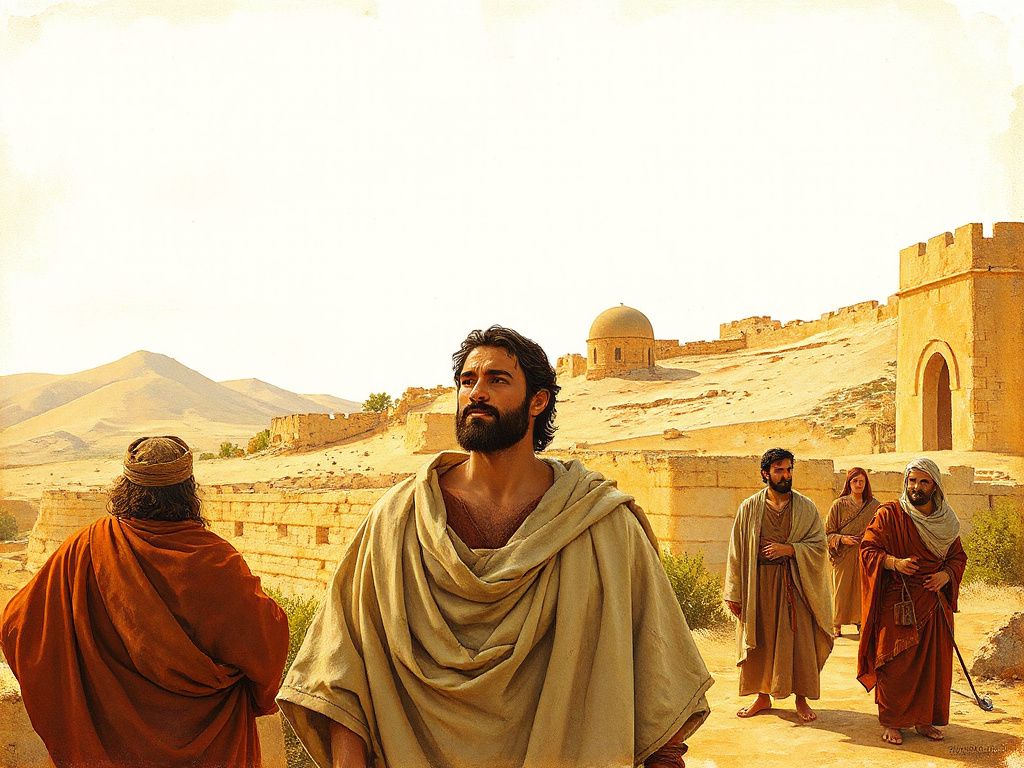
Mark 6:54 — Recognition at Gennesaret
As Jesus disembarks at Gennesaret, the crowd instantly recognizes him and spreads the news, setting off a region-wide movement to bring the sick to him.
Scripture
54And when they were come out of the boat, straightway the people knew him,
What this passage means
Verse 54 is a transitional verse that moves the narrative from the sea-crossing miracle to a new phase of ministry on land. The word 'straightway' (εὐθύς) emphasizes immediacy: there is no delay between Jesus stepping out of the boat and the crowd's recognition. The people did not need an introduction — they knew who he was, which sets up the rapid spread of news described in the following verses.
Mark uses this moment of recognition to explain why the sick were brought from every surrounding village. The crowd's identification of Jesus triggers a chain reaction: once they 'knew him,' they 'ran round about that whole region' carrying the sick on beds (v. 55). Recognition leads directly to action, and the verse therefore functions as the hinge between the disciples' hard-heartedness at sea and the open responsiveness of the Gennesaret populace on land.
The verse also contrasts human recognition with the disciples' spiritual recognition. Where the crowd knew Jesus by sight and reputation, the disciples 'understood not concerning the loaves' and had 'their heart… hardened' (v. 52). The same Jesus who was opaque to his inner circle in the boat is instantly transparent to ordinary people on the shore, a tension Mark deliberately highlights.
Context
Verses 53–56 form a single narrative unit: the landing at Gennesaret, the crowd's recognition, the spreading of news, and the resulting healings. Verse 54 sits between the disciples' hard-heartedness on the sea (vv. 51–52) and the Gennesaret villagers laying the sick in marketplaces so that even the fringe of his garment might be touched (v. 56). Mark stresses the speed of recognition ('straightway') and the breadth of the response ('that whole region,' 'villages, or cities, or the country').
Earlier in the chapter, Jesus was unable to do mighty works in his own country because of unbelief (vv. 5–6). At Gennesaret the response is the opposite: the people know him, run to bring the sick, and press in for healing. The contrast between Nazareth's rejection and Gennesaret's eager reception frames how Mark tells the story of Jesus's fame spreading beyond his hometown.
Common questions
Why did the people recognize Jesus 'straightway'?
Mark gives no explanation beyond the word 'straightway,' but the immediate recognition fits the pattern of Jesus's growing fame in the chapter. The crowd needed no introduction because his reputation had already spread through the region, as verse 55 confirms by describing how quickly they carried the news outward.
What is the significance of Gennesaret?
Within the chapter text provided, Gennesaret is simply the shore where Jesus's boat moored (v. 53) and where the crowd recognized him (v. 54). The chapter does not elaborate further on the location, so the verse's meaning rests on the contrast it sets up with the disciples' hard-heartedness in the preceding verses and the eager reception in the following verses.
How does verse 54 connect to the disciples' hard-heartedness in verse 52?
Mark places the crowd's swift recognition directly after stating that the disciples' hearts were hardened and that they did not understand the loaves. The juxtaposition shows that ordinary people on shore 'knew' Jesus immediately, while his closest followers failed to grasp who he was despite the feeding miracle. The verse therefore intensifies the irony Mark is building.