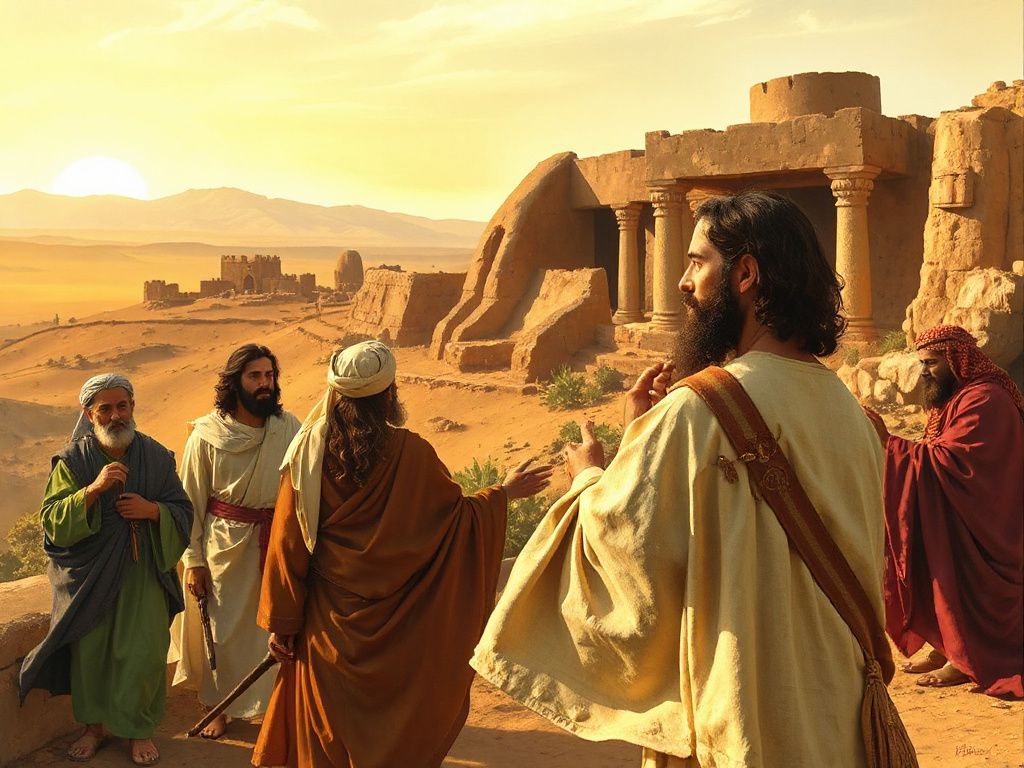
BIBLE VERSE STUDY
Matthew 5:3-12 — The Beatitudes
The Beatitudes announce who is blessed in the kingdom of heaven and promise divine reversal for the spiritually poor, mourning, meek, righteousness-hungry, merciful, pure-hearted, peace-making, and persecuted.
Scripture
3Blessed are the poor in spirit: for theirs is the kingdom of heaven.
4Blessed are they that mourn: for they shall be comforted.
5Blessed are the meek: for they shall inherit the earth.
6Blessed are they that hunger and thirst after righteousness: for they shall be filled.
7Blessed are the merciful: for they shall obtain mercy.
8Blessed are the pure in heart: for they shall see God.
9Blessed are the peacemakers: for they shall be called sons of God.
10Blessed are they that have been persecuted for righteousness' sake: for theirs is the kingdom of heaven.
11Blessed are ye when men shall reproach you, and persecute you, and say all manner of evil against you falsely, for my sake.
12Rejoice, and be exceeding glad: for great is your reward in heaven: for so persecuted they the prophets that were before you.
What this passage means
Each beatitude follows a consistent two-part pattern: a present characterization ("the poor in spirit," "those who mourn," "the meek") followed by an eschatological promise introduced by "for" (ὅτι). The blessing is not a description of present comfort but a declaration that the person's situation, however painful now, is the very condition God honors and will逆转. The repeated opening μακάριοι (G3107) sets a tone distinct from mere happiness — it signals a divine verdict of blessedness grounded in God's character, not in circumstance.
The list moves from inward disposition (poor in spirit, mourning, hungering for righteousness) to outward conduct (merciful, pure in heart, peacemakers) and finally to social consequence (persecuted). The poor in spirit (πτωχοί, G4434) are not the financially destitute but those who acknowledge spiritual bankruptcy before God; theirs is the kingdom of heaven. The meek (πραεῖς, G4239) inherit the earth, echoing Psalm 37:11. Those who hunger and thirst for righteousness (δικαιοσύνην, G1343) will be filled (χορτασθήσονται, G5526), a verb suggesting abundant satisfaction rather than mere token portions.
The closing pair (vv. 10-12) extends the blessing to those persecuted for righteousness' sake and identifies Jesus' disciples with the persecuted prophets of old. The promised reward is "in heaven," locating the ultimate vindication in the eschatological realm rather than in present redress. Together, the nine beatitudes form a portrait of kingdom citizenship that inverts conventional values: weakness, grief, and meekness are not obstacles to blessing but its very prerequisites.
Context
Matthew 5 opens with Jesus ascending a mountain, sitting down (the posture of an authoritative teacher), and his disciples approaching him. This setting echoes Moses at Sinai (Exodus 19-20) and frames the sermon as a new Torah from a new lawgiver. The crowds are mentioned (v. 1), but the audience specifically addressed is the disciples — a detail that matters for whether the Beatitudes are read as entrance requirements, kingdom ethics, or consolations.
Within Matthew's Gospel, the Beatitudes open the Sermon on the Mount (chapters 5-7) and are immediately followed by the salt-and-light sayings (5:13-16) and Jesus' teaching that he came to fulfill, not abolish, the law (5:17-20). Luke's parallel (Luke 6:20-23) is shorter and addresses more outwardly distressed groups; Matthew's version is internalized ("poor in spirit" rather than simply "poor"), suggesting a community already separated from Jesus by time, persecution, or both.
Key words in the original
- G3107 μακάριος (makarios): 'supremely blest,' a term used in classical Greek of the gods and the dead, but applied in the New Testament to those whom God has placed in a state of blessedness regardless of outward condition.
- G4434 πτωχός (ptōchos): a beggar-level pauper, denoting absolute mendicancy; in Matthew 5:3 it is qualified by 'in spirit,' so the term is spiritualized to mean those conscious of total dependence on God rather than financially destitute.
- G4239 πραΰς (praeüs): mild or humble, used in Greek of a domesticated animal trained to yield; in Matthew 5:5 it describes strength under control — power held in service to God and others, not passivity.
Related verses
- Isaiah 66:2 Isaiah 66:2 supplies the Old Testament background for 'poor in spirit': God looks to the one who is 'poor and of a contrite spirit,' anchoring Matthew 5:3 in prophetic expectation rather than introducing a novel ethic.
- Psalms 37:11 Matthew 5:5's promise that the meek 'shall inherit the earth' directly echoes Psalm 37:11, where the same meek inherit the land and delight in abundant peace, tying the beatitude to a Davidic wisdom psalm about divine reversal.
- James 1:12 James 1:12 — 'Blessed is the man that endureth temptation' — uses the same μακάριος vocabulary and ties blessedness to endurance under trial, paralleling Matthew 5:10-12 where persecution for righteousness' sake yields the kingdom of heaven.
Common questions
How many beatitudes are there in Matthew 5:3-12?
The text contains nine μακάριοι statements, not eight: verses 3-10 each begin with 'Bened,' verse 10 repeats the kingdom promise of verse 3, and verses 11-12 address the disciples directly with the same blessing extended to verbal persecution. Some traditions count eight by treating vv. 10-12 as one unit, which is why the section is commonly called 'the Eight Beatitudes,' though the Greek itself has nine distinct benedictions.
Are the Beatitudes commands or comfort?
Grammatically they are indicative ('blessed are…'), not imperative, so they primarily announce who already stands in God's favor. Many commentators note, however, that the character traits described also function as implicit discipleship goals — what one 'is' in God's sight is also what one is called to become.
Why does Matthew say 'poor in spirit' when Luke 6:20 says simply 'poor'?
The difference is widely noted among scholars. Matthew's 'poor in spirit' spiritualizes the condition, making it accessible to any who recognize spiritual bankruptcy before God, not only the economically destitute. Luke's wording, addressed to a more immediate audience of the materially poor, retains the outward reference. Whether Matthew edited a shared source or developed an independent tradition is debated among source critics.