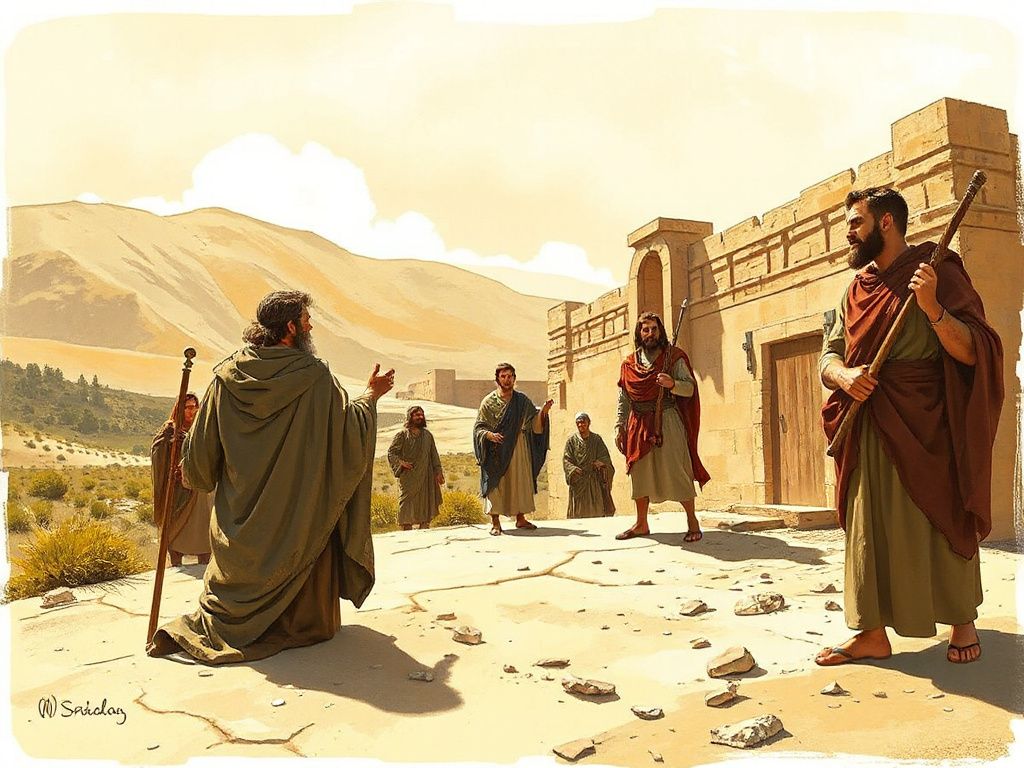
BIBLE CHAPTER STUDY
Psalms 2 — The King's Coronation and the Nations' Rebellion
A coronation psalm in which the world's kings plot against the LORD and his anointed, only to be met with divine laughter and a proclaimed King whose reign extends to the ends of the earth.
Scripture
1Why do the nations rage, And the peoples meditate a vain thing?
2The kings of the earth set themselves, And the rulers take counsel together, Against Jehovah, and against his anointed, saying,
3Let us break their bonds asunder, And cast away their cords from us.
4He that sitteth in the heavens will laugh: The Lord will have them in derision.
5Then will he speak unto them in his wrath, And vex them in his sore displeasure:
6Yet I have set my king Upon my holy hill of Zion.
7I will tell of the decree: Jehovah said unto me, Thou art my son; This day have I begotten thee.
8Ask of me, and I will give thee the nations for thine inheritance, And the uttermost parts of the earth for thy possession.
9Thou shalt break them with a rod of iron; Thou shalt dash them in pieces like a potter's vessel.
10Now therefore be wise, O ye kings: Be instructed, ye judges of the earth.
11Serve Jehovah with fear, And rejoice with trembling.
12Kiss the son, lest he be angry, and ye perish in the way, For his wrath will soon be kindled. Blessed are all they that take refuge in him.
What this passage means
The psalm opens with a rhetorical question: the nations' rage and plotting are called 'a vain thing' (H7385), exposing the futility of opposing the LORD (H3068) and his anointed (H4899). The kings' resolve to 'break their bonds asunder' frames human politics as a revolt against divine sovereignty.
Verses 4–6 shift perspective upward: the One enthroned in the heavens (H8064) responds not with panic but with derision, then declares, 'Yet I have set my king upon my holy hill of Zion.' This introduces the central royal decree in verse 7, 'Thou art my son; this day have I begotten thee,' which establishes both identity and authority.
The inheritance promised in verses 8–9 — the nations and the ends of the earth — is coupled with the image of a rod of iron and a shattered potter's vessel. The psalm closes with a summons: kings must serve the LORD with fear, kiss the Son, and find refuge, because his wrath is kindled quickly.
Context
Psalms 2 stands among the 'royal psalms' that depict the LORD's anointed king reigning from Zion. Within the Psalter, it pairs thematically with Psalms 1: the way of the righteous versus the rebellion of the nations. The curated chapter note records only that this chapter was backfilled from Psalms material outside the P0/P1 set, without further editorial commentary.
The psalm's language of kings, rulers, and 'the LORD and his anointed' is quoted in the New Testament (Acts 4:25–26; Acts 13:33; Hebrews 1:5; Hebrews 5:5), which read the decree of verse 7 as addressed to the Messiah. Those cross references are listed below; the present page does not add theological claims beyond what the provided verses and references contain.
Key words in the original
- H4899 The Hebrew מָשִׁיחַ (māšîaḥ) underlies 'anointed' in verse 2; its gloss notes the specific sense 'the Messiah', which the provided cross references (Acts 4:26; Hebrews 1:5–6) apply to Christ.
- H3068 The covenant name יהוה (yhwh) appears in verse 2 as the object of the nations' conspiracy; the gloss identifies it as 'Jehovah, Jewish national name of God'.
- H7832 In verse 4, שָׂחַק (yiśḥāq, 'laughs') describes the LORD's response to the rebels; the gloss distinguishes laughter in pleasure or derision, fitting the psalm's portrayal of divine mockery.
Related verses
- Acts 13:33 Acts applies the verse 7 decree 'Thou art my Son, this day have I begotten thee' to God's raising up of Jesus, quoting it as 'written in the second psalm'.
- Hebrews 1:5 Hebrews 1:5 quotes the same 'Today have I begotten thee' line and pairs it with the Father–Son promise, arguing for the Son's superiority over angels.
- Psalms 37:13 Psalms 37:13 echoes verse 4: 'The Lord will laugh at him; for he seeth that his day is coming', pairing divine laughter with the certainty of judgment.
Common questions
Who is the 'anointed' in Psalms 2:2?
The Hebrew term מָשִׁיחַ (H4899) literally means 'anointed'. In the psalm itself, he is the king set on Zion in verse 6; the provided cross references apply this title to Christ (Acts 4:26; Hebrews 1:5–6).
Why does the LORD laugh in verse 4?
Because the conspiracy of kings and rulers against him and his anointed is futile — already called 'a vain thing' in verse 1. The laughter expresses sovereign contempt rather than amusement, as echoed in Psalms 37:13 and Psalms 59:8 among the provided cross references.
What does 'kiss the son' mean in verse 12?
Within the psalm, the phrase is a summons to submit to the LORD's anointed king; the verse pairs it with taking refuge in him, contrasting wrath against rebels with blessing for those who submit. The psalm does not define the gesture further.