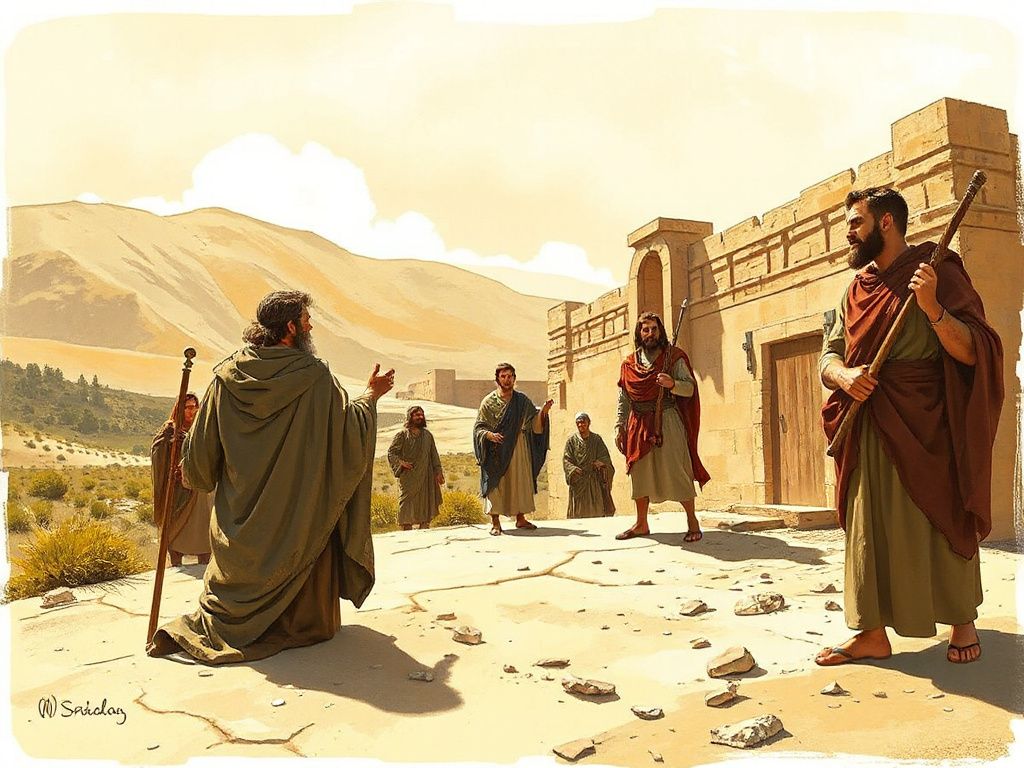
BIBLE CHAPTER STUDY
Psalms 40 — From the Pit to Praise and Petition
Psalms 40 moves from patient waiting (vv. 1–2) through public testimony (vv. 3–5), obedient surrender (vv. 6–10), and into urgent plea for deliverance (vv. 11–17).
Scripture
1For the Chief Musician. A Psalm of David. I waited patiently for Jehovah; And he inclined unto me, and heard my cry.
2He brought me up also out of a horrible pit, out of the miry clay; And he set my feet upon a rock, and established my goings.
3And he hath put a new song in my mouth, even praise unto our God: Many shall see it, and fear, And shall trust in Jehovah.
4Blessed is the man that maketh Jehovah his trust, And respecteth not the proud, nor such as turn aside to lies.
5Many, O Jehovah my God, are the wonderful works which thou hast done, And thy thoughts which are to us-ward; They cannot be set in order unto thee; If I would declare and speak of them, They are more than can be numbered.
6Sacrifice and offering thou hast no delight in; Mine ears hast thou opened: Burnt-offering and sin-offering hast thou not required.
7Then said I, Lo, I am come; In the roll of the book it is written of me:
8I delight to do thy will, O my God; Yea, thy law is within my heart.
9I have proclaimed glad tidings of righteousness in the great assembly; Lo, I will not refrain my lips, O Jehovah, thou knowest.
10I have not hid thy righteousness within my heart; I have declared thy faithfulness and thy salvation; I have not concealed thy lovingkindness and thy truth from the great assembly.
11Withhold not thou thy tender mercies from me, O Jehovah; Let thy lovingkindness and thy truth continually preserve me.
12For innumerable evils have compassed me about; Mine iniquities have overtaken me, so that I am not able to look up; They are more than the hairs of my head; And my heart hath failed me.
13Be pleased, O Jehovah, to deliver me: Make haste to help me, O Jehovah.
14Let them be put to shame and confounded together That seek after my soul to destroy it: Let them be turned backward and brought to dishonor That delight in my hurt.
15Let them be desolate by reason of their shame That say unto me, Aha, aha.
16Let all those that seek thee rejoice and be glad in thee: Let such as love thy salvation say continually, Jehovah be magnified.
17But I am poor and needy; Yet the Lord thinketh upon me: Thou art my help and my deliverer; Make no tarrying, O my God.
What this passage means
The psalm opens with a confession that waiting on Jehovah is not passive but active endurance (v. 1). The Hebrew root קוה (H6960), glossed 'to wait for,' carries the sense of binding together, gathering expectation, and the answer comes as God inclining His ear — a deliberate bending toward the petitioner (v. 1). Rescue is then pictured as physical extraction: being drawn up from a 'pit of destruction' (H7588 שָׁאוֹן) and 'miry clay' (H2916 טִיט / H3121 יָוֵן), with feet planted on a rock (H5553 סֶלַע) and steps made secure (vv. 2–3). The image of solid footing contrasts sharply with the sinking bog of the previous verses, and the transition from silence to a 'new song' makes the rescue audible to 'many.'
The middle section (vv. 6–10) marks a tonal shift from testimony to self-offering. Verses 7–8 directly echo Hebrews 10:7, 9 in the supplied cross references, where the same 'Lo, I am come; in the roll of the book it is written of me' is reapplied. Here David acknowledges that God has 'opened' his ears (a bodily readiness to listen) and that obedience — not altar ritual — is what delights him (v. 8). The vocabulary of 'law within the heart' parallels the inner man language of Romans 7:22. Verses 9–10 then frame obedience publicly: righteousness, faithfulness, salvation, lovingkindness, and truth are all declared in the great assembly, not concealed.
The closing movement (vv. 11–17) is a sudden reversal. After recounting rescue and resolve, the psalmist finds himself encircled by 'innumerable evils,' with iniquities so numerous that his heart has failed (v. 12). The plea is doubled — 'make haste to help me' (v. 13) — and the remainder alternates between imprecation against enemies who mock (vv. 14–15) and blessing toward those who seek God (v. 16). The psalm closes where it began, with the needy petitioner asking that God not delay (v. 17). The structural movement from pit to platform to peril is the chapter's central rhetorical shape.
Context
The chapter is supplied as a complete psalm with no surrounding chapters provided; the only contextual note states it was backfilled from chapters of Psalms outside an unspecified P0/P1 priority set. The supplied cross references cluster in two directions: psalms of patience and trust (Psalms 27:13–14; 37:7, 23; Jeremiah 17:7–8) and New Testament texts that quote or echo verses 7–8 (Hebrews 10:7, 9) and the inner delight in God's law (Romans 7:22). James 5:7, 11 extends the patience theme into New Testament ethics, and Jeremiah 29:11 parallels verse 5's confession that God's thoughts toward His people are beyond recounting.
No historical situation for the psalm is named in the provided material, and none should be assumed. The reader is given only David's superscription, his poetic movement between rescue and renewed distress, and the intertextual links the curated cross references provide. Where the chapter speaks of sacrifice and offering in verses 6–8, the Hebrew text and the cross references together point readers toward a theology of obedience that supersedes ritual — but the chapter itself frames this as the psalmist's confession, not as a doctrinal disquisition.
Key words in the original
- H6960 H6960 (קוה) is glossed 'to wait for,' with a literal sense of binding or twisting together and a figurative sense of collecting one's expectation. It frames the opening verb of the psalm: waiting is pictured as an active gathering of hope, not passive idleness.
- H7588 H7588 (שָׁאוֹן), glossed 'destruction,' denotes uproar or rushing noise and, by implication, ruin. The psalmist is rescued from a 'pit of destruction,' where the word pairs with physical peril (miry clay) to evoke both chaos and danger.
- H5553 H5553 (סֶלַע), glossed 'rock,' denotes a craggy rock used literally or figuratively as a fortress. The rescue reaches its climax when the psalmist's feet are planted on this rock — solid ground as the visible sign of divine establishment.
Related verses
- Hebrews 10:7 Hebrews 10:7 echoes verse 7 directly: 'Lo, I am come (In the roll of the book it is written of me) To do thy will, O God.' The supplied cross reference is the New Testament text that reapplies David's words about the written scroll to Christ, who comes to do God's will rather than to repeat the old sacrifices.
- Romans 7:22 Romans 7:22 — 'I delight in the law of God after the inward man' — is paired by the cross reference list with verse 8's 'thy law is within my heart.' Both texts locate obedience not in external observance but in an inner orientation toward God's word.
- Psalms 27:14 Psalms 27:14 — 'Wait for Jehovah: Be strong, And let thy heart take courage; Yea, wait thou for Jehovah' — extends the patience theme of verse 1 into a command to courage. Waiting is not weakness but a deliberate steadying of the heart.
Common questions
Why does the psalmist move from praise to fresh distress in verses 11–17?
The chapter provides no external explanation; it simply records the psalmist's experience of renewed trouble after testimony. Verse 12 names the cause directly: 'innumerable evils' and overwhelming iniquities. The shift models how Israelite prayer often moves from recounting past rescue into present need without resolving the tension — praise and petition coexist in the same voice.
Does verse 6 reject sacrifice altogether?
The verse as quoted says God 'hast no delight in sacrifice and offering' and does not require burnt-offering or sin-offering — but the psalmist immediately responds with a body and a will ready for obedience (vv. 7–8). The provided material does not frame this as a doctrinal repudiation of the sacrificial system, only as the psalmist's confession that willing obedience outranks ritual in his own experience.
How should verses 7–8 be read in light of Hebrews 10?
In their original setting the words are David's joyful response to God's call, expressing readiness to do God's will as written in the scroll. The supplied cross references (Hebrews 10:7, 9) show a New Testament writer reapplying the same words to Christ, who comes to do God's will and thereby supersedes the repeated sacrifices. The provided material does not adjudicate between these readings; it simply notes the textual reuse.