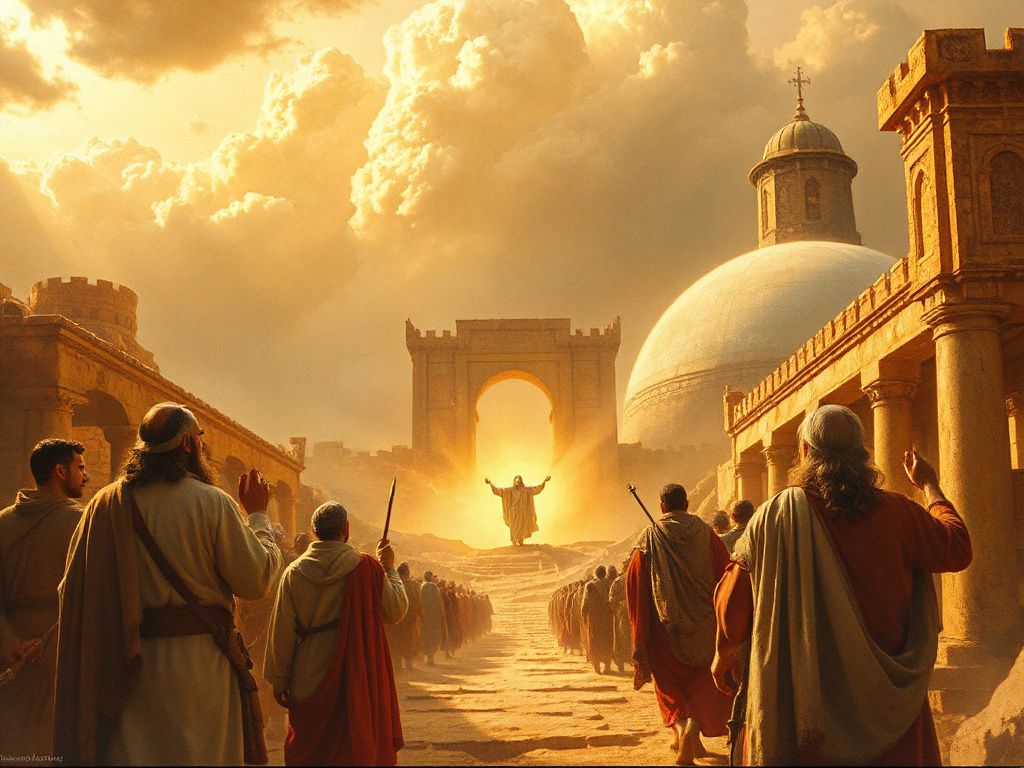
Revelation 21:17 — The Wall Measured by an Angel's Cubit
An angel measures the wall of the new Jerusalem at 144 cubits, using a standard shared by both humanity and angels.
Scripture
17And he measured the wall thereof, a hundred and forty and four cubits, according to the measure of a man, that is, of an angel.
What this passage means
The measuring angel turns from the city to the wall and announces its thickness: 144 cubits. The number 12 squared ties the wall to the city's twelve foundations (v. 14) and twelve gates (v. 12), making the wall itself a symbolic expression of the twelve tribes and twelve apostles that define the people of God.
The explanatory clause 'according to the measure of a man, that is, of an angel' identifies the unit being used. By calling the cubit both 'a man's measure' and 'an angel's measure,' the text presents the angel as employing the same human-forearm cubit referenced in older Scripture (see Deuteronomy 3:11), so that the dimensions are not an ethereal standard but a recognizable scale rendered vast.
Because the length, breadth, and height of the city are all 12,000 furlongs (v. 16), a wall of only 144 cubits is remarkably thin in proportion — a feature that the passage neither glosses nor explains. The verse's function is therefore to complete the city's measurements and to flag the angel's measuring activity as the lens through which the vision is given.
Context
The vision opens with a new heaven and new earth (v. 1), the descent of the holy city (v. 2), and God's promise to wipe away tears and death (vv. 3–4). After a warning to the fearful and unbelieving (vv. 7–8), an angel carrying the seven last plagues offers to show 'the bride, the wife of the Lamb' and carries John to a high mountain to see the city (vv. 9–10).
From verse 12 onward the city is described piece by piece: a high wall with twelve gates named for Israel's tribes (vv. 12–13), foundations bearing the apostles' names (v. 14), an angel with a golden reed for measuring (v. 15), and the city measured as a perfect cube of 12,000 furlongs (v. 16). Verse 17 continues this measuring sequence with the wall's thickness, leading into the jasper wall and gold city (v. 18) and the twelve precious-stone foundations (vv. 19–20).
Key words in the original
- G4083 πῆχυς (pēchys), 'cubit.' Defined as the fore-arm, used here as a unit of length. Verse 17 applies this human-body measure to an angelic vision, deliberately tying the measurement to ordinary human scale.
- G3358 μέτρον (metron), 'measure, unit of measurement.' The verse specifies that the wall is 'according to' this measure, indicating the standard by which the 144 cubits are reckoned.
- G5038 τεῖχος (teichos), 'wall.' Glossed as a wall that forms or surrounds a structure. In 21:17 it refers specifically to the enclosing wall of the new Jerusalem, distinct from its foundations (v. 14) and gates (v. 12).
Related verses
- Deuteronomy 3:11 The 'cubit of a man' language echoes Deuteronomy 3:11, where Og of Bashan's iron bedstead is given in 'the cubit of a man.' Both passages use a human-body unit of length to render an object's dimensions tangible, providing a scriptural precedent for measuring sacred or extraordinary objects by ordinary human cubits.
- Revelation 7:4 The 144,000 of Revelation 7:4 also equals 12 × 12 × 1000. Combined with 21:17's 144 (12 × 12), the number 12 squared repeatedly structures the seer into the measurements of the new Jerusalem, tying the sealed people to the city's geometry.
- Revelation 21:9 Revelation 21:9 introduces the same angel 'laden with the seven last plagues' who now does the measuring. The measuring scene in 21:15–17 is the angel's fulfillment of his offer in v. 9 to show John 'the bride, the wife of the Lamb,' identifying the bride with the measured city.
Common questions
Why is the wall only 144 cubits thick when the city is 12,000 furlongs tall?
The text gives both measurements without explanation. Readers note that 144 cubits is thin compared with the city's 12,000-furlong sides, but Revelation itself does not comment on or reconcile the proportions.
What does 'the measure of a man, that is, of an angel' mean?
The clause identifies the cubit used for the wall as the same fore-arm measure used by humans. By labeling it simultaneously 'a man's measure' and 'an angel's measure,' the verse presents the angel as employing an ordinary human scale rather than a separate angelic one.
What is the significance of the number 144 for the wall?
144 is 12 multiplied by 12. Twelve already structures the city — twelve gates for Israel's tribes (v. 12) and twelve foundations for the apostles (v. 14) — so a wall of 144 cubits folds the same twelve-based pattern into the city's thickness, tying the wall numerically to the people of God.