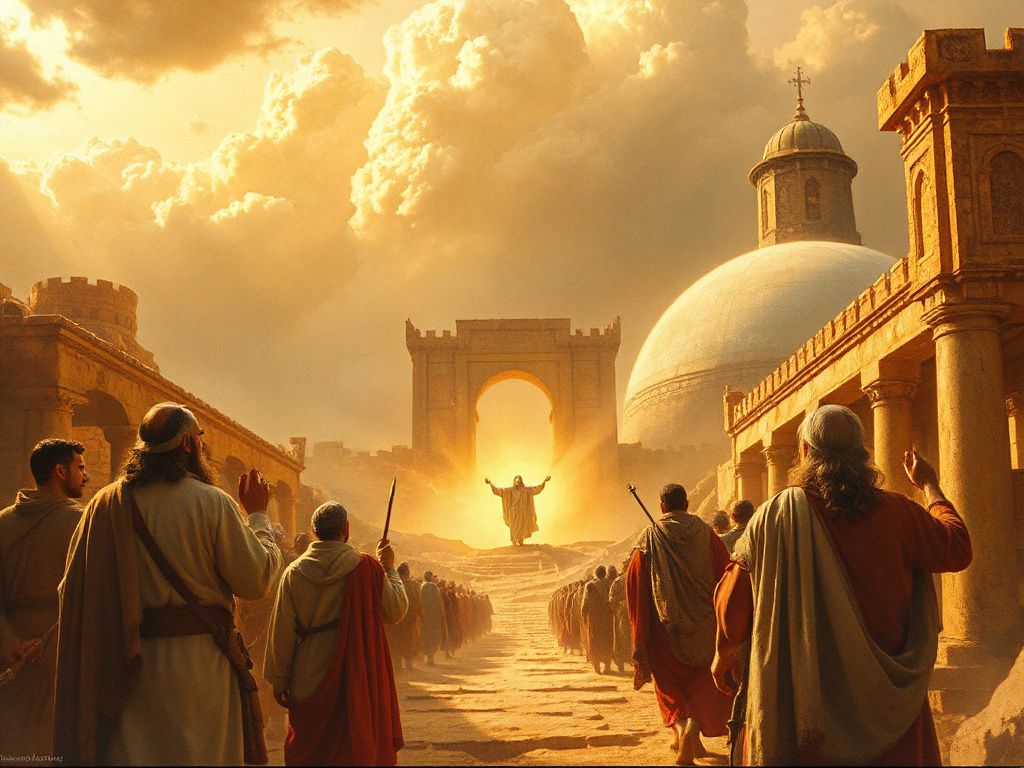
Revelation 21:9 — The Bride, the Wife of the Lamb
One of the seven bowl angels invites John to see the Bride, the wife of the Lamb, setting up the vision of the new Jerusalem.
Scripture
9And there came one of the seven angels who had the seven bowls, who were laden with the seven last plagues; and he spake with me, saying, Come hither, I will show thee the bride, the wife of the Lamb.
What this passage means
Revelation 21:9 marks a narrative pivot: the voice from the throne (vv. 5-8) has finished speaking, and now an angelic messenger steps forward to show John a new vision. The specific identity of this angel—one of the seven who carry the seven bowls of the last seven plagues—ties this scene back to the judgments described earlier in Revelation. By reusing an angel already familiar from the bowls sequence, the text connects the end of wrath with the revelation of salvation's goal.
The angel's command, "Come hither, I will show thee the bride, the wife of the Lamb," establishes the vision's subject. Two terms are used together for the same referent: "bride" (νύμφη) and "wife" (γυναῖκα). This pairing emphasizes both the covenant relationship (bride) and the consummated union (wife) between the Lamb and his people. The title "the Lamb" (τὸ ἀρνίον) harks back to the slain-yet-living figure introduced earlier in Revelation.
The verse functions as an introduction: the angel promises to show something, and the following verses (21:10 onward) deliver the actual vision by identifying the bride as the holy city, new Jerusalem. Thus 21:9 frames the bride imagery so that it will unfold as a concrete picture of the city coming down from heaven.
Context
Revelation 21:9 sits between two distinct movements in the chapter. Verses 1-8 present the broad vision: a new heaven and new earth, God's dwelling with humanity, the wiping away of tears, the declaration that all things are new, and the Alpha and Omega's invitation to the thirsty. Verse 8 issues a sober warning about the second death for the ungodly. Verse 9 then shifts from the throne's direct speech to angelic mediation, opening a vision that will dominate the rest of the chapter.
Within verses 9-27, the bride announced here is revealed to be the new Jerusalem. The angel carries John "in the Spirit to a mountain great and high" (21:10) and shows the city's glory, walls, twelve gates named for Israel's tribes, twelve foundations named for the apostles, and its measurement in precious materials. The bride language of 21:9 is therefore not abandoned but expanded: the wife of the Lamb is shown as a structured city whose light is the glory of God and whose lamp is the Lamb.
Key words in the original
- G3565 νύμφη (nymphē) is rendered "bride," denoting a young married or betrothed woman. Here it underscores the covenantal bond between the Lamb and his people.
- G1135 γυνή (gynē) means "woman" or "wife." Paired with νύμφη in this verse, it stresses the consummated union rather than merely the betrothal stage.
- G0721 ἀρνίον (arnion) is the diminutive "lamb," used throughout Revelation as a title for Christ that recalls the Passover lamb and the slain-yet-standing figure of earlier chapters.
Related verses
- Revelation 21:2 Earlier in the same chapter, the holy city is described as coming down "made ready as a bride adorned for her husband." Revelation 21:9 picks up that bridal image and pairs it with the title "wife," signaling the consummation of what 21:2 announced.
- Revelation 19:7 The marriage of the Lamb and the readiness of his wife are celebrated in 19:7. Revelation 21:9 shows the result of that readiness: the wife is now presented for John to behold.
- Revelation 17:1 A similar angelic introduction appears in 17:1, where one of the same seven bowl angels summons John to see "the judgment of the great harlot." The parallel structure highlights the deliberate contrast between the harlot and the bride that Revelation 21:9 invites John to see.
Common questions
Why does Revelation 21:9 say "bride" and "wife" together?
The two terms are used together in the provided verse to emphasize both the covenant relationship (bride) and the consummated union (wife) between the Lamb and his people. The pairing prepares the reader for a vision that will unfold the bride as the new Jerusalem.
Who is the angel in Revelation 21:9?
According to the verse, the angel is one of the seven who carry the seven bowls of the seven last plagues. The text gives no further identifying details about which of the seven this particular angel is.
Is the bride a person or a city?
Revelation 21:9 calls her "the bride, the wife of the Lamb." The verses that follow (21:10 onward) identify what John is shown as the holy city, new Jerusalem, coming down out of heaven. The text itself, as provided, does not treat "bride" and "city" as separate referents but presents the city as what the angel shows in answer to the promise of 21:9.