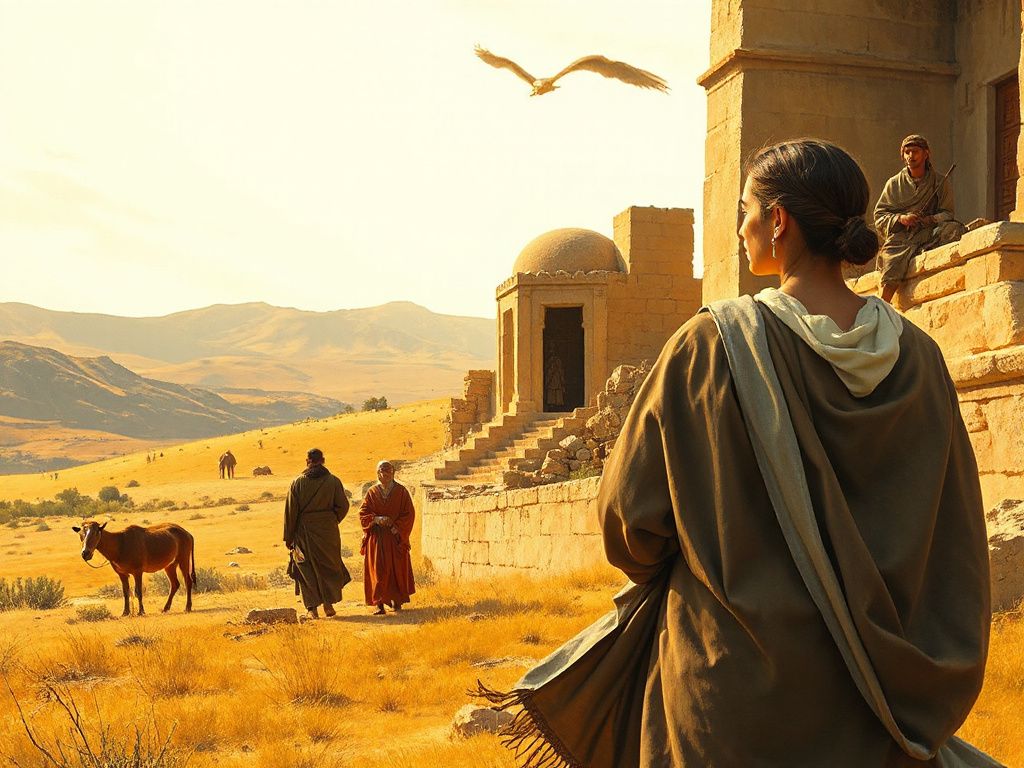
BIBLE CHAPTER STUDY
Ruth 1 — Return and Loyalty
In the days of the judges a famine drives Elimelech and Naomi to Moab, where the men of the family die; Naomi returns with Ruth, whose pledge of loyalty to Naomi's people and God frames the rest of the book.
Scripture
1And it came to pass in the days when the judges judged, that there was a famine in the land. And a certain man of Beth-lehem-judah went to sojourn in the country of Moab, he, and his wife, and his two sons.
2And the name of the man was Elimelech, and the name of his wife Naomi, and the name of his two sons Mahlon and Chilion, Ephrathites of Beth-lehem-judah. And they came into the country of Moab, and continued there.
3And Elimelech, Naomi's husband, died; and she was left, and her two sons.
4And they took them wives of the women of Moab; the name of the one was Orpah, and the name of the other Ruth: and they dwelt there about ten years.
5And Mahlon and Chilion died both of them; and the woman was left of her two children and of her husband.
6Then she arose with her daughters-in-law, that she might return from the country of Moab: for she had heard in the country of Moab how that Jehovah had visited his people in giving them bread.
7And she went forth out of the place where she was, and her two daughters-in-law with her; and they went on the way to return unto the land of Judah.
8And Naomi said unto her two daughters-in-law, Go, return each of you to her mother's house: Jehovah deal kindly with you, as ye have dealt with the dead, and with me.
9Jehovah grant you that ye may find rest, each of you in the house of her husband. Then she kissed them, and they lifted up their voice, and wept.
10And they said unto her, Nay, but we will return with thee unto thy people.
11And Naomi said, Turn again, my daughters: why will ye go with me? have I yet sons in my womb, that they may be your husbands?
12Turn again, my daughters, go your way; for I am too old to have a husband. If I should say, I have hope, if I should even have a husband to-night, and should also bear sons;
13would ye therefore tarry till they were grown? would ye therefore stay from having husbands? nay, my daughters, for it grieveth me much for your sakes, for the hand of Jehovah is gone forth against me.
14And they lifted up their voice, and wept again: and Orpah kissed her mother-in-law, but Ruth clave unto her.
15And she said, Behold, thy sister-in-law is gone back unto her people, and unto her god: return thou after thy sister-in-law.
16And Ruth said, Entreat me not to leave thee, and to return from following after thee, for whither thou goest, I will go; and where thou lodgest, I will lodge; thy people shall be my people, and thy God my God;
17where thou diest, will I die, and there will I be buried: Jehovah do so to me, and more also, if aught but death part thee and me.
18And when she saw that she was stedfastly minded to go with her, she left off speaking unto her.
19So they two went until they came to Beth-lehem. And it came to pass, when they were come to Beth-lehem, that all the city was moved about them, and the women said, Is this Naomi?
20And she said unto them, Call me not Naomi, call me Mara; for the Almighty hath dealt very bitterly with me.
21I went out full, and Jehovah hath brought me home again empty; why call ye me Naomi, seeing Jehovah hath testified against me, and the Almighty hath afflicted me?
22So Naomi returned, and Ruth the Moabitess, her daughter-in-law, with her, who returned out of the country of Moab: and they came to Beth-lehem in the beginning of barley harvest.
What this passage means
Ruth 1 opens with a temporal marker — 'the days when the judges judged' — that locates the story in a period the rest of the Hebrew Bible depicts as politically and spiritually unstable. The famine that follows is the narrative trigger that pulls a family from Bethlehem of Judah into Moab, a foreign territory east of the Dead Sea. The move introduces the book's recurring tension between Israel and the surrounding nations, and between security abroad and belonging at home.
The middle section (vv. 6–18) is built around speech and counter-speech. Naomi hears that 'Jehovah had visited his people in giving them bread' and decides to return. Her threefold urging of her daughters-in-law to stay tests their loyalty, and the two women respond differently: Orpah turns back to 'her people, and unto her god,' while Ruth clings to Naomi. Naomi's self-rebuke as 'Mara' ('bitter') frames her return as a return emptied of husband and sons, sustained only by the younger woman who refuses to leave.
Ruth's vow in vv. 16–17 is the chapter's hinge. The repeated formula 'whither thou goest, I will go… where thou lodgest, I will lodge' is an oath formula: it binds her to Naomi's people, Naomi's God, and even Naomi's burial place. The chapter's closing image — arriving at Bethlehem at the beginning of barley harvest — points forward to the provisions that will follow in chapters 2–4.
Context
The chapter sits inside the book of Ruth and depends on the names it introduces: Elimelech (whose name is explained by Naomi as 'God is king' against her experience of loss), Naomi ('pleasant'), Mahlon and Chilion, and the Moabite wives Orpah and Ruth. Within Ruth itself the chapter is paired with Ruth 2:11–12, where Boaz recounts to Ruth 'all that thou hast done unto thy mother-in-law' and blesses her refuge 'under the wings' of Israel's God — a direct echo of her pledge in 1:16. Ruth 3:1 then continues Naomi's concern that she 'seek rest' for Ruth, picking up the language of 'rest' from 1:9.
The opening phrase 'in the days when the judges judged' deliberately echoes the framing of the book of Judges. The chapter's note summarizes the movement as 'Return and loyalty,' which is exactly what the chapter's two halves enact: Naomi's physical return to Judah, and Ruth's covenantal return to Naomi's God.
Key words in the original
- H8199 The Hebrew root shaphat (H8199), rendered here 'judged/ruled,' supplies the chapter's opening time marker ('when the judges judged') and names the office whose instability frames the whole book. The gloss tracks the sense used in v. 1 — ruling/governing — rather than the forensic sense of pronouncing sentence.
- H7458 The noun ra'av (H7458), 'famine,' recurs across Israel's history as a sign of covenant disorder. Its appearance at the very start of Ruth 1 places the family's move to Moab under the same kind of pressure seen in Abram's descent to Egypt (Gen 12:10) and Isaac's move to Gerar (Gen 26:1).
- H1481 The verb gur (H1481), 'to sojourn,' marks someone living in a land without holding its citizenship or land rights. Elimelech's relocation to Moab is described with this verb, signaling that the family remains outsiders even during a ten-year stay.
Related verses
- 2 Samuel 15:21 Ittai's pledge to David — 'in what place my lord the king shall be, whether for death or for life, even there also will thy servant be' — is the clearest later echo of Ruth's oath in 1:16–17. Both bind a servant/daughter-in-law to the death-bound path of a covenant figure.
- Ruth 2:11 Boaz's summary to Ruth in 2:11 directly mirrors Naomi's report in 1:6: he names 'all that thou hast done unto thy mother-in-law' and the leaving of 'the land of thy nativity,' confirming that Ruth's pledge has become a known fact within the community of Bethlehem.
- Genesis 12:10 Abram's descent to Egypt because 'the famine was sore in the land' is the structural twin of Elimelech's move to Moab. The opening of Ruth 1 deliberately recalls the patriarchal pattern of sojourning under famine, marking Elimelech's family as living in the same unsettled era.
Common questions
Why does the chapter open with 'the days when the judges judged'?
The phrase is a deliberate frame linking Ruth to the book of Judges. It tells the reader the story unfolds in a period already characterized by the surrounding text as unstable, so that the events of Ruth 1 are read against that backdrop rather than in isolation.
Why does Naomi urge her daughters-in-law to leave?
Naomi gives three reasons across vv. 8–13: she wants the younger women to find 'rest' in a new husband's house; she has no sons to give them in levirate marriage; and she regards her own condition as under the active judgment of 'Jehovah' — so she believes staying with her would harm them. The urging is therefore pastoral concern, not rejection.
What makes Ruth's vow in vv. 16–17 distinctive?
The vow moves beyond the ordinary promise to stay with Naomi: it explicitly transfers Ruth to Naomi's people, names Naomi's God as her own God, and binds her even to Naomi's burial place. The closing self-curse formula ('Jehovah do so to me, and more also, if aught but death part thee and me') marks the speech as an oath rather than a sentiment.