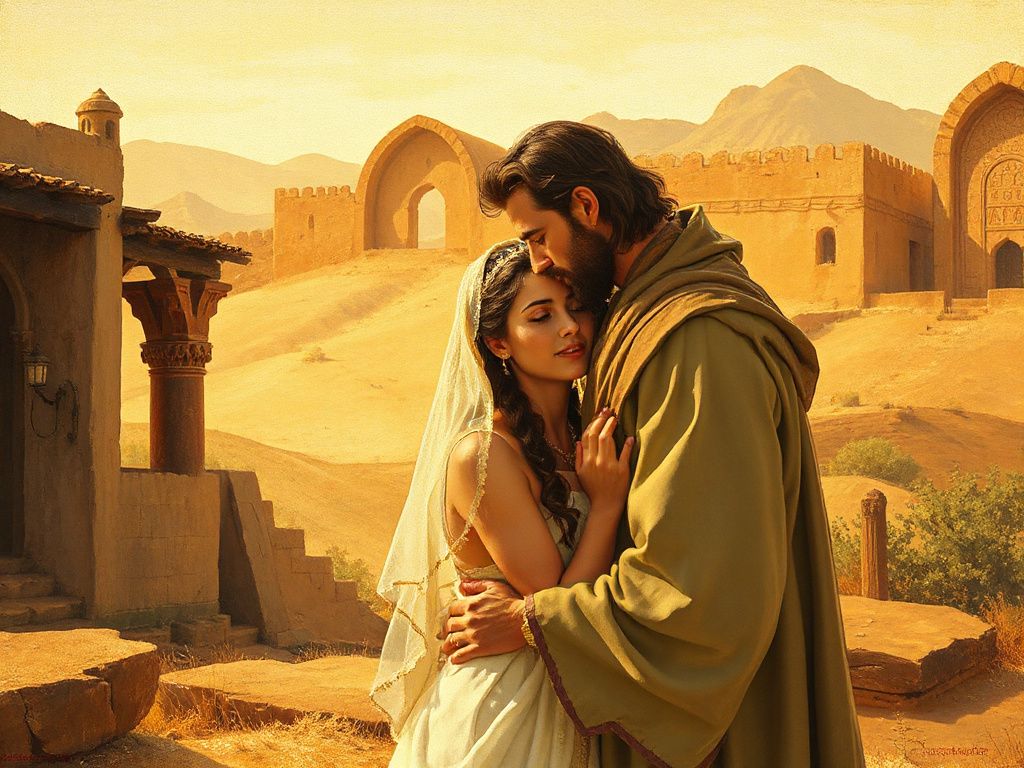
BIBLE VERSE STUDY
Song of Solomon 4:7 — The Bride Without Spot
The bridegroom's climactic declaration that his bride is altogether beautiful and without flaw, summing up the body imagery of the preceding verses.
Scripture
7Thou art all fair, my love; And there is no spot in thee.
What this passage means
Song of Solomon 4:7 is the climax of the bridegroom's poetic description of his beloved. After moving through her eyes, hair, teeth, lips, temples, neck, and breasts in verses 1–5, he gathers every detail into a single affirming sentence: 'Thou art all fair, my love; and there is no spot in thee.' The phrase 'all fair' (Hebrew: kol-yaphah) sums up each admired feature, while 'no spot' (Hebrew: mummah) signals that nothing mars the whole. The address 'my love' (Hebrew: rayah) is the same tender term used throughout the poem for the bride, framing the statement as a personal, relational declaration rather than a detached aesthetic judgment.
In its literary position, this verse serves as a hinge. It closes the section of detailed body imagery (4:1–7) and opens the bridegroom's summons in 4:8, 'Come with me from Lebanon, my bride,' which shifts the poem from admiration to invitation. The absence of any flaw therefore functions as the reason the bride can be called to travel with him: she is wholly beautiful and fully prepared to come. The collection of spices, gardens, and fountains in 4:12–15 then expands on the same theme of completeness, as the bride becomes a sealed garden and a fountain of living waters.
The verse is widely noted for its theological echo in Ephesians 5:27, where Paul describes the church as 'a glorious church, not having spot, or wrinkle,' and in Colossians 1:22, where believers are presented 'holy and without blemish.' The Song's setting is the love between bride and bridegroom, but the structural logic — full acceptance preceding union — is the same pattern Paul applies to Christ and the church. The curated note frames this verse precisely this way: the bridegroom's full acceptance of the bride foreshadows Christ's love for the church.
Context
Chapter 4 is organized as the bridegroom's praise of the bride (vv. 1–7), followed by his invitation to travel with him (v. 8) and her praise in return (vv. 9–11), and then the garden imagery (vv. 12–15) and the bride's invitation to her beloved (v. 16). Within this structure, 4:7 stands at the end of the praise section and immediately precedes the call 'Come with me from Lebanon.' The full-chapter movement goes from feature-by-feature admiration to total affirmation, and then to invitation, climaxing in the shared garden of verse 16.
The verse also reflects a wider pattern in the Song, where the lovers exchange parallel compliments: the bride praises the bridegroom in 5:10–16, and he praises her in 4:1–7 and again in 6:4–10. In 4:7 the praise is not comparative ('how fair' as in 1:15 or 4:10) but declarative and total: 'all fair … no spot.' This heightens the tone from admiration to affirmation, which is why the verse is often singled out as the bridegroom's highest word about the bride.
Common questions
What does 'no spot in thee' mean in Song of Solomon 4:7?
In the poem's literary setting, 'no spot' (Hebrew mummah) is the bridegroom's affirming conclusion to his detailed praise in 4:1–5. He catalogs her features — eyes, hair, teeth, lips, neck, breasts — and then sums them up: nothing mars the whole. The statement is personal and relational, addressed to 'my love,' and functions as the basis for his invitation in verse 8 to come with him.
How is Song of Solomon 4:7 connected to the New Testament?
The verse's language of total beauty and freedom from flaw echoes Paul's descriptions of the church as 'not having spot, or wrinkle' (Ephesians 5:27) and as presented 'holy and without blemish' (Colossians 1:22). Both texts use a bride-bridegroom pattern in which full acceptance precedes union, which is why the verse is often read as a foreshadowing of Christ's love for the church.
Why does the bridegroom's praise end with 4:7 before the invitation in 4:8?
The chapter is structured as a movement from detailed admiration (vv. 1–6) to total affirmation (v. 7) and then to invitation (v. 8). Verse 7 gathers every preceding image into one sentence — 'all fair … no spot' — so that the invitation in verse 8 ('Come with me from Lebanon, my bride') rests on a foundation of full acceptance. The affirmation precedes the journey, which is the structural key to the passage.