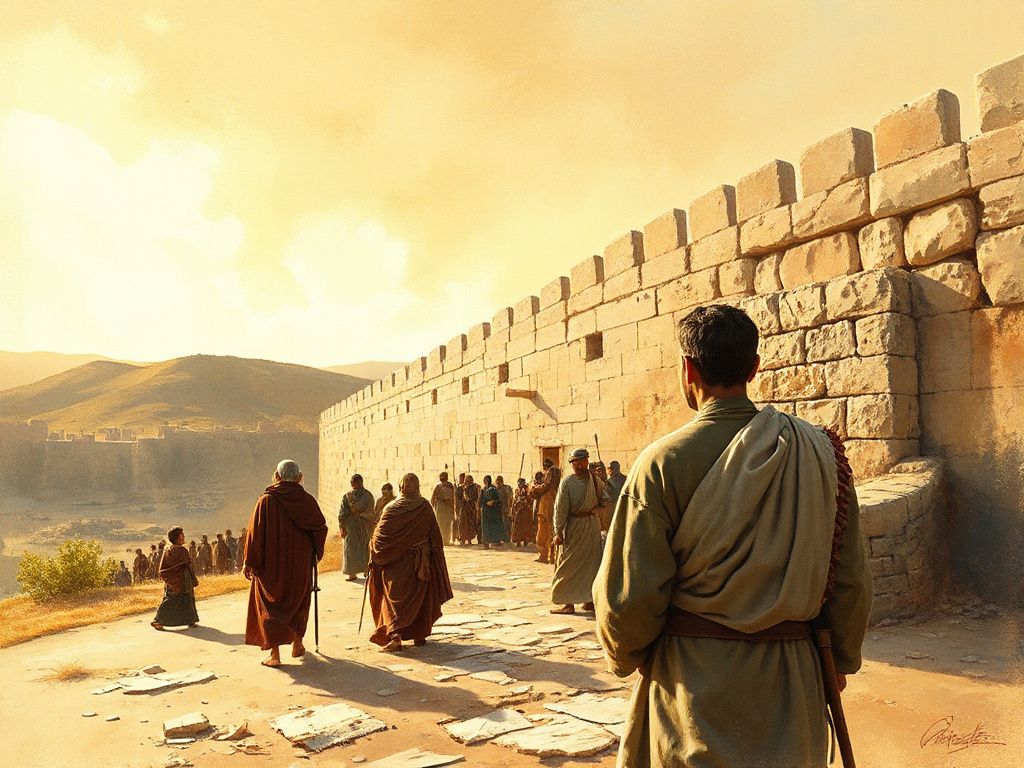
ESTUDIO DEL VERSÍCULO
Nehemías 2:17-18 — Llamamiento para reconstruir los muros de Jerusalén
Nehemías llama públicamente al pueblo a reconstruir los muros de Jerusalén, vinculando la ciudad en ruinas con su oprobio, y cuenta el favor de Dios ante el rey; el pueblo decide construir.
Escritura
- 17.Les dije, pues: Vosotros veis el mal en que estamos, que Jerusalén está desierta, y sus puertas consumidas por el fuego; venid, y edifiquemos el muro de Jerusalén, y no estemos más en oprobio.Then said I unto them, Ye see the evil case that we are in, how Jerusalem lieth waste, and the gates thereof are burned with fire: come, and let us build up the wall of Jerusalem, that we be no more a reproach.
- 18.Entonces les declaré cómo la mano de mi Dios había sido buena sobre mí, y asimismo las palabras que el rey me había dicho. Y dijeron: Levantémonos y edifiquemos. Así esforzaron sus manos para bien.And I told them of the hand of my God which was good upon me, as also of the king's words that he had spoken unto me. And they said, Let us rise up and build. So they strengthened their hands for the good work.
Qué significa este pasaje
Nehemías primero enfrenta al pueblo con la condición visible de Jerusalén — la ciudad desolada y sus puertas quemadas — y luego lanza la convocatoria: «venid y edifiquemos el muro de Jerusalén, para que ya no seamos un oprobio». El argumento va de la observación compartida al proyecto compartido. La ruina aquí se asocia con la vergüenza, y la reedificación se plantea como la eliminación de esa vergüenza, no meramente como una obra constructiva.
En el versículo 18, Nehemías fundamenta su apelación en dos realidades concretas: «la mano de mi Dios, que había sido buena conmigo» y «las palabras del rey que me había dicho». El decreto persa (capítulo 2:1–8) y el gobierno divino sobre él se presentan juntos, de modo que lo que parece un permiso político se lee como dirección providencial. La respuesta del pueblo, «Levantémonos y edifiquemos», alinea el esfuerzo humano con el relato que Nehemías acaba de ofrecer.
La línea final, «y ellos esforzaron sus manos para la buena obra», emplea un modismo hebreo para expresar resolución y aliento (lit. «esforzaron sus manos»). La obra es llamada «buena» en el propio texto, lo que señala que, desde la perspectiva del narrador, la condición moral de reconstruir los muros de Jerusalén no está en disputa.
Contexto
Los versículos 14–16 preparan el momento: Nehemías ha recorrido los muros de noche y aún no ha revelado su plan a los oficiales, sacerdotes, nobles ni obreros. El versículo 17 es, por tanto, la primera declaración pública del proyecto, dirigida a los que «hacían la obra» (v. 16), razón por la cual el llamado a construir del v. 17 puede responderse de inmediato en el v. 18.
El motivo del «oprobio» que Nehemías menciona en el v. 17 hace eco de sus propias palabras al rey en el v. 3 — la ciudad «está desierta, y sus puertas consumidas por el fuego» —, de modo que la pregunta del rey y la formulación previa de Nehemías reaparecen ante los oídos del pueblo. El capítulo termina (v. 20) con oposición: Sanbalat, Tobías y Geses ridiculizan a los constructores y los acusan de rebelarse contra el rey, y Nehemías responde que «el Dios del cielo» los prosperará. El acuerdo sin oposición de los vv. 17–18 se presenta así como una breve ventana antes del conflicto registrado en los vv. 19–20.
Preguntas frecuentes
¿Por qué Nehemías apela a los ojos del pueblo antes de pedirles que construyan?
Al comenzar con «Vosotros veis el mal en que estamos», Nehemías fundamenta el llamado en una realidad compartida e innegable — muros en ruinas y puertas quemadas — en lugar de en la autoridad o la emoción, haciendo visible para todos los presentes la necesidad de reedificar.
¿Cómo conecta Nehemías el decreto del rey con la mano de Dios?
Nehemías cuenta al pueblo dos cosas juntas en el v. 18: «la mano de mi Dios, que había sido buena conmigo», y «las palabras del rey que me había dicho». La autorización persa (2:1–8) y el favor divino se presentan como un único respaldo para la obra, de modo que el permiso político se lee como dirección providencial.
¿Qué significa «esforzaron sus manos para la buena obra»?
Es un modismo hebreo para expresar resolución y aliento mutuo para actuar («esforzaron sus manos»). El narrador también califica la reedificación como «la buena obra», lo que señala que la condición moral del proyecto queda establecida desde la perspectiva del propio texto antes de que surja la oposición en los vv. 19–20.