 ← Volver a temas
✉️ Iglesia Primitiva y Epístolas
Pentecostés
🎬0cursos
📜6escrituras
🔤0términos
💬6preguntas
Tradición:Protestante
Acts 27:18
protestant「And as we labored exceedingly with the storm, the next day they began to throw the the freight overboard;」
Acts 13:13
protestant「Now Paul and his company set sail from Paphos, and came to Perga in Pamphylia: and John departed from them and returned to Jerusalem.」
Acts 20:20
protestant「how I shrank not from declaring unto you anything that was profitable, and teaching you publicly, and from house to house,」
Acts 4:37
protestant「having a field, sold it, and brought the money and laid it at the apostles' feet.」
Acts 17:25
protestant「neither is he served by men's hands, as though he needed anything, seeing he himself giveth to all life, and breath, and all things;」
Acts 9:25
protestant「but his disciples took him by night, and let him down through the wall, lowering him in a basket.」
En Pentecostés, ¿por qué los discípulos hablaban en las lenguas de otras naciones en lugar de hacerlo en su arameo local?
Acts 2 records the disciples being filled with the Spirit and speaking in other tongues — what theological significance lies beneath this phenomenon?
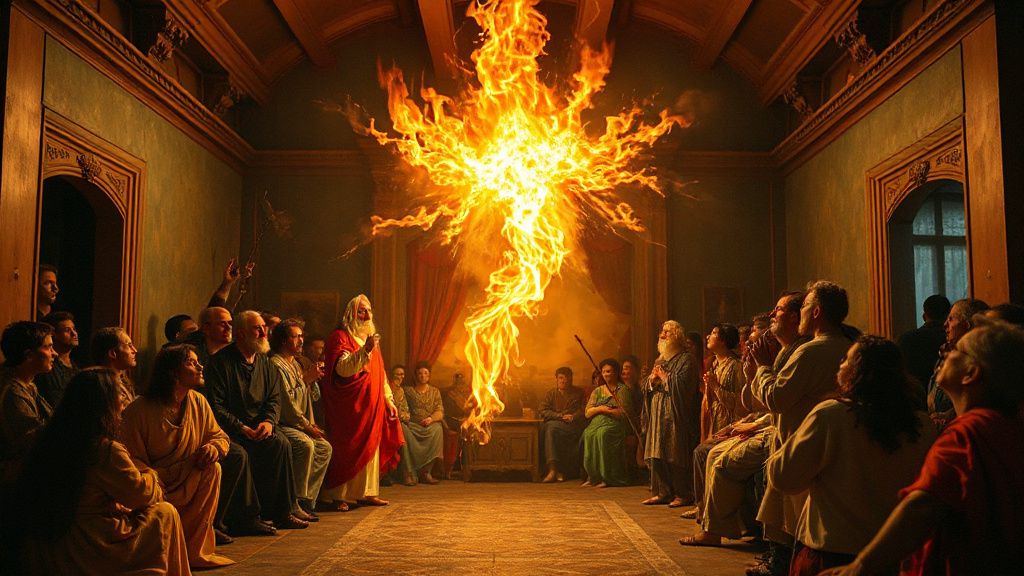
¿Qué significan los símbolos del Espíritu Santo y el fuego en el evento de Pentecostés?
A sound like a mighty wind and tongues like fire appeared as the Spirit filled the disciples, giving them utterance and power.
Why did the Holy Spirit descend on the fiftieth day, exactly ten days after Jesus' ascension?
Jesus told the disciples to wait, and on the day of Pentecost the Spirit came as tongues of fire and they began speaking in other languages.
¿Por qué Pedro citó al profeta Joel en su sermón de Pentecostés?
Peter stood up to explain the signs of the last days, citing Joel to show the Spirit's outpouring in the end times.
¿Qué continuidad existe entre Pentecostés y la experiencia de los creyentes hoy?
Is the Spirit's work in apostolic times continuous with today?
¿Por qué Pedro cita la profecía de Joel en su sermón de Pentecostés?
Peter cites Joel 2 in Acts 2 — how does this Old Testament prophecy frame the events of the day?