Exodus 21:8
protestant「If she please not her master, who hath espoused her to himself, then shall he let her be redeemed: to sell her unto a foreign people he shall have no power, seeing he hath dealt deceitfully with her.」
Exodus 11:1
protestant「And Jehovah said unto Moses, Yet one plague more will I bring upon Pharaoh, and upon Egypt; afterwards he will let you go hence: when he shall let you go, he shall surely thrust you out hence altogether.」
Exodus 30:27
protestant「and the table and all the vessels thereof, and the candlestick and the vessels thereof, and the altar of incense,」
Exodus 9:30
protestant「But as for thee and thy servants, I know that ye will not yet fear Jehovah God.」
Exodus 27:1
protestant「And thou shalt make the altar of acacia wood, five cubits long, and five cubits broad; the altar shall be foursquare: and the height thereof shall be three cubits.」
Exodus 17:1
protestant「And all the congregation of the children of Israel journeyed from the wilderness of Sin, by their journeys, according to the commandment of Jehovah, and encamped in Rephidim: and there was no water for the people to drink.」
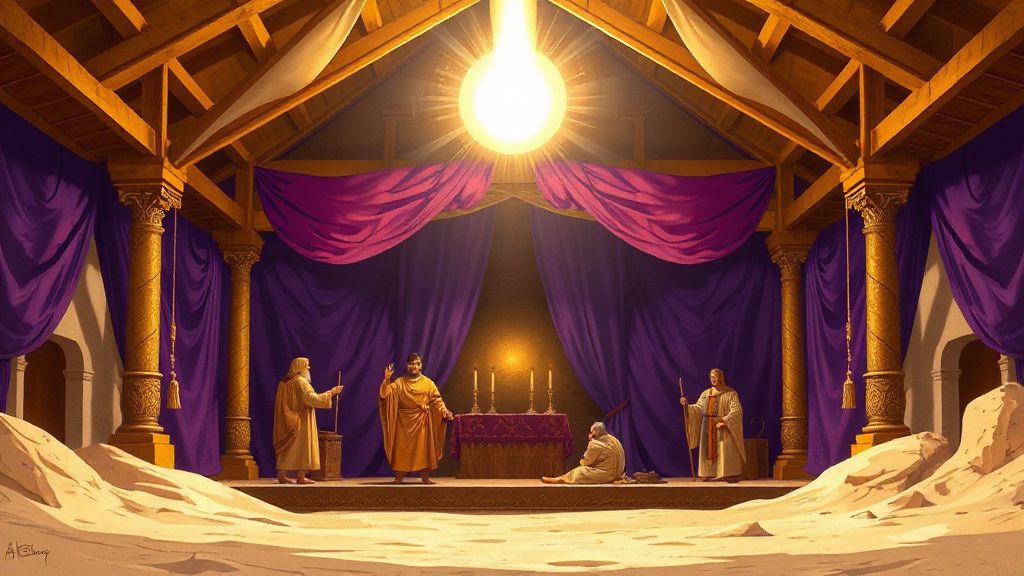
Tent of Meeting
allThe sacred tent where God met with Moses and His people, symbolizing divine presence and the center of Israelite worship in the wilderness.
Altar of Burnt Offering
allThe square bronze altar in the tabernacle courtyard used for sacrifices and atonement, central to Israel's worship as the place where sin is atoned through sacrifice.
Heave Offering (terumah)
allתְּרוּמָה denotes a portion lifted and separated for God; used here for voluntary gifts toward the Tabernacle, symbolizing willing devotion.
Tabernacle
allThe dwelling place God commanded Israel to build so He might dwell among them. Central OT symbol of divine presence, later seen as typological of Christ tabernacling among humanity.
Anointing Oil
allSacred oil used to consecrate the tabernacle and its furnishings, symbolizing the Holy Spirit's presence and consecration.
Ark of the Covenant
allThe most sacred Israelite object, containing the tablets of the Ten Commandments, symbolizing God's presence with Israel. Its acacia wood overlaid with pure gold reflects the union of divine and human.
¿Por qué Moisés y Aarón esperaron el mandato específico de Dios antes de cada plaga, en lugar de actuar por iniciativa propia?
The rhythm of obedience behind each plague reveals God's precise sovereignty.
¿Cómo entiende la tradición católica la revelación del 'YO SOY' en la zarza ardiente?
The self-disclosure in the fire—how does it connect to core Christological truth?
¿Cómo entiende la tradición católica la revelación del 'YO SOY' en la zarza ardiente?
The self-disclosure in the fire—how does it connect to core Christological truth?
¿Qué atributo de Dios revela Éxodo 33:20, que Moisés no puede ver su rostro?
The unseen God reveals Himself to Moses in the most intimate way.
¿Cómo enfatiza el judaísmo el mandamiento de honrar a los padres?
Honoring parents is a foundational ethic in Judaism.
¿Qué significa hoy "recordar" y "guardar" el día de reposo?
Two seemingly opposed commandments unite in Jewish observance.
🎬 Cursoprotestant
Exodus 20:1-17
Exodus · Ch.20
Exodus 20:1-17 The Ten Commandments
V 22min
Exodus and LawMt. Sinai