BIBLE FILM GUIDE
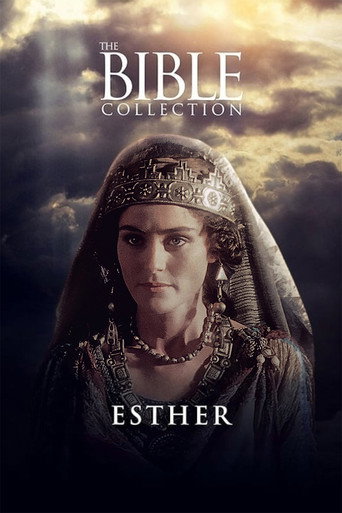
Esther
Film · 1999 · 87 min
The film tells the Old Testament story of Esther, the Jewish queen of Persia, who intervenes to save her people from a planned massacre.
What the story covers
According to the overview, the film follows the biblical account of Esther: Queen Vashti is deposed for refusing King Ahasuerus (Xerxes), and Esther, a Jewish woman raised by her cousin Mordecai, is chosen as the new queen. When Mordecai refuses to bow to the official Haman, Haman schemes to destroy all the Jews. Esther risks her life by approaching the king uninvited to save her people, and the story ends with the Jewish people surviving through faith.
The film is based on the Book of Esther (chapters 1–10), one of the two books in the Hebrew Bible that does not mention God by name. The central figures are Esther and Mordecai; the opposing figure is Haman, son of Hammedatha (the Agagite). The narrative is set in Susa during the Persian Empire and is the source of the Jewish festival of Purim.
Where it is in the Bible
- Esther 4:14Mordecai challenges her: if she stays silent, deliverance will come from elsewhere — and she and her family will be lost. The question 'for such a time as this' frames the whole crisis that the film depicts.
- Esther 4:16Esther commits to action: a three-day fast with the Jews in Susa, then she will go to the king uninvited — 'if I perish, I perish.' This is the moment of risk the film builds toward.
- Esther 6:1The king cannot sleep and has the royal records read aloud, where Mordecai's earlier loyalty is found. Providential reversals like this are central to the story the film retells.
- Esther 7:3-4Esther's petition to the king: her life and her people's lives are at stake, sold 'to be destroyed, to be slain, and to perish.' She contrasts this with mere slavery, which she would have endured in silence.
- Esther 8:15-17After Haman is hanged, Mordecai appears in royal apparel and Susa rejoices. The Jews experience 'light and gladness, and joy and honor,' and many people become Jews out of fear — the outcome the film celebrates and the basis of the festival of Purim.
How it differs from the Bible
Because no English overview is provided beyond the single sentence summary, this guide flags places where adaptations commonly reshape the story rather than asserting what this specific film changes. Viewers can compare what they see on screen with what the Bible actually says.
Things to compare with scripture: in Esther 4:14, the overview mentions Esther's intervention but not Mordecai's direct words; in 4:16, Esther's three-day fast and her phrase 'if I perish, I perish' are a key turning point that films often condense. Esther 7:3–4 records the exact petition she makes to the king; Esther 7:10 shows the reversal — Haman hanged on the gallows he prepared for Mordecai; and Esther 8:15–17 describes the public joy and the 'light and gladness' that festivals like Purim commemorate.
Discussion questions
- 1
Why is Esther Risk Register Uninvited Considered the So Nicely: Where does the pressure on Esther to act — or to stay silent — come from in the text?
Read Esther 4:14 together with 4:16. Mordecai reminds her that silence will not protect her family, and Esther herself commits to approaching the king uninvited after a three-day fast. Compare how it builds that decision in the film.
- 2
Where is God in the Book of Esther, and how does the film handle that absence?
Esther 4:14 and 6:1 both point to providence without naming God: deliverance 'from another place,' and a sleepless night that leads the king to discover Mordecai's service. Discuss how the film shows — or does not show — this providence. The ending is in Esther 8:15–17.
- 3
How does the story turn the tables on Haman, and what does Esther 7:10 ask us to notice about reversal and justice?
Esther 7:10 records Haman hanged on the gallows he had prepared for Mordecai, and 8:15–17 shows Mordecai exiting in royal apparel as Susa rejoices. Compare these reversals in the film and ask whether the film makes them feel earned or sudden.
Where to watch
Availability is for Canada and changes over time — check the platform before watching. TMDb ↗
After watching, read the passage itself — you will find details no film has time to show.