BIBLE FILM GUIDE
Left Behind
Film · 2000 · 100 min
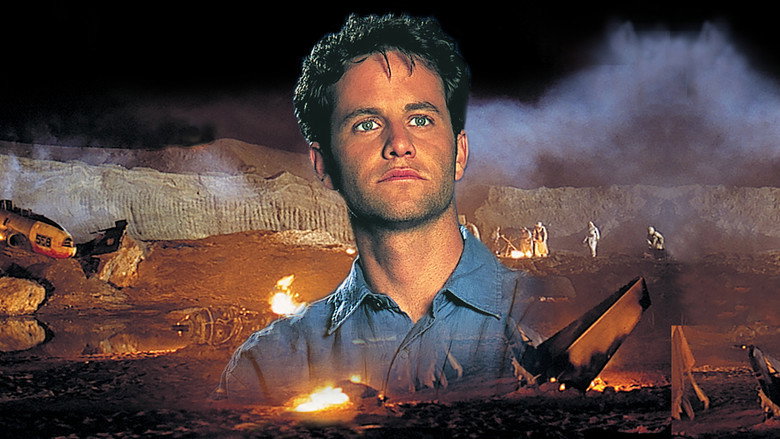
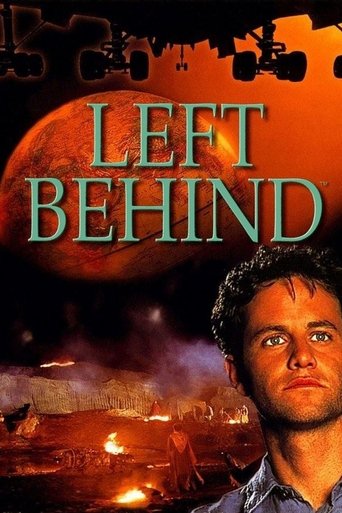
The 2000 film Left Behind dramatises what happens when millions vanish and the small group of people who remain try to understand why.
What the story covers
Based on the overview, Left Behind is a thriller built around a single premise: millions of people around the world — including passengers on a transatlantic jet — suddenly disappear, leaving only their clothes and personal belongings behind. A pilot, a journalist, and others band together to investigate the cause. The film uses their investigation as a frame for telling a story about end-times prophecy from the Christian New Testament.
Because the film's narrative is built on the disappearance of believers before a period of tribulation, it draws most directly on the book of Revelation (chapters 1–22), and especially on John's visions of the risen Christ, the throne room, the cosmic conflict between the Lamb and the dragon, and the final triumph of Christ as King of kings. The film's central mystery — why some people vanished and others did not — is therefore best read as a dramatic framing of themes Revelation presents in apocalyptic vision form.
Where it is in the Bible
- Revelation 1:8God declares Himself 'the Alpha and the Omega, who is and who was and who is to come, the Almighty.' For a film built around the question of who controls history after a sudden disappearance, this is the passage that frames God's sovereignty over beginning and end.
- Revelation 2:10Jesus tells the church at Smyrna, 'Be thou faithful unto death, and I will give thee the crown of life.' This passage sits behind the film's interest in what remains — and what faithfulness looks like — after the disappearances.
- Revelation 5:5-6John sees 'a Lamb standing, as though it had been slain' who is 'the Lion of the tribe of Judah.' This is a key image for the film's theology: the one who conquers does so through sacrifice, not through force.
- Revelation 12:10-11Heaven declares, 'they overcame him because of the blood of the Lamb, and because of the word of their testimony.' This passage gives the film's central conflict its theological vocabulary: victory comes through testimony and sacrifice, not self-preservation.
- Revelation 19:11-14John sees heaven opened and 'he that sat thereon called Faithful and True,' followed by armies in white linen. For viewers comparing the film to Revelation, this is the climactic vision the film's missing-and-remaining question ultimately points toward.
How it differs from the Bible
The overview does not give specific scene-by-scene departures from scripture, so it is hard to pin down precise differences. What is clear is that Left Behind takes a single theme from Revelation — the hope of believers being spared before coming judgment — and turns it into a contemporary thriller. Where Revelation unfolds as a sequence of visions with angels, trumpets, bowls, and symbolic beasts, the film uses an investigative plot to ask the same underlying question: who is faithful, and what happens to those who remain.
For a viewer comparing the film to the Bible, the most useful passages to keep open are Revelation 1:8 (God as the Alpha and Omega), Revelation 2:10 (a call to faithfulness under tribulation), and Revelation 12:10–11 (the casting down of the accuser and victory through the blood of the Lamb). The film compresses what Revelation spreads across visions of heaven, earth, and a coming battle into one disappearance event; viewers may want to notice where the script leans on imagery (a Lamb who has been slain, a rider called Faithful and True) rather than reproducing John's visions directly.
Discussion questions
- 1
Is Left Behind (2000) based on the book of Revelation?
The overview ties the film's vanishing premise to Revelation (chapters 1–22). Passages like Revelation 1:8 and Revelation 2:10 show that Revelation frames history by God's sovereignty and by a call to faithfulness — the same questions the film's survivors are asking.
- 2
Where does the idea of a 'rapture' — believers being taken — come from?
The provided scripture anchors include passages about the faithful overcoming (Revelation 12:10-11) and about Christ as King of kings (Revelation 17:14). The 'rapture' concept itself is not in these verses verbatim, but Revelation's contrast between those who are sealed and those who are not, and its call to be 'faithful unto death' (Revelation 2:10), forms the theological ground the film dramatises.
- 3
What should I look for in the film that connects to scripture?
Watch for moments where characters talk about who disappeared and why. Compare those explanations with Revelation 19:11-14, where the rider is called 'Faithful and True,' and Revelation 5:5-6, where the conquering figure is a slain Lamb. The film is most useful as a prompt for comparing modern dramatic framing with John's original visions.
Where to watch
Availability is for Canada and changes over time — check the platform before watching. TMDb ↗
Reflections on Revelation
After watching, read the passage itself — you will find details no film has time to show.