Acts 27:4
「And putting to sea from thence, we sailed under the lee of Cyprus, because the winds were contrary.」
Acts 13:8
「But Elymas the sorcerer (for so is his name by interpretation) withstood them, seeking to turn aside the proconsul from the faith.」
Acts 20:7
「And upon the first day of the week, when we were gathered together to break bread, Paul discoursed with them, intending to depart on the morrow; and prolonged his speech until midnight.」
Acts 4:26
「The kings of the earth set themselves in array, And the rulers were gathered together, Against the Lord, and against his Anointed:」
Acts 17:11
「Now these were more noble than those in Thessalonica, in that they received the word with all readiness of the mind, examining the Scriptures daily, whether these things were so.」
Acts 9:28
「And he was with them going in and going out at Jerusalem,」
At Pentecost, why did the disciples speak in the languages of other nations rather than in their local Aramaic?
Acts 2 records the disciples being filled with the Spirit and speaking in other tongues — what theological significance lies beneath this phenomenon?
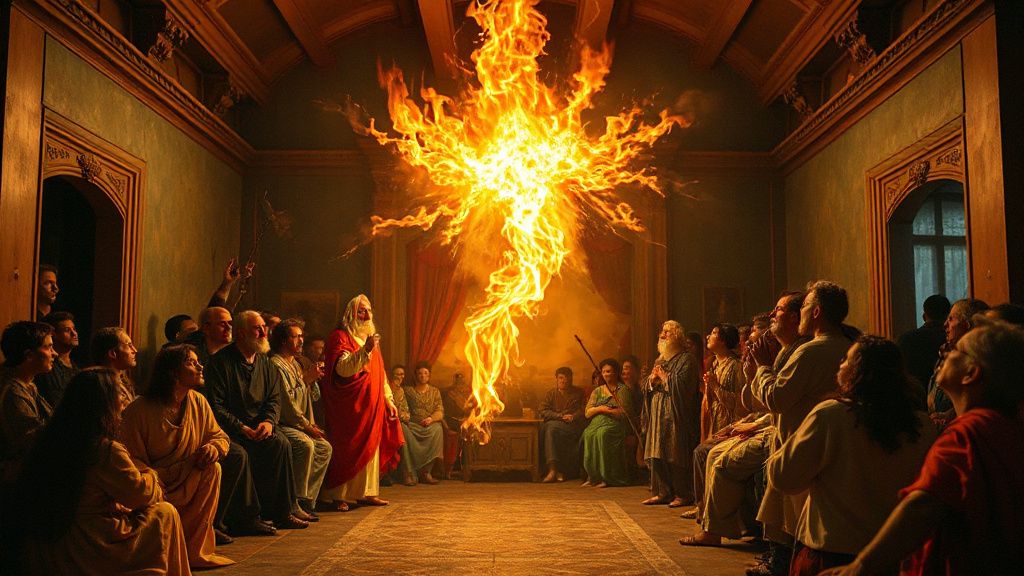
What do the symbols of the Holy Spirit and fire signify in the Pentecost event?
A sound like a mighty wind and tongues like fire appeared as the Spirit filled the disciples, giving them utterance and power.
Why did the Holy Spirit descend on the fiftieth day, exactly ten days after Jesus' ascension?
Jesus told the disciples to wait, and on the day of Pentecost the Spirit came as tongues of fire and they began speaking in other languages.
Why did Peter quote the prophet Joel in his Pentecost sermon?
Peter stood up to explain the signs of the last days, citing Joel to show the Spirit's outpouring in the end times.
What continuity exists between Pentecost and believers' experience today?
Is the Spirit's work in apostolic times continuous with today?
Why does Peter quote the prophecy of Joel in his Pentecost sermon?
Peter cites Joel 2 in Acts 2 — how does this Old Testament prophecy frame the events of the day?