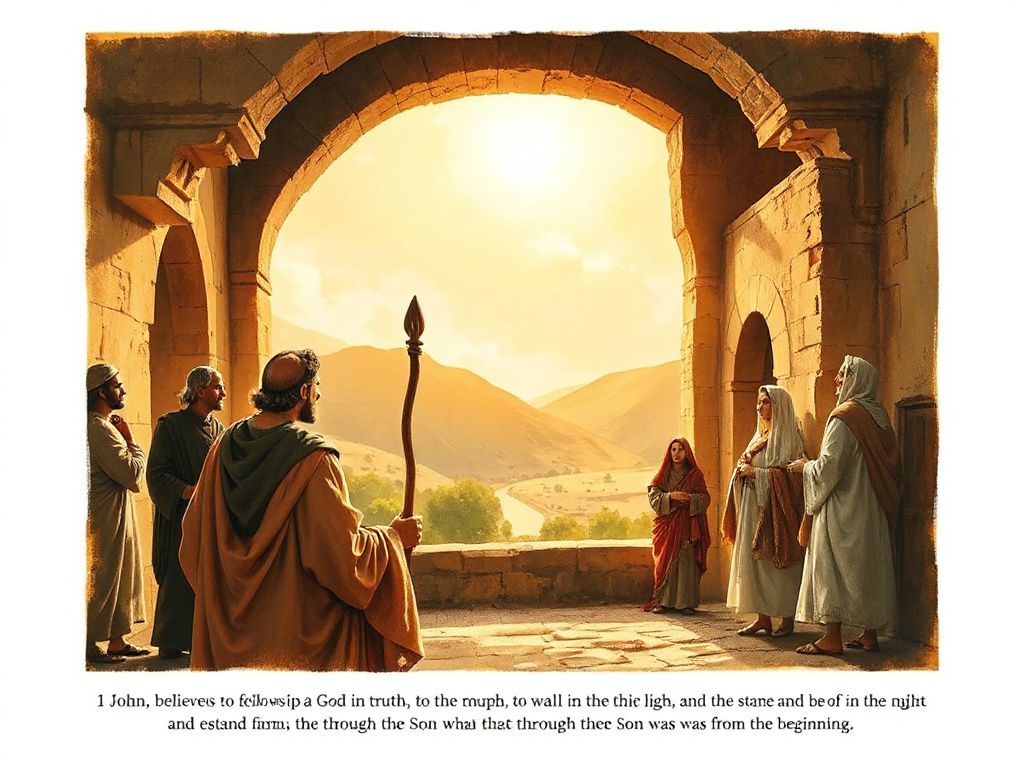
经文研读

1 John 2:3-4 — Knowing God Proven by Obedience

John defines a practical test for knowing God: obedience to His commandments exposes either authentic fellowship or self-deception.

经文

  1. 3.我 們 若 遵 守 他 的 誡 命 , 就 曉 得 是 認 識 他 。And hereby we know that we know him, if we keep his commandments.
  2. 4.人 若 說 我 認 識 他 , 卻 不 遵 守 他 的 誡 命 , 便 是 說 謊 話 的 , 真 理 也 不 在 他 心 裡 了 。He that saith, I know him, and keepeth not his commandments, is a liar, and the truth is not in him;

这段经文的意思

The passage opens with the phrase "and hereby we know that we know him," presenting experiential knowledge of God as something that can be observed and tested rather than merely claimed. The conditional clause "if we keep his commandments" frames obedience as the visible evidence by which one's knowledge of God becomes verifiable to oneself and to others. John is not describing how a person first comes to know God, but how that knowledge is confirmed and made certain.

In verse 4 John issues a sharp indictment: whoever says "I know him" yet does not keep his commandments is a "liar," and "the truth is not in him." The two-fold statement moves from a moral label (liar) to an inward condition (absence of truth). The claim to know God is treated as a verbal profession that must correspond to a life shaped by obedience; where the two diverge, the claim is false and the inner life is described as lacking truth altogether.

The passage functions as a diagnostic for self-assessment. By linking knowledge of God to the concrete act of keeping his commandments, John establishes that true knowledge is not abstract information but relational reality that issues in a particular way of living. The "if" and "is not" constructions leave no neutral middle ground: either the commandments are kept, or the profession of knowing God is exposed as untrue.

背景

Verses 1-2 establish the foundation for the test in 2:3-4: believers have an Advocate with the Father and Christ is the propitiation for sins, so the relationship John addresses is one already grounded in Christ's atoning work. The shift from forgiveness to obedience reflects John's pastoral concern that the reality of that atonement be visible in daily conduct, not merely acknowledged in doctrine.

Verses 5-6 extend the same logic further: keeping God's word is where the love of God is perfected, and abiding in Christ requires walking as Jesus walked. This surrounding context confirms that "his commandments" in 2:3-4 is not a narrow ritual list but a comprehensive pattern of obedience shaped by Christ's example, reinforced by the recurring theme throughout chapter 2 that profession and practice must align.

常见问题

Does keeping commandments mean earning salvation?

The passage does not address how one is saved but how knowledge of God is verified. The preceding verses (2:1-2) ground the relationship in Christ as Advocate and propitiation, so obedience in 2:3-4 functions as evidence of an already-established relationship, not as the basis for earning it.

What does calling someone a "liar" mean here?

It is a strong indictment of self-deception: claiming to know God while living in disobedience contradicts the reality. John pairs the label with the statement that "the truth is not in him," indicating that the person's inner life is out of alignment with the verbal profession.

Which commandments does John have in mind?

The passage itself does not enumerate specific commandments, but the surrounding context (2:5-8) links obedience to keeping God's word and walking as Christ walked. The wider chapter connects obedience to loving fellow believers (2:9-11) and doing the will of God (2:17), suggesting a comprehensive pattern of life shaped by Christ's example rather than a narrow checklist.

继续研读

HomeDiscoverStudyReadMe