经文研读
2 Chronicles 7:14 — Humility, Prayer, and Healing
God promises that a people bearing His name, when they humble themselves, pray, seek His face, and turn from wickedness, will be heard, forgiven, and healed.
经文
- 14.這 稱 為 我 名 下 的 子 民 , 若 是 自 卑 、 禱 告 , 尋 求 我 的 面 , 轉 離 他 們 的 惡 行 , 我 必 從 天 上 垂 聽 , 赦 免 他 們 的 罪 , 醫 治 他 們 的 地 。if my people, who are called by my name, shall humble themselves, and pray, and seek my face, and turn from their wicked ways; then will I hear from heaven, and will forgive their sin, and will heal their land.
这段经文的意思
The verse is structured as a conditional promise: four human actions followed by three divine responses. The people are identified not by ethnicity or location but by the relational name 'called by my name' — belonging to God sets the entire condition. Without that identity, the sequence has no address.
The four actions move inward and outward: 'humble themselves' (an internal disposition), 'pray' (verbal address to God), 'seek my face' (relational pursuit of God's presence), and 'turn from their wicked ways' (concrete behavioral change). The progression links attitude, speech, relationship, and conduct. Repentance in this verse is not a private feeling but a multi-directional turn back to God.
The three divine responses — 'hear,' 'forgive their sin,' and 'heal their land' — address the relational breach (sin) and its communal consequence (a broken land). The movement from heaven to land shows that divine forgiveness is not only individual but restores the shared life of the people.
背景
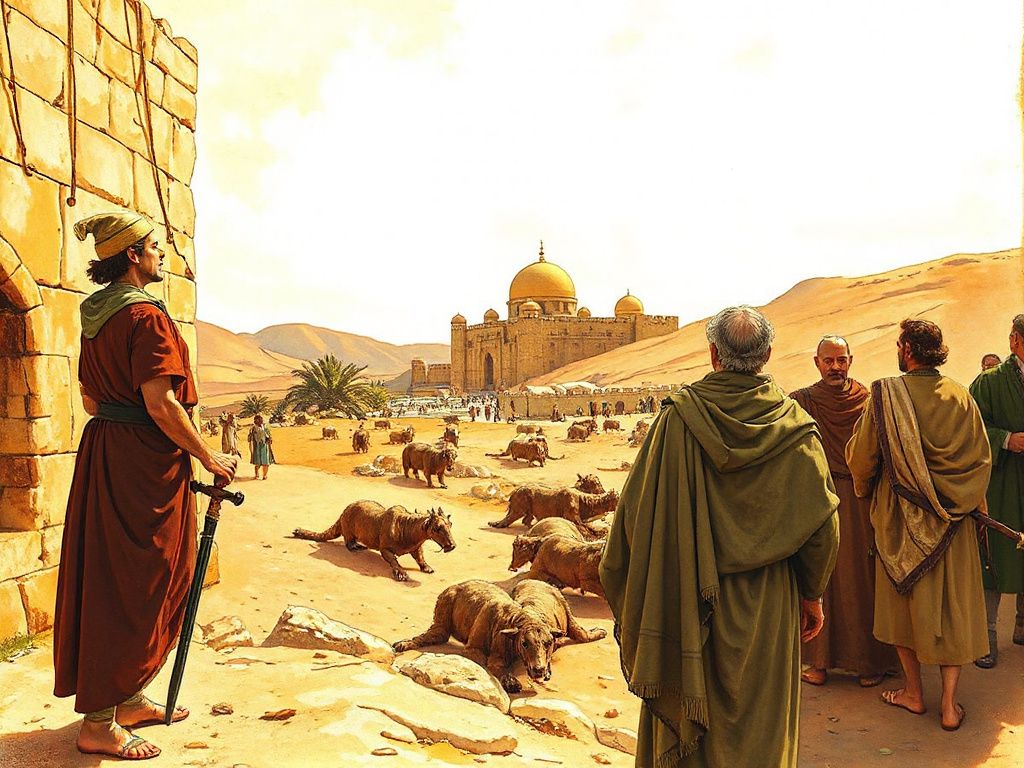
Verse 14 sits inside Solomon's temple-dedication narrative. Chapter 7 opens with fire from heaven consuming the sacrifices and the glory of Jehovah filling the house (7:1–3), followed by Solomon's massive dedication sacrifices and a seven-day feast (7:4–10). The temple is complete, and Jehovah appears to Solomon at night to respond to the dedication prayer (7:11–12).
Verses 13–14 form a unit: God names the judgments that may fall (closed heavens, locusts, pestilence) and then states the condition for deliverance. Verses 15–22 extend the response — God's eyes and ears open to the temple, the dynastic promise to Solomon is reaffirmed (7:17–18), and a warning of exile is given if Israel forsakes God's statutes (7:19–22). Verse 14 is therefore the pivot between promised blessing and threatened judgment.
常见问题
Who are 'my people who are called by my name' in 2 Chronicles 7:14?
In its immediate context the verse addresses Israel, the people whose temple has just been dedicated. The identifying marker is relational: they are the people belonging to God, marked by His name. The verse defines them by that divine ownership, not by geography or bloodline.
What four actions does the verse require, and how do they relate to one another?
The four actions are humbling oneself, praying, seeking God's face, and turning from wicked ways. They progress from internal disposition to verbal address, then to relational pursuit, and finally to concrete behavioral change. Repentance in this verse is the full sequence, not a single step.
What does 'heal their land' mean in this verse?
Within the chapter's setting, where God has just named closed heavens, locusts, and pestilence as possible judgments (7:13), healing the land refers to the reversal of those communal consequences of sin. The phrase ties the people's repentance to the restoration of their shared life, not only to private forgiveness.