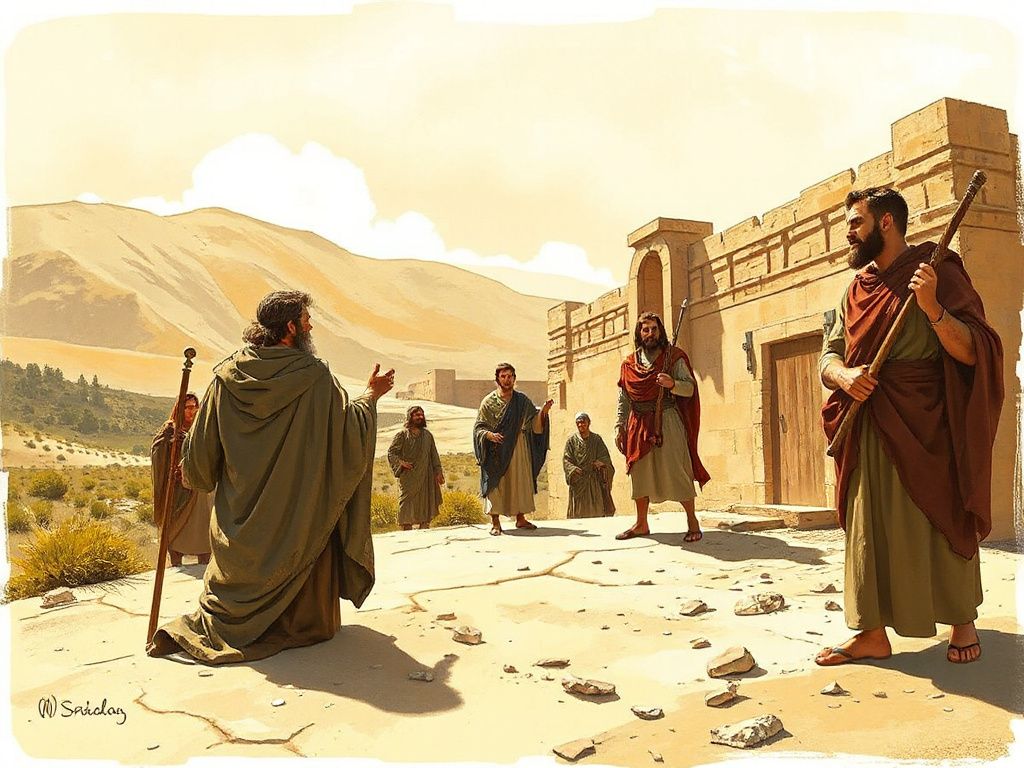
经文研读
Psalms 23:1-4 — Jehovah, My Shepherd
Psalms 23 opens with a personal confession of trust: the Lord is the psalmist's shepherd, who provides rest, restores the soul, guides in righteousness, and comforts with rod and staff through the darkest valley.
经文
- 1.( 大 衛 的 詩 。 ) 耶 和 華 是 我 的 牧 者 , 我 必 不 致 缺 乏 。A Psalm of David. Jehovah is my shepherd; I shall not want.
- 2.他 使 我 躺 臥 在 青 草 地 上 , 領 我 在 可 安 歇 的 水 邊 。He maketh me to lie down in green pastures; He leadeth me beside still waters.
- 3.他 使 我 的 靈 魂 甦 醒 , 為 自 己 的 名 引 導 我 走 義 路 。He restoreth my soul: He guideth me in the paths of righteousness for his name's sake.
- 4.我 雖 然 行 過 死 蔭 的 幽 谷 , 也 不 怕 遭 害 , 因 為 你 與 我 同 在 ; 你 的 杖 , 你 的 竿 , 都 安 慰 我 。Yea, thou I walk through the valley of the shadow of death, I will fear no evil; for thou art with me; Thy rod and thy staff, they comfort me.
这段经文的意思
The passage begins with a deliberate confession of relationship: "Jehovah is my shepherd." In the Hebrew of verse 1, the verb form for "I shall not want" (H2637, ʾeḥsār) is treated by the supplied lexical entry as a Qal-stem expression of lacking; the affirmation is therefore not a claim to material abundance but a declaration that no genuine need goes unmet under the shepherd's care. The shepherd imagery is sustained through the verbs: he makes (H7257, wayarbiṣēni) the sheep lie down, leads (H5095) beside still waters, restores (H7725, yəšôḇēḇ) the soul, and guides (H5148) along righteous tracks.
Verses 2-3 pair nourishment with direction. The "green pastures" (H1877 dešeʾ, fresh grass) and "still waters" (H4496 mənuḥôṯ, resting-places) describe an environment of rest; the verb forms in the supplied English ("maketh," "leadeth," "restoreth," "guideth") carry an ongoing, present-imperfect sense rather than a single past action, so the verbs picture habitual shepherdly care. The purpose clause in verse 3, "for his name's sake," gives the ultimate reason for the guiding: the shepherd acts to uphold the honor of his own name (H8034 šēm).
Verse 4 introduces the darkest scene: walking through the valley of the shadow of death (H6757 ṣalmāweṯ). The Hebrew word ṣalmāweṯ is a compound of shadow and death, conveying deep darkness; the psalmist, addressing God directly as "thou," responds with "I will fear no evil." The reason given is presence ("thou art with me") rather than the removal of danger, and the comfort comes from the shepherd's two implements, the rod and staff, which in pastoral practice are used to protect and to guide the flock.
背景
Psalms 23 is a single, tightly woven poem of six verses, and vv. 1-4 form its first half. The context_after verses (vv. 5-6) shift the imagery from pasture and path to a banquet table and a lifelong house, suggesting that the same shepherd who provides green pastures also hosts the psalmist before enemies and accompanies him all his days. Within vv. 1-4, the movement is from rest (v. 2) to guidance (v. 3) to danger faced without fear (v. 4), so the passage builds a cumulative picture of a shepherd whose care holds in every setting.
The superscription "A Psalm of David" (H1732 Dāwiḏ) identifies the literary attribution; the Hebrew term mizmôr (H4210) marks the poem as one intended for musical accompaniment. Beyond the supplied material, the reader should note that scholarly discussion of David's authorship and the editorial history of the Psalter is not addressed here.
原文关键词
- H2637 ʾeḥsār (חָסֵר) is the supplied gloss for "want" in verse 1; the lexical entry defines the root as expressing lack or failure. The confession "I shall not want" therefore rests on this idea of genuine lack being met, not on material abundance.
- H6757 ṣalmāweṯ (צַלְמָוֶת), "shadow of death," is a compound noun in verse 4 that combines the idea of shadow with death; the supplied definition points to the grave or to calamity as figurative senses, conveying deep, life-threatening darkness.
- H5148 nāḥāh (נָחָה), "to guide," is the supplied gloss for the verb rendered "guideth" in verse 3; the lexical entry describes it as guiding or transporting, fitting the shepherd imagery of directing the flock along the right paths.
相关经文
- John 10:11 Jesus identifies himself as the good shepherd who lays down his life for the sheep, supplying a New Testament self-identification that echoes the "Jehovah is my shepherd" confession of verse 1.
- Revelation 7:17 The Lamb upon the throne is described as the shepherd who guides to fountains of waters of life and wipes away tears, extending the shepherd imagery of Ps 23 into the final vision of Scripture.
- Isaiah 40:11 Isaiah portrays the LORD feeding his flock like a shepherd, gathering lambs and gently leading nursing ewes, a prophetic parallel to the pastoral care depicted in vv. 2-3.
常见问题
Does "I shall not want" mean a life without any lack at all?
The Hebrew verb ʾeḥsār (H2637) expresses genuine lack, and the verse follows a confession that the LORD personally is the speaker's shepherd. Within the supplied text, the affirmation is read as a declaration that no true need goes unmet under the shepherd's care, not a claim that the psalmist faces no hardship.
What does "the valley of the shadow of death" refer to?
The Hebrew noun ṣalmāweṯ (H6757) is a compound of shadow and death, and the supplied lexical entry points to the grave or to calamity as figurative senses. In the context of Ps 23, it names the darkest stretch of the path, where the psalmist's confidence rests on the shepherd's presence rather than on the removal of danger.
Why are the rod and staff described as comfort?
In the verse itself, the comfort comes from the shepherd's two implements being present with the psalmist in the darkest valley. Pastoral usage of rod and staff, widely understood in the shepherd tradition referenced by the imagery, points to protection and guidance; the supplied text, however, only explicitly records that these tools "comfort" the speaker.