经文研读
Psalms 23:4-6 — Valley, Table, House
The closing verses of Psalm 23 move from the valley of death's shadow (v.4) to a host who provides abundantly before enemies (v.5), culminating in a life-long跟随 of goodness and lovingkindness within Jehovah's house (v.6).
经文
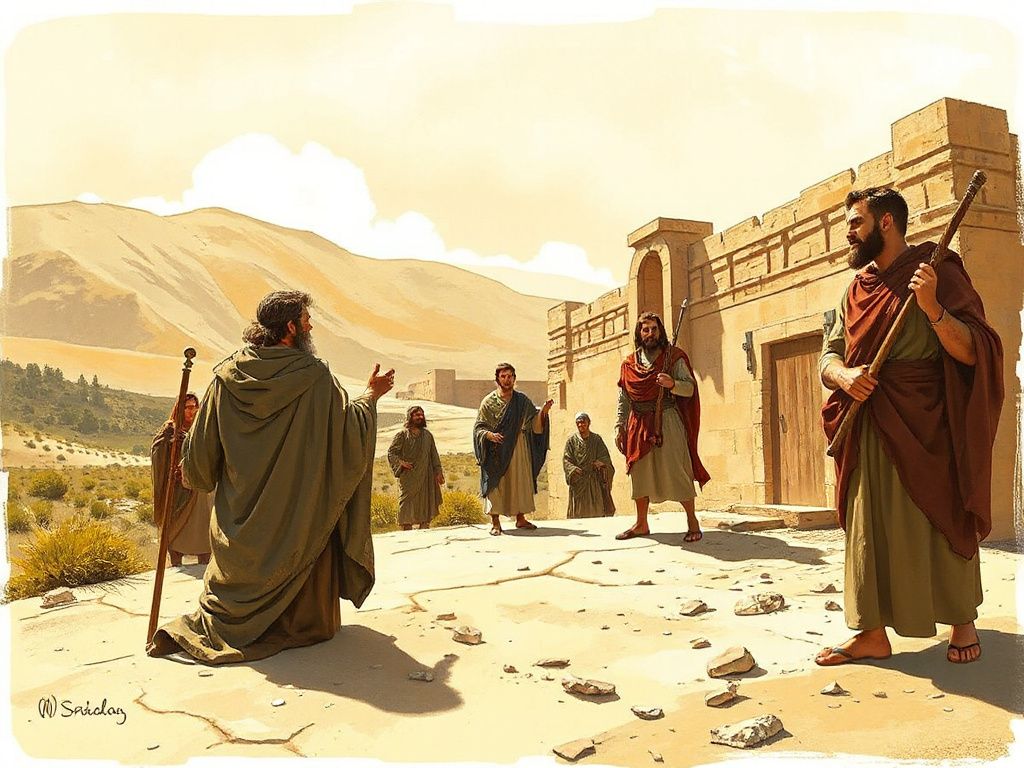
- 4.我 雖 然 行 過 死 蔭 的 幽 谷 , 也 不 怕 遭 害 , 因 為 你 與 我 同 在 ; 你 的 杖 , 你 的 竿 , 都 安 慰 我 。Yea, thou I walk through the valley of the shadow of death, I will fear no evil; for thou art with me; Thy rod and thy staff, they comfort me.
- 5.在 我 敵 人 面 前 , 你 為 我 擺 設 筵 席 ; 你 用 油 膏 了 我 的 頭 , 使 我 的 福 杯 滿 溢 。Thou preparest a table before me in the presence of mine enemies: Thou hast anointed my head with oil; My cup runneth over.
- 6.我 一 生 一 世 必 有 恩 惠 慈 愛 隨 著 我 ; 我 且 要 住 在 耶 和 華 的 殿 中 , 直 到 永 遠 。Surely goodness and lovingkindness shall follow me all the days of my life; And I shall dwell in the house of Jehovah for ever.
这段经文的意思
Verse 4 names the hardest setting the psalmist can imagine — a valley so dark it casts the shadow of death — yet the reason given for fearlessness is not the absence of danger but divine presence: 'for thou art with me.' The shepherd's two implements are then named: the rod (Hebrew H7626), a short club used for defense and counting the flock, and the staff (H4938), a longer support for walking and pulling sheep from danger. Together they 'comfort,' a word that in Hebrew (H5162, nacham) means more than soothing — it conveys a deep sigh of relief, the consolation that comes after dread.
Verse 5 shifts the image from shepherd-and-flock to host-and-guest. The same God who walked through the valley now 'prepares a table' (Hebrew H7979, shulchan) in the sight of those who oppose the psalmist. The anointing with oil and the overflowing cup (H3563/H7310) picture honor bestowed upon a guest and abundance that exceeds the cup itself. The enemies are not removed; they are made spectators of the psalmist's provision.
Verse 6 closes the psalm with an emphatic 'surely' (Hebrew H0389, ak) and pairs two divine attributes — 'goodness' (H2896, tob) and 'lovingkindness' (chesed) — that 'follow' the psalmist. 'Follow' here reads as pursuit: these qualities chase the believer through every day. The destination is 'the house of Jehovah' for ever, where the psalm began in pastoral intimacy and ends in permanent residence.
背景
Psalm 23 is a single Hebrew poem attributed to David. Verses 1-3 establish the shepherd metaphor — green pastures, still waters, restored soul, righteous paths. Verses 4-6 then push the imagery further: the psalmist first walks a valley so dark it resembles death, then sits as a guest at a table under hostile eyes, then settles into a permanent home. The progression moves from outdoor danger to indoor hospitality to eternal dwelling.
The pairing of 'goodness and lovingkindness' in verse 6 echoes earlier Old Testament descriptions of God's self-revealed character (e.g. Exodus 34:6, though not cited here). Jewish and Christian readers alike have read verse 6 as a confession of ongoing divine pursuit rather than a one-time blessing, and as a longing for the temple courts that anticipates the later theological theme of dwelling with God.
原文关键词
- H6757 tsalmaweth — 'shadow of death.' The noun is built on tsel (shadow) and maweth (death). It denotes the deepest darkness, often linked with Sheol or any calamity so severe it resembles death.
- H5162 nacham — 'comfort.' The root suggests a sigh or strong breath, hence the relief that follows dread. In Psalm 23:4 the comfort comes through the shepherd's tools, not through words.
- H0389 ak — 'surely.' An emphatic particle that opens the climactic verse 6, signalling a confession rather than a wish.
相关经文
- Isaiah 41:10 Echoes the psalm's 'I will fear no evil' with God's own 'Fear thou not… for I am with thee,' applying the shepherd's presence to Israel in exile.
- Psalms 27:4 Pairs with verse 6: the same psalmist who asks to 'dwell in the house of Jehovah all the days of my life' here locates that longing in beholding God's beauty and inquiring in his temple.
- Isaiah 43:2 Mirrors the valley imagery: just as the psalmist walks the valley of death's shadow unafraid, Isaiah's Israel passes through waters and fire without being overwhelmed because God is with them.
常见问题
Why is the valley called 'the shadow of death' if the psalmist doesn't die there?
The Hebrew tsalmaweth denotes the deepest possible darkness, not necessarily a literal passage into death. The psalmist walks through the threat, and the shepherd's presence makes the shadow bearable.
Who are the 'enemies' in verse 5?
The psalm does not name them. 'Enemies' (Hebrew tsarar) likely refers to anyone opposing the psalmist — military foes, accusers, or hostile circumstances — whose presence is acknowledged but whose threat is overridden by the host's provision.
Does 'dwell in the house of Jehovah for ever' mean a physical temple?
The Hebrew likely refers both to the Jerusalem temple (a real place where the faithful gathered) and to ongoing communion with God. Jewish and Christian interpreters have read it variously as literal temple worship, as the believer's lifelong devotion, and as the eschatological hope of dwelling with God — scholars differ on which reading carries the most weight.