ERA
Conquest and Judges
1400 BC
Receiving the promise: Joshua 1:9; faith and return: Ruth 1:16
Key Passages
Filter by Place
Joshua
Joshua
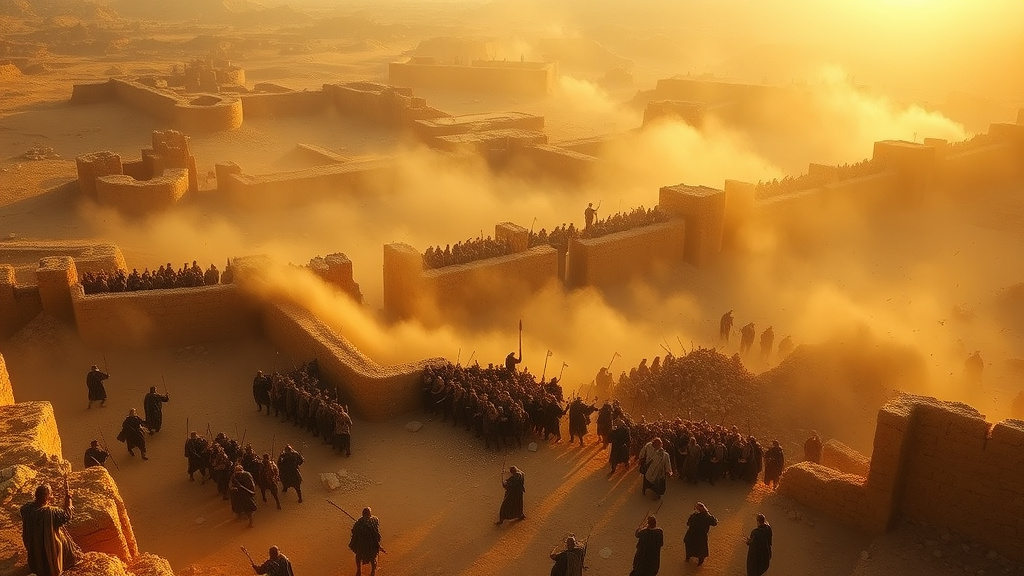
The Conquest of Canaan
Joshua 22:16
judaism「“Thus said all of GOD’s community: What is this treachery that you have committed this day against the God of Israel, turning away from GOD, building yourselves an altar and rebelling this day against GOD!」
Choosing New Gods
allDeborah's song identifies Israel's decline as rooted in 'choosing new gods'—a covenant breach that explains the loss of military capacity and divine protection.
How did Joshua's allotment of the twelve tribes foreshadow the later division of the kingdom?
Tribal tensions in Joshua—geographic and identity fissures that foreshadowed future division.
Joshua 8:17
judaism「Not a man was left in Ai or in Bethel who did not go out after Israel; they left the city open while they pursued Israel.」
Divine warfare
allGod Himself fights for Israel, defeating enemies and displaying His sovereignty and saving power.
Were there already seeds of north-south division in the Joshua period?
Tracing tribal tensions back to the book of Joshua.
Ruth 3:2
protestant「And now is not Boaz our kinsman, with whose maidens thou wast? Behold, he winnoweth barley to-night in the threshing-floor.」
burn chariots
allJoshua's divinely commanded act of disabling enemy cavalry and destroying chariots, symbolizing Israel's reliance on God's power alone, not on military technology.
Were there already seeds of division among the tribes in Joshua's time?
From Joshua's farewell charge, look back at tensions within the tribal confederation.
Judges 7:1
judaism「Early next day, Jerubbaal—that is, Gideon—and all the troops with him encamped above En-harod, while the camp of Midian was in the plain to the north of him, at Gibeath-moreh.」
God's Anger/Wrath
allHebrew literally 'nostril,' metaphorically divine wrath. God's anger at Israel's sin shows the holy God's righteous response to unholiness within His covenant people.
Before the kingdom split, what seeds of division were already sown in the Joshua era?
Joshua's closing record of unconquered lands and intermingled peoples foreshadowed the coming split.
Joshua 13:16
judaism「and it became theirs: The territory from Aroer, on the edge of the Wadi Arnon and the town in the middle of the wadi, up to Medeba—the entire Tableland—」
Forced Labor
allCompulsory labor imposed upon the remaining Canaanites, reflecting Israel's partial obedience and the theological tension of incomplete conquest.
How did Joshua's allotment of the twelve tribes foreshadow the later division of the kingdom?
Tribal tensions in Joshua—geographic and identity fissures that foreshadowed future division.
Joshua 3:7
judaism「GOD said to Joshua, “This day, for the first time, I will exalt you in the sight of all Israel, so that they shall know that I will be with you as I was with Moses.」
Ephod
allOriginally a sacred priestly garment or oracle-device used to inquire of God's will. Here Micah privately made one for divination, deviating from its holy purpose and reflecting religious disorder.
Before the kingdom split, what seeds of division were already sown in the Joshua era?
Joshua's closing record of unconquered lands and intermingled peoples foreshadowed the coming split.
Joshua 8:8
protestant「And it shall be, when ye have seized upon the city, that ye shall set the city on fire; according to the word of Jehovah shall ye do: see, I have commanded you.」
Levite
allA member of the tribe of Levi set apart for sanctuary service. This Levite wandered as a sojourner and was hired as a private priest, foreshadowing the corruption of priestly office.
Were there already seeds of north-south division in the Joshua period?
Tracing tribal tensions back to the book of Joshua.
Judges 14:12
judaism「Then Samson said to them, “Let me propound a riddle to you. If you can give me the right answer during the seven days of the feast, I shall give you thirty linen tunics and thirty sets of clothing;」
Rahab
allA Jericho prostitute who by faith hid the spies, becoming an example of Gentile inclusion in God's plan.
Were there already seeds of division among the tribes in Joshua's time?
From Joshua's farewell charge, look back at tensions within the tribal confederation.
Joshua 11:8
judaism「GOD delivered them into the hands of Israel, and they defeated them and pursued them all the way to Great Sidon and Misrephoth-maim, and all the way to the Valley of Mizpeh on the east; they crushed them, letting none escape.」
Gilgal
allIsrael's first encampment west of the Jordan, meaning 'rolling,' named because God rolled away Egypt's reproach; became a holy base of operations.
Judges 9:1
judaism「Abimelech son of Jerubbaal went to his mother’s brothers in Shechem and spoke to them and to the whole clan of his mother’s family. He said,」
The Great Name of God
allGod's Name represents His presence and glory. Joshua feared that Israel's defeat would dishonor God's name among the nations, showing God's honor outweighs Israel's survival.
Ruth 1:19
protestant「So they two went until they came to Beth-lehem. And it came to pass, when they were come to Beth-lehem, that all the city was moved about them, and the women said, Is this Naomi?」
Ark of the Covenant
allThe sacred chest symbolizing God's presence and covenant, carried by Levitical priests to lead Israel into the Promised Land.
Judges 11:4
judaism「Some time later, the Ammonites went to war against Israel.」
Name
allRepresents identity, reputation, and legacy, perpetuated through offspring in levirate marriage.
Joshua 7:7
judaism「“Ah, my Sovereign GOD!” cried Joshua. “Why did You lead this people across the Jordan only to deliver us into the hands of the Amorites, to be destroyed by them? If only we had been content to remain on the other side of the Jordan!」
Inheritance
allThe land promised by God to Israel as a possession, symbolizing covenant blessing and rest.
Judges 3:5
judaism「The Israelites settled among the Canaanites, Hittites, Amorites, Perizzites, Hivites, and Jebusites;」
Ark of the Covenant
allThe sacred chest containing the tablets of God's covenant, representing His presence, authority, and faithfulness, leading Israel into the Promised Land.
Joshua 17:7
protestant「And the border of Manasseh was from Asher to Michmethath, which is before Shechem; and the border went along to the right hand, unto the inhabitants of En-tappuah.」
Canaanites
allThe indigenous people of Canaan, whose presence tested Israel's obedience and faith in God's commands.
Joshua 13:6
protestant「all the inhabitants of the hill-country from Lebanon unto Misrephoth-maim, even all the Sidonians; them will I drive out from before the children of Israel: only allot thou it unto Israel for an inheritance, as I have commanded thee.」
The ETERNAL
judaismThe four-letter divine name YHWH, paired with 'God of Israel' to emphasize covenant relationship; in Jewish tradition this name is revered and not pronounced casually.
Judges 10:8
protestant「And they vexed and oppressed the children of Israel that year: eighteen years oppressed they all the children of Israel that were beyond the Jordan in the land of the Amorites, which is in Gilead.」
Land
allThe land of Canaan promised by God to Israel, a covenantal inheritance and central symbol of salvation history.
Judges 6:18
protestant「Depart not hence, I pray thee, until I come unto thee, and bring forth my present, and lay it before thee. And he said, I will tarry until thou come again.」
Burnt Offering
allAn offering wholly consumed by fire, symbolizing dedication and atonement. Israel offered it at Bethel to express repentance after the devastating civil war.
Judges 6:3
judaism「After the Israelites had done their sowing, Midian, Amalek, and the Kedemites would come up and raid them;」
Lot
allThe casting of lots to divide the land, signifying divine sovereignty and just distribution as God apportions the Promised Land among the tribes of Israel.
Joshua 18:14
protestant「And the border extended thence, and turned about on the west quarter southward, from the mountain that lieth before Beth-horon southward; and the goings out thereof were at Kiriath-baal (the same is Kiriath-jearim), a city of the children of Judah: this was the west quarter.」
Passover
allThe festival commemorating Israel's redemption from Egypt; celebrated for the first time in the Promised Land at Gilgal, marking a new beginning and God's ongoing salvation.
Joshua 12:2
judaism「King Sihon of the Amorites, who resided in Heshbon and ruled over part of Gilead—from Aroer on the bank of the Wadi Arnon and the wadi proper up to the Wadi Jabbok [and] the border of the Ammonites—」
Commandments
allSpecific divine commands to be kept and observed, the concrete expression of covenant love for God, demanding careful obedience.
Ruth 1:10
judaism「and said to her, “No, we will return with you to your people.”」
High Priest
allIsrael's supreme religious leader whose death marked the manslayer's release from the city of refuge, foreshadowing Christ as the eternal High Priest delivering sinners.
Ruth 4:17
protestant「And the women her neighbors gave it a name, saying, There is a son born to Naomi; and they called his name Obed: he is the father of Jesse, the father of David.」
Mourning
allTearing clothes, strewing dust on heads, and falling facedown are Israelite rituals of grief and penitence, expressing humility and urgent petition before God.
Joshua 21:17
protestant「And out of the tribe of Benjamin, Gibeon with its suburbs, Geba with its suburbs,」
Self-boasting
allGod deliberately reduces Gideon's army to prevent Israel from boasting that their own hand saved them, emphasizing that salvation belongs to God alone.