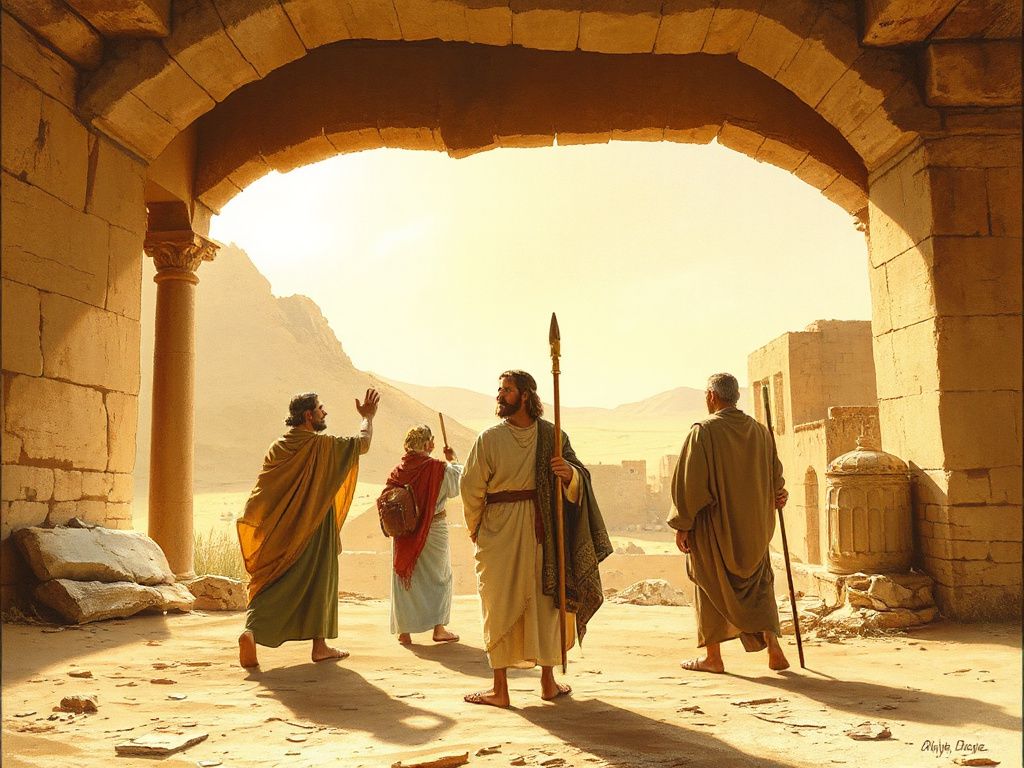
BIBLE CHAPTER STUDY
Exodus 1 — Israel's Growth and Egyptian Oppression
Exodus 1 opens with the roster of Jacob's household that entered Egypt, then traces Israel's dramatic multiplication, a new Pharaoh's fearful enslavement, and the failed attempt to suppress the Hebrews through forced labor and infanticide.
Scripture
1Now these are the names of the sons of Israel, who came into Egypt (every man and his household came with Jacob):
2Reuben, Simeon, Levi, and Judah,
3Issachar, Zebulun, and Benjamin,
4Dan and Naphtali, Gad and Asher.
5And all the souls that came out of the loins of Jacob were seventy souls: and Joseph was in Egypt already.
6And Joseph died, and all his brethren, and all that generation.
7And the children of Israel were fruitful, and increased abundantly, and multiplied, and waxed exceeding mighty; and the land was filled with them.
8Now there arose a new king over Egypt, who knew not Joseph.
9And he said unto his people, Behold, the people of the children of Israel are more and mightier than we:
10come, let us deal wisely with them, lest they multiply, and it come to pass, that, when there falleth out any war, they also join themselves unto our enemies, and fight against us, and get them up out of the land.
11Therefore they did set over them taskmasters to afflict them with their burdens. And they built for Pharaoh store-cities, Pithom and Raamses.
12But the more they afflicted them, the more they multiplied and the more they spread abroad. And they were grieved because of the children of Israel.
13And the Egyptians made the children of Israel to serve with rigor:
14and they made their lives bitter with hard service, in mortar and in brick, and in all manner of service in the field, all their service, wherein they made them serve with rigor.
15And the king of Egypt spake to the Hebrew midwives, of whom the name of the one was Shiphrah, and the name of the other Puah:
16and he said, When ye do the office of a midwife to the Hebrew women, and see them upon the birth-stool; if it be a son, then ye shall kill him; but if it be a daughter, then she shall live.
17But the midwives feared God, and did not as the king of Egypt commanded them, but saved the men-children alive.
18And the king of Egypt called for the midwives, and said unto them, Why have ye done this thing, and have saved the men-children alive?
19And the midwives said unto Pharaoh, Because the Hebrew women are not as the Egyptian women; for they are lively, and are delivered ere the midwife come unto them.
20And God dealt well with the midwives: and the people multiplied, and waxed very mighty.
21And it came to pass, because the midwives feared God, that he made them households.
22And Pharaoh charged all his people, saying, Every son that is born ye shall cast into the river, and every daughter ye shall save alive.
What this passage means
Exodus 1 functions as a hinge between the patriarchal narratives of Genesis and the redemption account that follows. It opens with a genealogical list — Reuben, Simeon, Levi, Judah, Issachar, Zebulun, Benjamin, Dan, Naphtali, Gad, and Asher (vv. 2–4) — followed by the summary that all those who came out of Jacob's loins were seventy souls, with Joseph already in Egypt (v. 5). This anchors the reader in covenant continuity: the family Abraham was promised has become a people, even while resident in a foreign land.
The central theological claim appears in verse 7: 'the children of Israel were fruitful, and increased abundantly, and multiplied, and waxed exceeding mighty; and the land was filled with them.' The chapter then sets this divine blessing against human hostility. A new king arises 'who knew not Joseph' (v. 8), and the rest of the chapter traces an escalating program of suppression — political intimidation (vv. 9–10), forced labor through taskmasters and the building of store-cities Pithom and Raamses (v. 11), harsher bondage in mortar, brick, and field labor (vv. 13–14), and finally the covert murder of Hebrew newborns through the midwives Shiphrah and Puah (vv. 15–22). Each measure fails: 'the more they afflicted them, the more they multiplied' (v. 12).
Verses 17–21 form the chapter's moral pivot. The midwives 'feared God' and refused Pharaoh's command, saving the male children alive. When confronted, they answered, 'the Hebrew women are not as the Egyptian women; for they are lively, and are delivered ere the midwife come unto them' (v. 19). The text notes twice that 'God dealt well with the midwives' and 'made them households' because they feared God (vv. 20–21). Pharaoh's final decree to cast every Hebrew son into the river (v. 22) closes the chapter on a note of unrestrained tyranny — and sets the stage for the birth of Moses.
Context
Exodus 1 opens the second major division of the Old Testament and links directly to the patriarchal narratives. The chapter begins by restating the genealogy established in Genesis, recalling that Joseph and his generation have died (v. 6), which removes the political protection the family had enjoyed. The land of Egypt — introduced here as the setting where Israel becomes a great people — becomes the place of both growth and oppression.
The chapter's structure moves from list to oppression to resistance. After the genealogy, Pharaoh's fear leads to escalating policies: forced labor (vv. 11–14), covert infanticide through midwives (vv. 15–21), and an overt decree to throw every Hebrew male into the Nile (v. 22). The midwives' fear of God is presented as the decisive moral response within the chapter, standing in contrast to Pharaoh's commands and preparing the reader for the deliverance account that follows in subsequent chapters.
Key words in the original
- H3478 Israel (Hebrew yiśrāʾēl) appears in verse 1 as the covenant name for Jacob's descendants. Here it designates the family group that entered Egypt, which by verse 7 has multiplied into a people 'filling the land.'
- H5315 nep̄eš (H5315), rendered 'souls' in verse 5, literally means 'breathing creatures' or 'living beings.' Counting Israel at seventy nep̄eš emphasizes that the promise to Abraham of descendants as numerous as the stars has already begun to take concrete, countable form.
- H7657 šiḇʿiym (H7657), 'seventy' in verse 5, is the number assigned to Jacob's household entering Egypt. The precise figure is significant in the chapter's framing, marking the size of the incipient nation before its dramatic growth described in verse 7.
Related verses
- Genesis 15:13 God's prophecy to Abram that his seed would be 'sojourners in a land that is not theirs' and 'serve them; and they shall afflict them four hundred years' provides the theological backdrop for Exodus 1. The oppression of Israel in Egypt is not an accident but the fulfillment of a prior divine revelation.
- Acts 7:18 Stephen's speech in Acts 7:18 cites the same turning point described in Exodus 1:8 — 'till there arose another king over Egypt, who knew not Joseph.' This phrase marks the transition from favor to affliction and is treated as a pivotal moment in Israel's history in both testaments.
- Exodus 1:21 The note that God 'made them households' because the midwives feared God is the explicit divine reward for their civil disobedience against Pharaoh. It links the fear of God, refusal of unjust commands, and divine blessing within a single narrative unit.
Common questions
Why does Exodus begin with a genealogy rather than a narrative?
The chapter opens with 'the names of the sons of Israel' (v. 1) to establish continuity with Genesis. The genealogy reminds the reader that the people entering Egypt are the same family promised to Abraham, and the count of seventy souls (v. 5) marks the starting point of the growth that follows.
What does 'a new king who knew not Joseph' (v. 8) signify?
The phrase marks the loss of political favor that Joseph's family had enjoyed. The shift in regime removes the historical memory of how Israel came to Egypt, transforming the Hebrews from protected residents into a perceived threat.
How does the chapter portray the midwives' resistance?
Shiphrah and Puah 'feared God' (v. 17) and refused to kill the Hebrew newborn males. The chapter states explicitly that 'God dealt well with the midwives' (v. 20) and 'made them households' (v. 21) because they feared God. Their civil disobedience is presented as the moral center of the chapter, contrasted with Pharaoh's escalating decrees.