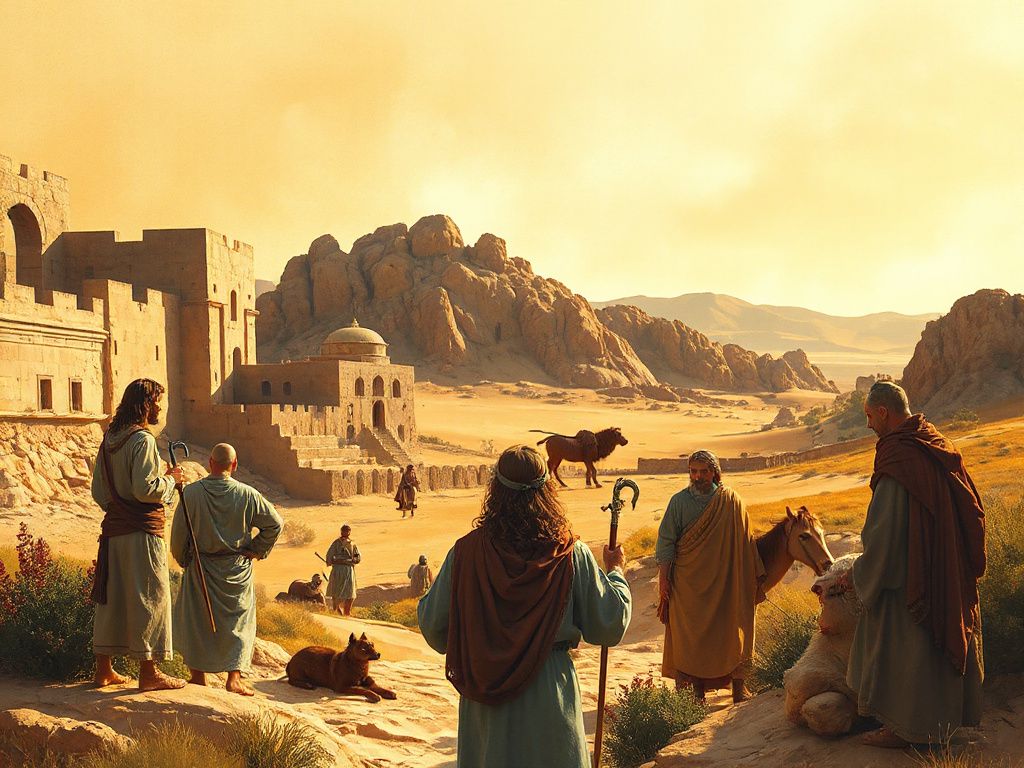
BIBLE CHAPTER STUDY
Genesis 18 — Theophany, Promise, and Intercession
Jehovah appears to Abraham at the oaks of Mamre, promises a son to Sarah, and then reveals His plan to judge Sodom, prompting Abraham to intercede for its righteous inhabitants.
Scripture
1And Jehovah appeared unto him by the oaks of Mamre, as he sat in the tent door in the heat of the day;
2and he lifted up his eyes and looked, and, lo, three men stood over against him: and when he saw them, he ran to meet them from the tent door, and bowed himself to the earth,
3and said, My lord, if now I have found favor in thy sight, pass not away, I pray thee, from thy servant:
4let now a little water be fetched, and wash your feet, and rest yourselves under the tree:
5and I will fetch a morsel of bread, and strengthen ye your heart; after that ye shall pass on: forasmuch as ye are come to your servant. And they said, So do, as thou hast said.
6And Abraham hastened into the tent unto Sarah, and said, Make ready quickly three measures of fine meal, knead it, and make cakes.
7And Abraham ran unto the herd, and fetched a calf tender and good, and gave it unto the servant; and he hasted to dress it.
8And he took butter, and milk, and the calf which he had dressed, and set it before them; and he stood by them under the tree, and they did eat.
9And they said unto him, Where is Sarah thy wife? And he said, Behold, in the tent.
10And he said, I will certainly return unto thee when the season cometh round; and, lo, Sarah thy wife shall have a son. And Sarah heard in the tent door, which was behind him.
11Now Abraham and Sarah were old, and well stricken in age; it had ceased to be with Sarah after the manner of women.
12And Sarah laughed within herself, saying, After I am waxed old shall I have pleasure, my lord being old also?
13And Jehovah said unto Abraham, Wherefore did Sarah laugh, saying, Shall I of a surety bear a child, who am old?
14Is anything too hard for Jehovah? At the set time I will return unto thee, when the season cometh round, and Sarah shall have a son.
15Then Sarah denied, saying, I laughed not; for she was afraid. And he said, Nay; but thou didst laugh.
16And the men rose up from thence, and looked toward Sodom: and Abraham went with them to bring them on the way.
17And Jehovah said, Shall I hide from Abraham that which I do;
18seeing that Abraham shall surely become a great and mighty nation, and all the nations of the earth shall be blessed in him?
19For I have known him, to the end that he may command his children and his household after him, that they may keep the way of Jehovah, to do righteousness and justice; to the end that Jehovah may bring upon Abraham that which he hath spoken of him.
20And Jehovah said, Because the cry of Sodom and Gomorrah is great, and because their sin is very grievous;
21I will go down now, and see whether they have done altogether according to the cry of it, which is come unto me; and if not, I will know.
22And the men turned from thence, and went toward Sodom: but Abraham stood yet before Jehovah.
23And Abraham drew near, and said, Wilt thou consume the righteous with the wicked?
24Peradventure there are fifty righteous within the city: wilt thou consume and not spare the place for the fifty righteous that are therein?
25That be far from thee to do after this manner, to slay the righteous with the wicked, that so the righteous should be as the wicked; that be far from thee: shall not the Judge of all the earth do right?
26And Jehovah said, If I find in Sodom fifty righteous within the city, then I will spare all the place for their sake.
27And Abraham answered and said, Behold now, I have taken upon me to speak unto the Lord, who am but dust and ashes:
28peradventure there shall lack five of the fifty righteous: wilt thou destroy all the city for lack of five? And he said, I will not destroy it, if I find there forty and five.
29And he spake unto him yet again, and said, Peradventure there shall be forty found there. And he said, I will not do it for the forty's sake.
30And he said, Oh let not the Lord be angry, and I will speak: peradventure there shall thirty be found there. And he said, I will not do it, if I find thirty there.
31And he said, Behold now, I have taken upon me to speak unto the Lord: peradventure there shall be twenty found there. And he said, I will not destroy it for the twenty's sake.
32And he said, Oh let not the Lord be angry, and I will speak yet but this once: peradventure ten shall be found there. And he said, I will not destroy it for the ten's sake.
33And Jehovah went his way, as soon as he had left off communing with Abraham: and Abraham returned unto his place.
What this passage means
Genesis 18 is structured around two connected divine actions. First, Jehovah appears to Abraham in human form by the oaks of Mamre, accepts hospitality, and announces that Sarah will bear a son at the next appointed time (vv. 1-15). Second, after the visitors look toward Sodom, Jehovah discloses His intention to investigate the city's outcry and asks whether He should hide this from Abraham, the man through whom all nations will be blessed (vv. 16-22).
The chapter's central question is found in verse 14: 'Is anything too hard for Jehovah?' This question is posed in the context of Sarah's aged body and her secret laugh, framing the promised birth of Isaac as a test of divine power rather than human capacity. Sarah's denial and the visitor's response — 'Nay; but thou didst laugh' — underline that nothing is hidden from the speaker, who is identified with Jehovah throughout the chapter.
In the second half, Abraham approaches Jehovah with a model of covenantal intercession, negotiating the threshold of righteous inhabitants downward from fifty to ten (vv. 23-33). His argument rests on the justice of the Judge of all the earth and the principle that the righteous should not perish with the wicked. The chapter closes with Jehovah departing and Abraham returning to his place, leaving the negotiation resolved at ten.
Context
Genesis 18 sits within the Abraham cycle and follows directly on God's covenant ratification in Genesis 15 and the birth of Ishmael in Genesis 16. The visit occurs at Mamre, where Abraham has settled as an ally of the Amorite Mamre (cf. Genesis 14:13), and the chapter concludes with the visitors heading toward Sodom, the city whose judgment will be carried out in Genesis 19. The text itself does not identify the three visitors beyond calling them 'three men,' yet the speech of one of them is attributed to Jehovah, and Abraham addresses him as 'Lord.'
The chapter is composed of two intertwined scenes: a hospitality scene in which the promise of Isaac is renewed, and a judicial scene in which Abraham learns of the outcry against Sodom and Gomorrah and bargains for mercy. The transition between the two is marked by the visitors 'looking toward Sodom' (v. 16) and Jehovah's self-disclosure that He will 'go down now, and see' (v. 21). The chapter ends with Abraham's unanswered final petition at ten righteous, since not even ten are found in the next chapter.
Key words in the original
- H7200 The verb rendered 'appeared' and 'saw' in verses 1-2 is the Hebrew רָאָה (rāʾāh), 'to see.' In verse 1 it is used of Jehovah's self-disclosure to Abraham — 'Jehovah appeared' — while in verse 2 the same verb describes Abraham lifting his eyes and seeing three men. The dual usage shows how a single Hebrew root bridges the divine appearance and the human perception that receives it.
- H7323 The verb רוּץ (rûṣ), rendered 'ran' in verse 2, describes Abraham's urgent movement to meet the visitors from the tent entrance. The same root is used in verse 7 for his running to the herd to fetch a calf, painting a picture of eager, energetic hospitality rather than ceremonial reluctance.
- H3068 The divine name יְהוָה (YHWH), rendered 'Jehovah' and 'LORD' throughout the chapter, identifies the covenant God of Abraham. Within Genesis 18 the name is applied to the speaker whose words are quoted, while the visitors are also called 'men' (אֲנָשִׁים). The Hebrew text itself does not resolve the question of how one visitor speaks for Jehovah; the chapter simply alternates between calling the speaker Jehovah and grouping him with the men.
Related verses
- Luke 1:37 Luke 1:37 — 'For no word from God shall be void of power' — echoes Genesis 18:14, where Jehovah asks, 'Is anything too hard for Jehovah?' Both passages frame divine speech as efficacious: the announcement that Sarah will bear a son, like the announcement to Mary, is presented as a word that cannot return empty.
- Romans 4:21 Romans 4:21 — 'being fully assured that what he had promised, he was able also to perform' — corresponds to Abraham's posture in Genesis 18. After Sarah laughs and Jehovah asks the rhetorical question about His power, Abraham does not argue further but receives the promise, modeling the assurance that Paul describes in the citation of Genesis 15:6.
- Job 42:2 Job 42:2 — 'I know that thou canst do all things, And that no purpose of thine can be restrained' — is a retrospective confession that matches the question of Genesis 18:14. Job's earlier struggles (Job 9-10) questioned God's justice in a way structurally similar to Abraham's intercession for Sodom, where the issue is whether divine power and divine justice can cohere.
Common questions
Who are the three men who visit Abraham in Genesis 18?
The text itself calls them 'three men' and then identifies the one who speaks as Jehovah. The chapter does not resolve how the three visitors relate to Jehovah, and the provided material does not support further identification beyond what the text states.
Why does Sarah laugh, and why is her laugh significant?
According to verse 11, both Abraham and Sarah are old, and Sarah's body has ceased the manner of women. Her laugh in verse 12 is an internal response to the announcement that she will bear a son, and it sets up the question in verse 14: 'Is anything too hard for Jehovah?'
What is the purpose of Abraham's negotiation with Jehovah in verses 23-32?
Abraham asks whether Jehovah will spare Sodom for the sake of the righteous within it, beginning at fifty and bargaining down to ten. His stated principle is that the Judge of all the earth should do right and should not slay the righteous with the wicked. The negotiation ends with Jehovah agreeing to spare the city if ten righteous are found.