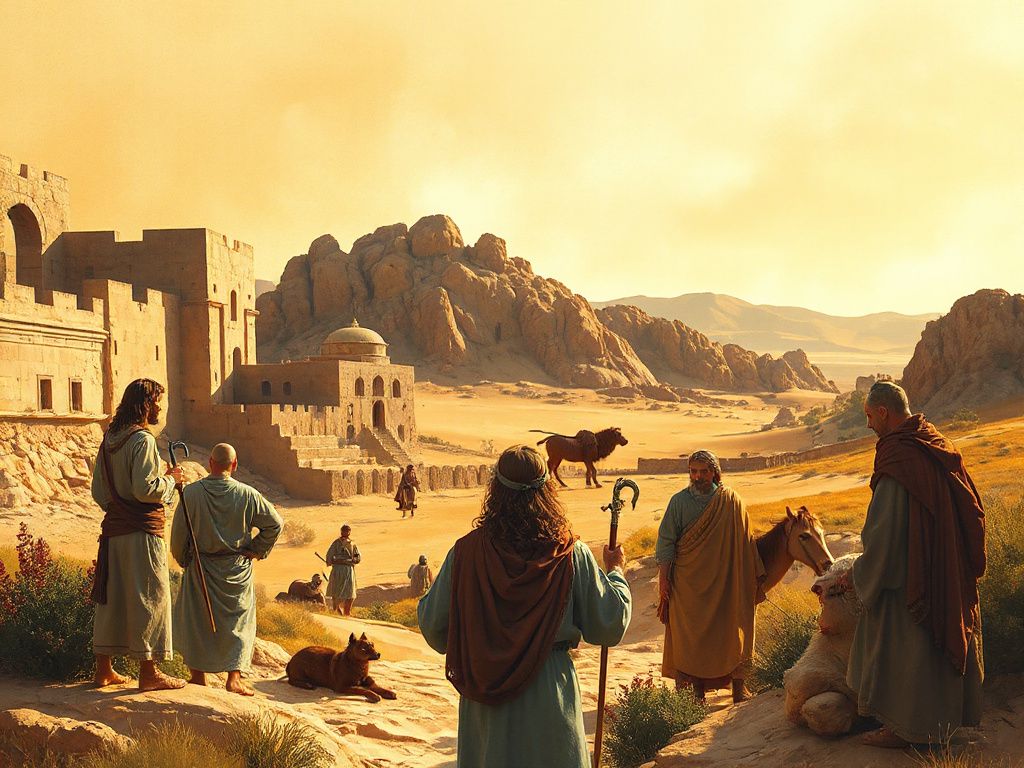
BIBLE CHAPTER STUDY
Genesis 23 — Sarah's Death and the Purchase of Machpelah
Sarah dies at age 127 in Hebron; Abraham negotiates with the Hittites and purchases the cave of Machpelah from Ephron for 400 shekels of silver as a permanent family burial plot.
Scripture
1And the life of Sarah was a hundred and seven and twenty years: these were the years of the life of Sarah.
2And Sarah died in Kiriath-arba (the same is Hebron), in the land of Canaan: and Abraham came to mourn for Sarah, and to weep for her.
3And Abraham rose up from before his dead, and spake unto the children of Heth, saying,
4I am a stranger and a sojourner with you: give me a possession of a burying-place with you, that I may bury my dead out of my sight.
5And the children of Heth answered Abraham, saying unto him,
6Hear us, my lord; thou art a prince of God among us: in the choice of our sepulchres bury thy dead; none of us shall withhold from thee his sepulchre, but that thou mayest bury thy dead.
7And Abraham rose up, and bowed himself to the people of the land, even to the children of Heth.
8And he communed with them, saying, If it be your mind that I should bury my dead out of my sight, hear me, and entreat for me to Ephron the son of Zohar,
9that he may give me the cave of Machpelah, which he hath, which is in the end of his field; for the full price let him give it to me in the midst of you for a possession of a burying-place.
10Now Ephron was sitting in the midst of the children of Heth: and Ephron the Hittite answered Abraham in the audience of the children of Heth, even of all that went in at the gate of his city, saying,
11Nay, my lord, hear me: the field give I thee, and the cave that is therein, I give it thee; in the presence of the children of my people give I it thee: bury thy dead.
12And Abraham bowed himself down before the people of the land.
13And he spake unto Ephron in the audience of the people of the land, saying, But if thou wilt, I pray thee, hear me: I will give the price of the field; take it of me, and I will bury my dead there.
14And Ephron answered Abraham, saying unto him,
15My lord, hearken unto me: a piece of land worth four hundred shekels of silver, what is that betwixt me and thee? bury therefore thy dead.
16And Abraham hearkened unto Ephron; and Abraham weighed to Ephron the silver which he had named in the audience of the children of Heth, four hundred shekels of silver, current money with the merchant.
17So the field of Ephron, which was in Machpelah, which was before Mamre, the field, and the cave which was therein, and all the trees that were in the field, that were in all the border thereof round about, were made sure
18unto Abraham for a possession in the presence of the children of Heth, before all that went in at the gate of his city.
19And after this, Abraham buried Sarah his wife in the cave of the field of Machpelah before Mamre (the same is Hebron), in the land of Canaan.
20And the field, and the cave that is therein, were made sure unto Abraham for a possession of a burying-place by the children of Heth.
What this passage means
The chapter opens with a formal lifespan notice — 'the life of Sarah was a hundred and seven and twenty years' — that frames her death within a measured, covenantal accounting of time. The repetition 'these were the years of the life of Sarah' gives the notice a deliberate, almost epitaph-like weight, treating Sarah's age as a complete unit before the narrative turns to her burial.
Abraham's self-description in verse 4 — 'I am a stranger and a sojourner with you: give me a possession of a burying-place with you' — is the theological heart of the episode. Despite the covenant promise of land, Abraham owns no ground in Canaan and must negotiate as an outsider. The request is modest (a single tomb), but it is also a legal claim: he wants title transferred 'in the midst of you,' meaning a public, witnessed transaction, not a temporary loan.
The Ephron negotiation in verses 7–16 is a careful choreography of ancient Near Eastern bargaining. Ephron's generous offer ('the field give I thee, and the cave that is therein, I give it thee') is a politeness that masks the real price — 'four hundred shekels of silver.' Abraham refuses the gift and insists on paying, preserving the integrity of his purchase. The transaction is witnessed 'in the audience of the children of Heth, even of all that went in at the gate of his city,' and the deed is then sealed so that the field, the cave, and all the trees within its border pass to Abraham as a hereditary possession.
Context
The provided curated_note frames Genesis 23 as a backfilled chapter outside earlier priority ranges, with no additional chapter-level commentary. The cross-references supplied with this passage cluster around four themes: the burial of Sarah, Abraham, Isaac and Ishmael, Jacob, and ultimately Joseph in the same cave at Machpelah (Genesis 25:9; Genesis 50:13); the identity language of 'stranger' and 'sojourner' tied to the promise of land (1 Chronicles 29:15; Hebrews 11:9; Genesis 17:8); the legal setting at the city gate where transactions were publicly ratified (Genesis 34:20; Genesis 34:24); and commercial practices of weighing silver (Jeremiah 32:9; Ezekiel 45:12) and recognizing Abraham's wealth (Genesis 24:35).
Within the chapter itself, the negotiation scene is bracketed by public speech: Abraham addresses 'the children of Heth' at the gate, Ephron answers in the hearing of the same assembly, and the final transfer is ratified 'in the presence of the children of Heth, before all that went in at the gate of his city.' This gate-court setting is the only social and legal context the provided material itself describes, and it explains why the bargaining, though outwardly polite, is conducted as a witnessed public act rather than a private gift.
Key words in the original
- H5594 The Hebrew root sāpad (סָפַד) glossed here as 'mourn' is defined in the provided lexical entry as 'properly, to tear the hair and beat the breasts (as Orientals do in grief); generally to lament.' The entry appears in verse 2 where Abraham comes 'to mourn for Sarah, and to weep for her.'
- H6965 The verb qûm (קוּם) glossed 'rose up' is defined in the provided entry as 'to rise (in various applications, literal, figurative, intensive and causative).' It appears in verse 3 where 'Abraham rose up from before his dead' to begin the negotiation with the Hittites.
- H4191 The verb mûth (מוּת) glossed 'died' is defined in the provided lexical entry as 'to die (literally or figuratively); causatively, to kill.' It is the term used in verse 2: 'And Sarah died in Kiriath-arba (the same is Hebron), in the land of Canaan.'
Related verses
- Genesis 23:19 This cross-reference is the chapter's own closing summary: 'And after this, Abraham buried Sarah his wife in the cave of the field of Machpelah before Mamre (the same is Hebron), in the land of Canaan.' It identifies the place secured by the negotiation as Sarah's actual burial site and ties Mamre and Hebron as alternate names for the same location.
- Genesis 17:8 The supplied verse reads: 'And I will give unto thee, and to thy seed after thee, the land of thy sojournings, all the land of Canaan, for an everlasting possession; and I will be their God.' Abraham's self-identification as a 'stranger and a sojourner' in Genesis 23:4 fits directly into this covenant promise, where the land he does not yet possess is pledged as 'an everlasting possession.'
- Hebrews 11:9 The provided verse says: 'By faith he became a sojourner in the land of promise, as in a land not his own, dwelling in tents, with Isaac and Jacob, the heirs with him of the same promise.' This echoes the sojourner language of Genesis 23 and frames Abraham's tent-dwelling, landless status there as a faith-driven posture rather than a failure of the promise.
Common questions
Why does Abraham call himself 'a stranger and a sojourner' when he has lived in Canaan for decades?
Within the chapter's own terms, Abraham's self-description is tied to his legal situation: he still owns no ground in Canaan and must negotiate even for a burial plot (Genesis 23:4). The provided cross-references link this language directly to the covenant promise that the land will one day be 'an everlasting possession' (Genesis 17:8), and to the broader portrait of Abraham as a sojourner 'in the land of promise, as in a land not his own' (Hebrews 11:9). The chapter itself does not resolve why the promise and the present possession do not yet match — it only registers Abraham's outsider status as the premise for the purchase.
Is Ephron's offer in verse 11 a genuine gift or a polite bargaining move?
The chapter presents Ephron's words — 'the field give I thee, and the cave that is therein, I give it thee' — as a public speech in the hearing of the Hittites, immediately followed by a named price of 'four hundred shekels of silver' (Genesis 23:15). Within the negotiation sequence the text places the gift-offer and the price side by side, and Abraham insists on paying rather than accepting the gift (Genesis 23:13). The chapter thus records both the polite form of the offer and Abraham's refusal to treat it as a free transfer.
What makes the cave of Machpelah significant beyond being Sarah's burial place?
On the basis of the provided cross-references, the cave of Machpelah becomes the family tomb across generations: Isaac and Ishmael bury Abraham there (Genesis 25:9), and later Jacob's sons carry Joseph into Canaan and bury him 'in the cave of the field of Machpelah, which Abraham bought with the field, for a possession of a burying-place, of Ephron the Hittite, before Mamre' (Genesis 50:13). Genesis 23:19 identifies the same site as the place 'before Mamre (the same is Hebron), in the land of Canaan' where Sarah is buried, tying the single purchase in this chapter to a multi-generational burial ground.