BIBLE CHAPTER STUDY
Genesis 29 — Jacob Meets Rachel and Serves for His Wives
Jacob arrives in the east, meets Rachel at a well, and agrees to serve Laban seven years for her; Laban substitutes Leah on the wedding night, and Jacob serves another seven years for Rachel.
Scripture
1Then Jacob went on his journey, and came to the land of the children of the east.
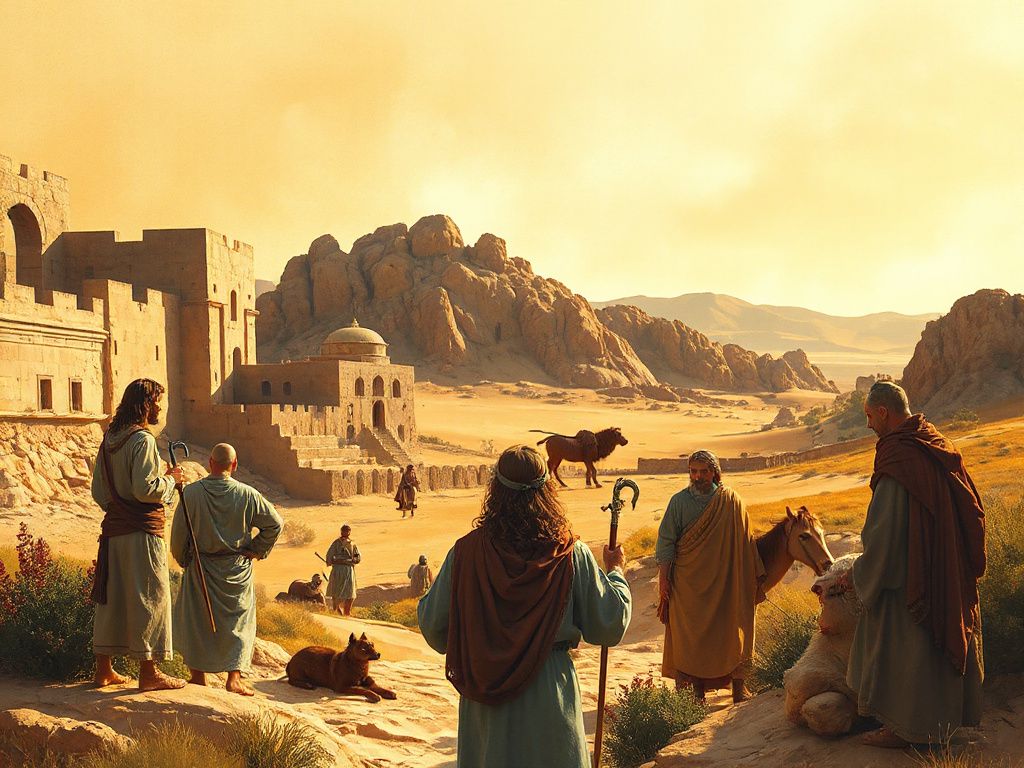
2And he looked, and, behold, a well in the field, and, lo, three flocks of sheep lying there by it; for out of that well they watered the flocks: and the stone upon the well's mouth was great.
3And thither were all the flocks gathered: and they rolled the stone from the well's mouth, and watered the sheep, and put the stone again upon the well's mouth in its place.
4And Jacob said unto them, My brethren, whence are ye? And they said, Of Haran are we.
5And he said unto them, Know ye Laban the son of Nahor? And they said, We know him.
6And he said unto them, Is it well with him? And they said, It is well: and, behold, Rachel his daughter cometh with the sheep.
7And he said, Lo, it is yet high day, neither is it time that the cattle should be gathered together: water ye the sheep, and go and feed them.
8And they said, We cannot, until all the flocks be gathered together, and they roll the stone from the well's mouth; then we water the sheep.
9While he was yet speaking with them, Rachel came with her father's sheep; for she kept them.
10And it came to pass, when Jacob saw Rachel the daughter of Laban his mother's brother, and the sheep of Laban his mother's brother, that Jacob went near, and rolled the stone from the well's mouth, and watered the flock of Laban his mother's brother.
11And Jacob kissed Rachel, and lifted up his voice, and wept.
12And Jacob told Rachel that he was her father's brother, and that he was Rebekah's son: and she ran and told her father.
13And it came to pass, when Laban heard the tidings of Jacob his sister's son, that he ran to meet him, and embraced him, and kissed him, and brought him to his house. And he told Laban all these things.
14And Laban said to him, Surely thou art my bone and my flesh. And he abode with him the space of a month.
15And Laban said unto Jacob, Because thou art my brother, shouldest thou therefore serve me for nought? tell me, what shall thy wages be?
16And Laban had two daughters: the name of the elder was Leah, and the name of the younger was Rachel.
17And Leah's eyes were tender; but Rachel was beautiful and well-favored.
18And Jacob loved Rachel; and he said, I will serve thee seven years for Rachel thy younger daughter.
19And Laban said, It is better that I give her to thee, than that I should give her to another man: abide with me.
20And Jacob served seven years for Rachel; and they seemed unto him but a few days, for the love he had to her.
21And Jacob said unto Laban, Give me my wife, for my days are fulfilled, that I may go in unto her.
22And Laban gathered together all the men of the place, and made a feast.
23And it came to pass in the evening, that he took Leah his daughter, and brought her to him; and he went in unto her.
24And Laban gave Zilpah his handmaid unto his daughter Leah for a handmaid.
25And it came to pass in the morning that, behold, it was Leah: and he said to Laban, What is this thou hast done unto me? did not I serve with thee for Rachel? wherefore then hast thou beguiled me?
26And Laban said, It is not so done in our place, to give the younger before the first-born.
27Fulfil the week of this one, and we will give thee the other also for the service which thou shalt serve with me yet seven other years.
28And Jacob did so, and fulfilled her week: and he gave him Rachel his daughter to wife.
29And Laban gave to Rachel his daughter Bilhah his handmaid to be her handmaid.
30And he went in also unto Rachel, and he loved also Rachel more than Leah, and served with him yet seven other years.
31And Jehovah saw that Leah was hated, and he opened her womb: but Rachel was barren.
32And Leah conceived, and bare a son, and she called his name Reuben: for she said, Because Jehovah hath looked upon my affliction; for now my husband will love me.
33And she conceived again, and bare a son: and said, Because Jehovah hath heard that I am hated, he hath therefore given me this son also: and she called his name Simeon.
34And she conceived again, and bare a son; and said, Now this time will my husband be joined unto me, because I have borne him three sons: therefore was his name called Levi.
35And she conceived again, and bare a son: and she said, This time will I praise Jehovah: therefore she called his name Judah; and she left off bearing.
What this passage means
The chapter frames Jacob's journey as a movement into a new household where he will be the one who serves, reversing the pattern of a servant bringing a bride for Isaac (Gen 24). The well scene repeats familiar motifs—meeting a relative, watering flocks, a stone too heavy for travelers alone—but here Jacob single-handedly rolls the stone aside, an act that signals his strength and eagerness (vv. 1–10). His kiss and weeping upon seeing Rachel (v. 11) show that what he seeks is kinship, not merely a wife.
Laban's deception parallels Jacob's earlier deception of Isaac and Esau. Having tricked others about identity and birthright, Jacob is now out-tricked by a relative whose words, 'It is not so done in our place, to give the younger before the first-born' (v. 26), echo earlier family disputes about primogeniture. The chapter therefore reads as a recurring cycle of deception within the family line, with consequences now extending to marriage and children.
The closing genealogy of Leah's four sons (Reuben, Simeon, Levi, Judah) shows the covenant line continuing through the unloved wife, while Rachel, the beloved, is barren (v. 31). The names themselves encode Leah's lament and hope—'Jehovah hath looked upon my affliction' (v. 32), 'Jehovah hath heard that I am hated' (v. 33), and finally 'This time will I praise Jehovah' (v. 35)—locating the chapter's theology in divine attention to the afflicted rather than in human affection.
Context
Within the book of Genesis, chapter 29 stands in the transition between Jacob's departure from Canaan and his eventual return. It introduces the family in Haran—Laban, Leah, and Rachel—that will frame Jacob's twenty years of service (Gen 31:38–41). The chapter's well scene deliberately recalls Abraham's servant meeting Rebekah at a well (Gen 24), but the roles are reversed: the patriarch's relative now courts a bride for himself.
The chapter also opens the long account of Jacob's children. Leah's four sons and Rachel's initial barrenness set up the sibling rivalry among the twelve sons, while the handmaids Zilpah and Bilhah (vv. 24, 29) introduce the custom of surrogate mothers that will recur. The closing line 'she left off bearing' (v. 35) anticipates the next movement of the narrative, when Rachel's complaint will reopen the question of who carries the covenant line.
Key words in the original
- H0875 בְּאֵר (be'er) refers to a well or cistern used to water flocks. Genesis 29 uses this term repeatedly to anchor the chapter around water and the gathering of shepherds (vv. 2, 3, 8, 10).
- H6629 צֹאן (ṣō'n) denotes sheep or small cattle collectively. The flocks lying by the well (v. 2) and Rachel's keeping of her father's sheep (v. 9) connect the chapter's marriage story to pastoral labor.
- H8248 שָׁקָה (šāqāh), 'to water,' appears in the chapter's central action of giving the flocks drink (vv. 2, 3, 8, 10). The verb is reused when Jacob waters Laban's flock, marking the act that initiates his seven-year service.
Related verses
- Hosea 12:12 Hosea 12:12 compresses the chapter's two movements into a single line: 'Jacob fled into the field of Aram, and Israel served for a wife.' This summarizes Genesis 29:1 and the seven-year service (vv. 18–20).
- Genesis 33:4 Esau's later embrace and kiss of Jacob (Gen 33:4) is bracketed by Laban's identical embrace and kiss in 29:13. Both scenes resolve a family estrangement through physical affection, framing Jacob's time in Haran by parallel reconciliations.
- Exodus 3:7 Leah names her firstborn because 'Jehovah hath looked upon my affliction' (29:32). The same phrasing of divine attention to affliction recurs in God's self-disclosure to Moses at the burning bush (Exod 3:7).
Common questions
Why does the chapter spend so much space on a well scene before reaching the marriage?
The well scene echoes Abraham's servant meeting Rebekah at a well in Genesis 24. By reusing the motif with Jacob as the suitor rather than a servant, the chapter signals both continuity in the family story and Jacob's changed position as the one who serves.
Is Laban's substitution of Leah legitimate by the standards of the passage?
The chapter presents Laban's claim that 'the younger before the first-born' is not done in their place (v. 26) as his stated reason, but the text also frames his act as deceiving Jacob, who protests 'wherefore then hast thou beguiled me?' (v. 25). The passage itself calls the act a deception.
What is the theological significance of Leah's sons being named for what God 'saw' and 'heard'?
The naming formula 'Jehovah hath looked upon my affliction' (v. 32) and 'Jehovah hath heard that I am hated' (v. 33) attributes the children's birth to divine attention rather than to Jacob's love. The chapter thus grounds the continuation of the family line in God's care for the unloved rather than in human favor.