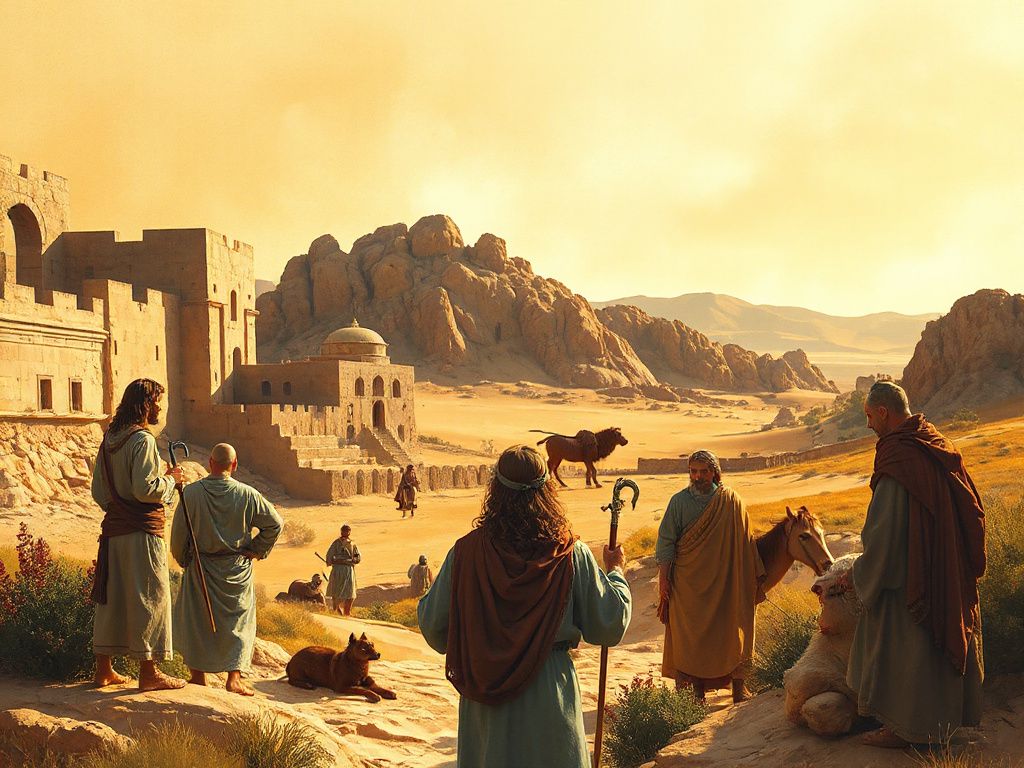
BIBLE CHAPTER STUDY
Genesis 30 — Rachel, Leah, and Jacob's Flocks
Rachel and Leah compete through their handmaids Bilhah and Zilpah; mandrakes trade a night with Jacob; Rachel bears Joseph; Jacob negotiates a wages deal with Laban and prospers through selective flock-breeding.
Scripture
1And when Rachel saw that she bare Jacob no children, Rachel envied her sister; and she said unto Jacob, Give me children, or else I die.
2And Jacob's anger was kindled against Rachel: and he said, Am I in God's stead, who hath withheld from thee the fruit of the womb?
3And she said, Behold, my maid Bilhah, go in unto her; that she may bear upon my knees, and I also may obtain children by her.
4And she gave him Bilhah her handmaid to wife: and Jacob went in unto her.
5And Bilhah conceived, and bare Jacob a son.
6And Rachel said, God hath judged me, and hath also heard my voice, and hath given me a son: therefore called she his name Dan.
7And Bilhah Rachel's handmaid conceived again, and bare Jacob a second son.
8And Rachel said, With mighty wrestlings have I wrestled with my sister, and have prevailed: and she called his name Naphtali.
9When Leah saw that she had left off bearing, she took Zilpah her handmaid, and gave her to Jacob to wife.
10And Zilpah Leah's handmaid bare Jacob a son.
11And Leah said, Fortunate! and she called his name Gad.
12And Zilpah Leah's handmaid bare Jacob a second son.
13And Leah said, Happy am I! for the daughters will call me happy: and she called his name Asher.
14And Reuben went in the days of wheat harvest, and found mandrakes in the field, and brought them unto his mother Leah. Then Rachel said to Leah, Give me, I pray thee, of thy son's mandrakes.
15And she said unto her, Is it a small matter that thou hast taken away my husband? and wouldest thou take away my son's mandrakes also? And Rachel said, Therefore he shall lie with thee to-night for thy son's mandrakes.
16And Jacob came from the field in the evening, and Leah went out to meet him, and said, Thou must come in unto me; for I have surely hired thee with my son's mandrakes. And he lay with her that night.
17And God hearkened unto Leah, and she conceived, and bare Jacob a fifth son.
18And Leah said, God hath given me my hire, because I gave my handmaid to my husband: and she called his name Issachar.
19And Leah conceived again, and bare a sixth son to Jacob.
20And Leah said, God hath endowed me with a good dowry; now will my husband dwell with me, because I have borne him six sons: and she called his name Zebulun.
21And afterwards she bare a daughter, and called her name Dinah.
22And God remembered Rachel, and God hearkened to her, and opened her womb.
23And she conceived, and bare a son: and said, God hath taken away my reproach:
24and she called his name Joseph, saying, Jehovah add to me another son.
25And it came to pass, when Rachel had borne Joseph, that Jacob said unto Laban, Send me away, that I may go unto mine own place, and to my country.
26Give me my wives and my children for whom I have served thee, and let me go: for thou knowest my service wherewith I have served thee.
27And Laban said unto him, If now I have found favor in thine eyes, tarry: for I have divined that Jehovah hath blessed me for thy sake.
28And he said, Appoint me thy wages, and I will give it.
29And he said unto him, Thou knowest how I have served thee, and how thy cattle have fared with me.
30For it was little which thou hadst before I came, and it hath increased unto a multitude; and Jehovah hath blessed thee whithersoever I turned: and now when shall I provide for mine own house also?
31And he said, What shall I give thee? And Jacob said, Thou shalt not give me aught: if thou wilt do this thing for me, I will again feed thy flock and keep it.
32I will pass through all thy flock to-day, removing from thence every speckled and spotted one, and every black one among the sheep, and the spotted and speckled among the goats: and of such shall be my hire.
33So shall my righteousness answer for me hereafter, when thou shalt come concerning my hire that is before thee: every one that is not speckled and spotted among the goats, and black among the sheep, that, if found with me, shall be counted stolen.
34And Laban said, Behold, I would it might be according to thy word.
35And he removed that day the he-goats that were ringstreaked and spotted, and all the she-goats that were speckled and spotted, every one that had white in it, and all the black ones among the sheep, and gave them into the hand of his sons;
36and he set three days' journey betwixt himself and Jacob: and Jacob fed the rest of Laban's flocks.
37And Jacob took him rods of fresh poplar, and of the almond and of the plane-tree; and peeled white streaks in them, and made the white appear which was in the rods.
38And he set the rods which he had peeled over against the flocks in the gutters in the watering-troughs where the flocks came to drink; and they conceived when they came to drink.
39And the flocks conceived before the rods, and the flocks brought forth ringstreaked, speckled, and spotted.
40And Jacob separated the lambs, and set the faces of the flocks toward the ringstreaked and all the black in the flock of Laban: and he put his own droves apart, and put them not unto Laban's flock.
41And it came to pass, whensoever the stronger of the flock did conceive, that Jacob laid the rods before the eyes of the flock in the gutters, that they might conceive among the rods;
42but when the flock were feeble, he put them not in: so the feebler were Laban's, and the stronger Jacob's.
43And the man increased exceedingly, and had large flocks, and maid-servants and men-servants, and camels and asses.
What this passage means
Genesis 30 advances the family struggle of Jacob's household. Rachel's barrenness, which began in Genesis 29:31, drives the opening scene: she demands children from Jacob, and Jacob answers that fruitfulness belongs to God alone. Both sisters then resort to the handmaids Bilhah and Zilpah as surrogates, producing Dan, Naphtali, Gad, and Asher. The names themselves carry theology — Dan meaning 'he judged', Naphtali 'my wrestling', Gad 'fortune', Asher 'happy' — turning the rivalry into a running commentary on who is blessed and who is overlooked.
The middle episode centers on the mandrakes Reuben finds and Rachel's bargain for them. Leah trades a night with Jacob for the plants, and God hearkens to Leah so that she conceives Issachar and Zebulun and bears Dinah. Then the text explicitly states that God remembered Rachel and opened her womb; Joseph is born and named with a hope that Jehovah would add another son. The chapter shows childlessness as a matter of divine remembrance, not of human effort — the same pattern seen with Sarah and Hannah.
The final section shifts from family to economy. Jacob proposes an unusual wage: only the speckled, spotted, and black animals. Through peeled rods placed at the watering troughs and by exposing only the stronger animals to them, Jacob's flocks multiply while Laban's diminish. Whatever modern readers make of the breeding method, the chapter presents Jacob's increase as the outcome of shrewd practice combined with divine blessing, preparing the tension that explodes in Genesis 31.
Context
The chapter sits inside the Jacob cycle, picking up directly from Genesis 29 where Leah bore four sons but Rachel remained barren. No external historical or geographical material is supplied beyond the chapter itself. The cross references cluster around three themes already present in Genesis 30: divine remembrance of the barren wife (Genesis 8:1; Luke 1:25; Psalms 113:9; Genesis 21:1), the recognition that Laban's household had been blessed for Jacob's sake (Genesis 26:24; Genesis 12:3), and the duty to provide for one's own household (1 Timothy 5:8).
The chapter closes Jacob's twenty years under Laban in narrative terms even though the departure proper belongs to chapter 31. Jacob's growth into a wealthy man with large flocks, servants, camels, and asses sets up the family separation from Laban that follows.
Key words in the original
- H0430 אֱלֹהִים (ʾĕlōhîm) — the generic Hebrew term for 'God' (or gods). In Genesis 30 it appears as the one who withholds fruit of the womb (v.2), hearkens to Leah (v.17), opens Rachel's womb (v.22), and whose blessing Jacob traces back to Laban (v.27, v.30).
- H7065 קָנָא (qānāʾ) — 'to be envious / jealous'. Rachel's envying of Leah in v.1 frames the rivalry that drives the chapter's first half.
- H3205 יָלַד (yālad) — 'to bear / beget'. The verb recurs throughout the chapter as each wife or handmaid bears another son, making barrenness and fruitfulness the structural pulse of Genesis 30.
Related verses
- Genesis 29:31 Directly preceding context: Jehovah saw Leah was hated and opened her womb while Rachel was barren — the situation Genesis 30 takes up and continues.
- Genesis 21:1 Sarah's story — God visited her and did as he had spoken. Rachel's experience in Genesis 30 follows the same pattern of barrenness ended by divine action.
- 1 Timothy 5:8 Provides for one's own household. Jacob's stated motivation in v.30 — 'when shall I provide for mine own house also?' — echoes this duty even before the later pastoral counsel.
Common questions
Why does Rachel ask Jacob for children 'or else I die'?
The text presents Rachel's demand as the response of a barren woman in a culture where a wife's value was bound up with producing children. Jacob answers that only God can give the fruit of the womb, and the chapter later shows God opening her womb in v.22.
What do the sons' names in Genesis 30 mean?
Dan — 'he has judged' (v.6); Naphtali — 'my wrestling' (v.8); Gad — 'fortune' (v.11); Asher — 'happy' (v.13); Issachar — 'hire' (v.18); Zebulun — 'dwelling' (v.20); Joseph — 'may Jehovah add' (v.24). Each name reflects the mother's reading of her circumstances.
How did Jacob's flock-breeding method work?
Jacob proposed to take only the speckled, spotted, and black animals as his wages (v.32). He peeled white streaks into rods of poplar, almond, and plane wood and placed them at the watering troughs when the stronger animals came to drink (v.37–41). The chapter reports that the flocks brought forth ringstreaked, speckled, and spotted young, and that the stronger animals became Jacob's while the feebler ones remained Laban's (v.42). Whatever view one takes of the method's scientific plausibility, the text attributes Jacob's increase to the rods he set up, presented without commentary on its mechanism.