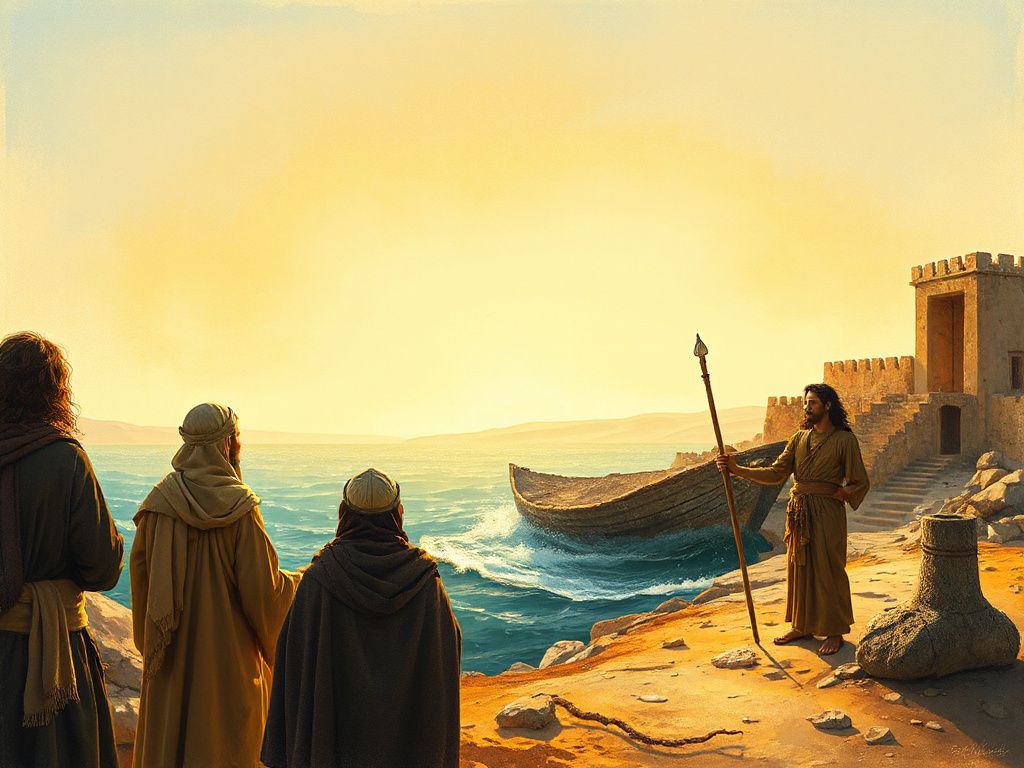
BIBLE CHAPTER STUDY
Jonah 2 — Jonah's Prayer from the Belly of the Fish
Jonah, swallowed by a great fish, prays a psalm that rehearses his descent into Sheol, God's hearing of his cry, and his vow of thanksgiving.
Scripture
1Then Jonah prayed unto Jehovah his God out of the fish's belly.
2And he said, I called by reason of mine affliction unto Jehovah, And he answered me; Out of the belly of Sheol cried I, And thou heardest my voice.
3For thou didst cast me into the depth, in the heart of the seas, And the flood was round about me; All thy waves and thy billows passed over me.
4And I said, I am cast out from before thine eyes; Yet I will look again toward thy holy temple.
5The waters compassed me about, even to the soul; The deep was round about me; The weeds were wrapped about my head.
6I went down to the bottoms of the mountains; The earth with its bars closed upon me for ever: Yet hast thou brought up my life from the pit, O Jehovah my God.
7When my soul fainted within me, I remembered Jehovah; And my prayer came in unto thee, into thy holy temple.
8They that regard lying vanities Forsake their own mercy.
9But I will sacrifice unto thee with the voice of thanksgiving; I will pay that which I have vowed. Salvation is of Jehovah.
10And Jehovah spake unto the fish, and it vomited out Jonah upon the dry land.
What this passage means
Jonah 2 is structured as a psalm: a report of calling (v. 2), a vivid narration of being cast into the deep and overwhelmed by waves (vv. 3-5), a declaration that even in the roots of the mountains God brought up his life (v. 6), a turn from fainting to remembering the Lord (v. 7), a warning against idolaters who forfeit mercy (v. 8), and a vow of thanksgiving culminating in the confession that salvation belongs to Jehovah (v. 9).
The psalm moves from past distress to present deliverance, so the verbs 'cast' (vv. 3-4) and 'brought up' (v. 6) frame the theology: Jonah describes both divine judgment and divine rescue in the same breath. The temple imagery (vv. 4, 7) shows that Jonah's prayer is not directed at the fish but toward the holy temple, so the location is symbolic — Sheol is paired with sanctuary, and the belly of the fish becomes a liturgical space.
Verse 9, 'Salvation is of Jehovah,' is the theological climax. It echoes the confession embedded in the chapter's own structure: the one who sank into the sea rose again only because the Lord heard. The final verse (v. 10) shows the prayer answered: the fish vomits Jonah onto dry land, closing the chapter with action that matches the vow.
Context
The chapter consists of two frames around a central psalm. Verse 1 sets the scene: Jonah prays to Jehovah his God from inside the fish. Verse 10 closes the scene: Jehovah speaks to the fish and it vomits Jonah onto dry land. Between these two frames, the prayer itself unfolds in verses 2-9, where Jonah alternates between narrated past distress and present vows of praise.
The fish, described as 'great' and assigned three days and three nights, functions as the immediate context for every image in the prayer — the depths, the seaweed wrapped around the head, the bars of the earth. Because the chapter does not name the speaker's geographic location or give external background, the internal imagery of sea, Sheol, and temple is the context the reader works with.
Key words in the original
- H6419 The verb translated 'prayed' (palal) carries the sense of intercession and judicial appeal — the same root used for official mediation. Jonah's prayer inside the fish is not a private sigh but a formal plea directed at Jehovah his God.
- H4578 The Hebrew word for 'belly' (me'im, intestines) is used three times in the chapter (vv. 1, 2) for the inside of the fish and once for 'belly of Sheol' (v. 2). The repeated word links the fish's stomach with Sheol, so that the fish becomes a figure for the underworld.
- H3068 The covenant name Jehovah (yhwh) appears as the direct addressee of Jonah's prayer. Jonah 2:9 closes with 'Salvation is of Jehovah' — placing rescue under the covenant name rather than the more generic 'God' (Elohim) used alongside it in v. 1.
Related verses
- Psalms 18:4 Jonah 2:3 — 'All thy waves and thy billows passed over me' — uses the same overwhelming-water imagery as Psalm 18:4, where the cords of death and floods of ungodliness encircle the psalmist. Both speakers describe divine discipline as drowning imagery.
- Psalms 120:1 Jonah 2:2 — 'I called by reason of mine affliction unto Jehovah, And he answered me' — matches the structure of Psalm 120:1, 'In my distress I cried unto Jehovah, And he answered me.' The call-and-answer shape becomes a standard form for distress prayer in the Psalter.
- Psalms 3:8 Jonah 2:9 closes with 'Salvation is of Jehovah,' and Psalm 3:8 likewise affirms 'Salvation belongeth unto Jehovah.' The identical confession anchors Jonah's vow of thanksgiving in the same theology the Psalter uses for evening deliverance.
Common questions
Is Jonah 2 a historical report or a poem?
The chapter opens with a narrative frame (vv. 1, 10) and centers on a poetic prayer (vv. 2-9). The prayer uses parallelism, vivid imagery, and standard psalm vocabulary such as Sheol, waves, fainting, and the temple, so the central block reads as a composed song set within a narrative envelope.
What does 'belly of Sheol' mean in verse 2?
Sheol is the Hebrew name for the realm of the dead. Jonah describes his situation inside the fish as equivalent to being inside Sheol itself, so the fish's belly functions as a figure for the underworld — a place from which he cries out and is heard.
Why does Jonah vow sacrifice after he is delivered (v. 9)?
The vow of thanksgiving (sacrifice with the voice of thanksgiving and payment of vows) is presented in the prayer as the proper response to having been heard. The chapter ends with the fish's action on dry land (v. 10), and verse 9 functions as the worshiper's commitment to respond to that rescue with public praise.