BIBLE BOOK GUIDE
Lamentations
5 chapters
Laments over Jerusalem's destruction that acknowledge God's righteous judgment while clinging to His faithfulness and hoping for restoration.
Lamentations
Choose a chapter
Pick a chapter and it opens in the Current chapter tab. Come back here whenever you want to choose another one.
Why this book was written
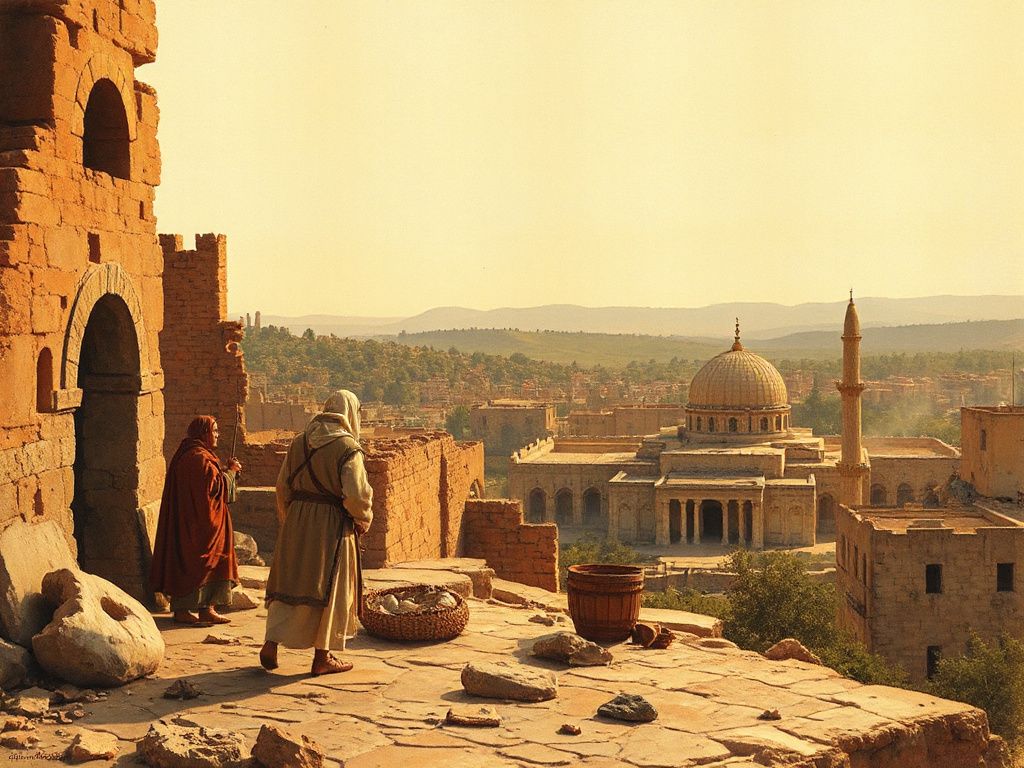
Written after Jerusalem's fall in 586 BC, the author laments the devastated city through five acrostic poems. He expresses the depth of suffering, confesses sin, pleads with God, and calls upon His mercy—comforting the remnant with the hope that God's faithfulness endures even in judgment.
Structure
- 1Zion's Lament (Aleph)
- 2Sorrow Under the Lord's Anger
- 3Hope and Meditation of the Sufferer
- 4Contrast Between the City's Past and Present
- 5Intercession and Hope for Restoration
Major themes
The Destruction of Jerusalem
The book vividly depicts the ruined city, the burned temple, and the exiled people, showing the real consequences of divine judgment (1:1-4; 2:8-9).
How it points to Christ
Though Lamentations does not directly prophesy the Messiah, it points to the Man of Sorrows who bears our griefs (cf. Isa 53:4). Jeremiah's cry for God's faithfulness amid suffering prefigures Christ, who on the cross cried 'My God, why have you forsaken me?' (cf. Matt 27:46) yet still trusted the Father. The movement from lament to hope in this book foreshadows the turn from sorrow to joy at Christ's resurrection.
Key verses
- 1:1The opening lament—how the city once full of people now sits alone like a widow—sets the tone for the entire book.
- 1:18Acknowledging the Lord's righteousness while pleading for Him to see the suffering—exemplifying the book's twin posture of repentance and appeal.
- 2:22The author calls on God to summon the destruction He threatened, showing faith in God's sovereignty even amid suffering.
- 3:21–23The book's theological center—recalling God's love and mercies in the midst of despair fuels hope; a key turning-point of faith.
- 3:55A plea to be delivered from the depths—modeling personal and communal cry from the abyss of suffering.
- 4:13Connects Jerusalem's fall directly to the sins of prophets and priests—linking suffering to its moral cause.
- 5:19Despite suffering, the confession that the Lord reigns forever—the climactic declaration of faith and hope that closes the book.
Questions for reflection
- ·When you suffer, will you honestly pour out your pain to God as Jeremiah did, rather than suppress or flee from it? (cf. Lam 2:19)
- ·Do you believe God's steadfast love and faithfulness remain even when He disciplines or seems silent? (cf. Lam 3:22-23)
- ·How do you respond to those who suffer around you — with quick answers, or with willingness to weep alongside them? (cf. Lam 1:9; John 11:35)
- ·After reading all five chapters, does your heart, like Jeremiah's, move from despair to looking up to God? What hinders that shift in you?
Where Lamentations fits in the Bible's storyline
This book appears in the 12-stop storyline at:
Where to start reading the Bible? See the full 12-stop storyline
Want to read Lamentations start to finish? Open the reader for parallel Chinese/English text and ask anything as you go.
Start reading LamentationsLamentations
Chapter 4
1How is the gold become dim! how is the most pure gold changed! The stones of the sanctuary are poured out at the head of every street.
2The precious sons of Zion, comparable to fine gold, How are they esteemed as earthen pitchers, the work of the hands of the potter!
3Even the jackals draw out the breast, they give suck to their young ones: The daughter of my people is become cruel, like the ostriches in the wilderness.
4The tongue of the sucking child cleaveth to the roof of his mouth for thirst: The young children ask bread, and no man breaketh it unto them.
5They that did feed delicately are desolate in the streets: They that were brought up in scarlet embrace dunghills.
6For the iniquity of the daughter of my people is greater than the sin of Sodom, That was overthrown as in a moment, and no hands were laid upon her.
7Her nobles were purer than snow, they were whiter than milk; They were more ruddy in body than rubies, their polishing was as of sapphire.
8Their visage is blacker than a coal; They are not known in the streets: Their skin cleaveth to their bones; it is withered, it is become like a stick.
9They that are slain with the sword are better than they that are slain with hunger; For these pine away, stricken through, for want of the fruits of the field.
10The hands of the pitiful women have boiled their own children; They were their food in the destruction of the daughter of my people.
11Jehovah hath accomplished his wrath, he hath poured out his fierce anger; And he hath kindled a fire in Zion, which hath devoured the foundations thereof.
12The kings of the earth believed not, neither all the inhabitants of the world, That the adversary and the enemy would enter into the gates of Jerusalem.
13It is because of the sins of her prophets, and the iniquities of her priests, That have shed the blood of the just in the midst of her.
14They wander as blind men in the streets, they are polluted with blood, So that men cannot touch their garments.
15Depart ye, they cried unto them, Unclean! depart, depart, touch not! When they fled away and wandered, men said among the nations, They shall no more sojourn here.
16The anger of Jehovah hath scattered them; He will no more regard them: They respected not the persons of the priests, they favored not the elders.
17Our eyes do yet fail in looking for our vain help: In our watching we have watched for a nation that could not save.
18They hunt our steps, so that we cannot go in our streets: Our end is near, our days are fulfilled; for our end is come.
19Our pursuers were swifter than the eagles of the heavens: They chased us upon the mountains, they laid wait for us in the wilderness.
20The breath of our nostrils, the anointed of Jehovah, was taken in their pits; Of whom we said, Under his shadow we shall live among the nations.
21Rejoice and be glad, O daughter of Edom, that dwellest in the land of Uz: The cup shall pass through unto thee also; thou shalt be drunken, and shalt make thyself naked.
22The punishment of thine iniquity is accomplished, O daughter of Zion; He will no more carry thee away into captivity: He will visit thine iniquity, O daughter of Edom; he will uncover thy sins.