BIBLE CHAPTER STUDY
Leviticus 16: The Day of Atonement Ritual
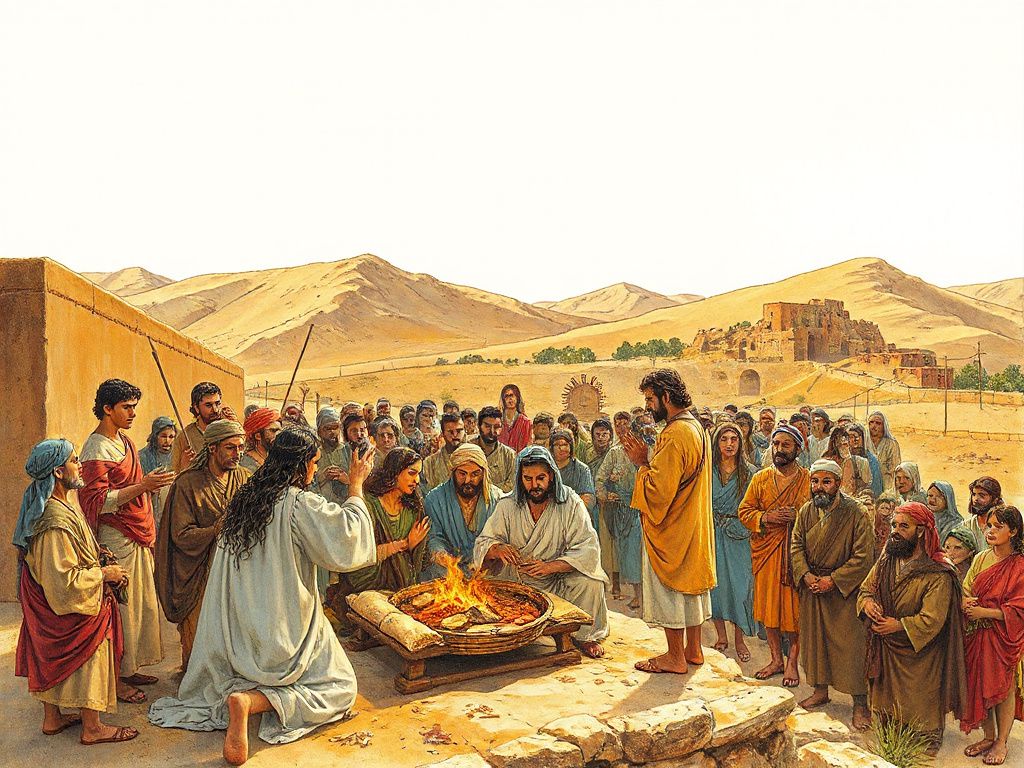
Leviticus 16 prescribes the annual Day of Atonement ritual in which the high priest atones for himself, his household, the sanctuary, and all Israel through the blood of a bull and two goats—one slain and one sent into the wilderness for Azazel.
Scripture
1And Jehovah spake unto Moses, after the death of the two sons of Aaron, when they drew near before Jehovah, and died;
2and Jehovah said unto Moses, Speak unto Aaron thy brother, that he come not at all times into the holy place within the veil, before the mercy-seat which is upon the ark; that he die not: for I will appear in the cloud upon the mercy-seat.
3Herewith shall Aaron come into the holy place: with a young bullock for a sin-offering, and a ram for a burnt-offering.
4He shall put on the holy linen coat, and he shall have the linen breeches upon his flesh, and shall be girded with the linen girdle, and with the linen mitre shall he be attired: they are the holy garments; and he shall bathe his flesh in water, and put them on.
5And he shall take of the congregation of the children of Israel two he-goats for a sin-offering, and one ram for a burnt-offering.
6And Aaron shall present the bullock of the sin-offering, which is for himself, and make atonement for himself, and for his house.
7And he shall take the two goats, and set them before Jehovah at the door of the tent of meeting.
8And Aaron shall cast lots upon the two goats; one lot for Jehovah, and the other lot for Azazel.
9And Aaron shall present the goat upon which the lot fell for Jehovah, and offer him for a sin-offering.
10But the goat, on which the lot fell for Azazel, shall be set alive before Jehovah, to make atonement for him, to send him away for Azazel into the wilderness.
11And Aaron shall present the bullock of the sin-offering, which is for himself, and shall make atonement for himself, and for his house, and shall kill the bullock of the sin-offering which is for himself:
12and he shall take a censer full of coals of fire from off the altar before Jehovah, and his hands full of sweet incense beaten small, and bring it within the veil:
13and he shall put the incense upon the fire before Jehovah, that the cloud of the incense may cover the mercy-seat that is upon the testimony, that he die not:
14and he shall take of the blood of the bullock, and sprinkle it with his finger upon the mercy-seat on the east; and before the mercy-seat shall he sprinkle of the blood with his finger seven times.
15Then shall he kill the goat of the sin-offering, that is for the people, and bring his blood within the veil, and do with his blood as he did with the blood of the bullock, and sprinkle it upon the mercy-seat, and before the mercy-seat:
16and he shall make atonement for the holy place, because of the uncleannesses of the children of Israel, and because of their transgressions, even all their sins: and so shall he do for the tent of meeting, that dwelleth with them in the midst of their uncleannesses.
17And there shall be no man in the tent of meeting when he goeth in to make atonement in the holy place, until he come out, and have made atonement for himself, and for his household, and for all the assembly of Israel.
18And he shall go out unto the altar that is before Jehovah, and make atonement for it, and shall take of the blood of the bullock, and of the blood of the goat, and put it upon the horns of the altar round about.
19And he shall sprinkle of the blood upon it with his finger seven times, and cleanse it, and hallow it from the uncleannesses of the children of Israel.
20And when he hath made an end of atoning for the holy place, and the tent of meeting, and the altar, he shall present the live goat:
21and Aaron shall lay both his hands upon the head of the live goat, and confess over him all the iniquities of the children of Israel, and all their transgressions, even all their sins; and he shall put them upon the head of the goat, and shall send him away by the hand of a man that is in readiness into the wilderness:
22and the goat shall bear upon him all their iniquities unto a solitary land: and he shall let go the goat in the wilderness.
23And Aaron shall come into the tent of meeting, and shall put off the linen garments, which he put on when he went into the holy place, and shall leave them there:
24and he shall bathe his flesh in water in a holy place, and put on his garments, and come forth, and offer his burnt-offering and the burnt-offering of the people, and make atonement for himself and for the people.
25And the fat of the sin-offering shall he burn upon the altar.
26And he that letteth go the goat for Azazel shall wash his clothes, and bathe his flesh in water, and afterward he shall come into the camp.
27And the bullock of the sin-offering, and the goat of the sin-offering, whose blood was brought in to make atonement in the holy place, shall be carried forth without the camp; and they shall burn in the fire their skins, and their flesh, and their dung.
28And he that burneth them shall wash his clothes, and bathe his flesh in water, and afterward he shall come into the camp.
29And it shall be a statute for ever unto you: in the seventh month, on the tenth day of the month, ye shall afflict your souls, and shall do no manner of work, the home-born, or the stranger that sojourneth among you:
30for on this day shall atonement be made for you, to cleanse you; from all your sins shall ye be clean before Jehovah.
31It is a sabbath of solemn rest unto you, and ye shall afflict your souls; it is a statute for ever.
32And the priest, who shall be anointed and who shall be consecrated to be priest in his father's stead, shall make the atonement, and shall put on the linen garments, even the holy garments:
33and he shall make atonement for the holy sanctuary; and he shall make atonement for the tent of meeting and for the altar; and he shall make atonement for the priests and for all the people of the assembly.
34And this shall be an everlasting statute unto you, to make atonement for the children of Israel because of all their sins once in the year. And he did as Jehovah commanded Moses.
What this passage means
Leviticus 16 establishes the Day of Atonement (Yom Kippur) as the single annual occasion when the high priest enters the Most Holy Place—the space behind the veil before the mercy-seat on the ark. The chapter opens by linking the ritual to the death of Aaron's two sons, who died when they approached God's presence unauthorized (Lev 10:1–2), making explicit that coming before the LORD's cloud over the mercy-seat is lethal apart from prescribed mediation. The high priest is warned not to come 'at all times' but only with the prescribed offering.
The ritual unfolds in three movements. First, Aaron offers a bull for his own sin and that of his household (vv. 6, 11). Second, two goats are chosen by lot: one is slaughtered as a sin-offering whose blood is sprinkled on and before the mercy-seat, and the other is presented alive before the LORD. The high priest confesses all Israel's iniquities over the live goat and sends it away into the wilderness 'for Azazel' (vv. 20–22). Third, after exiting, Aaron changes garments, bathes, and offers burnt offerings for himself and the people (vv. 23–25). The bodies of the sin-offering animals are burned outside the camp, and those who handle them must wash before re-entering (vv. 27–28).
Verses 29–34 frame the ritual as a perpetual statute: on the tenth day of the seventh month the people must afflict themselves, cease work, and be cleansed from all their sins before the LORD. The Day of Atonement is declared 'a sabbath of solemn rest' and 'an everlasting statute.' The chapter thus ties together sanctuary purification, priestly mediation, substitutionary blood, and the removal of sin—all concentrated in one national day each year.
Context
The chapter stands within the Levitical sacrificial system detailed in Leviticus 1–15. Chapters 1–7 outline the five basic offerings (burnt, grain, peace, sin, guilt); chapters 8–10 describe the consecration of Aaron and his sons and the deaths of Nadab and Abihu. Leviticus 11–15 address ritual purity. Leviticus 16 then addresses the unresolved problem of accumulated impurity and sin affecting the sanctuary itself, requiring annual cleansing.
The chapter's placement after the death of Aaron's sons (cited explicitly in v. 1 and in cross-references to Leviticus 10:1–2) frames the ritual as a response to unauthorized priestly approach. The cloud over the mercy-seat and the limitation to one annual entry shape the rhythm of Israel's worship, culminating in the regulations for observance in vv. 29–34.
Key words in the original
- H6944 The term קֹּדֶשׁ (qōdesh, 'sanctuary') in v. 2 designates the Most Holy Place—the inner sanctuary behind the veil where the mercy-seat sat. The chapter emphasizes that access to this qodesh is restricted and lethal apart from the prescribed ritual.
- H3068 The divine name יְהוָה (YHWH, 'LORD') appears throughout the chapter as the covenant God who prescribes the ritual, dwells above the mercy-seat in the cloud (v. 2), and before whom the people are cleansed (v. 30).
- H1696 The verb דָבַר (dābar, 'spoke/tell') in vv. 1–2 frames the entire chapter as direct divine speech to Moses, establishing the ritual's authority as God's command rather than human invention.
Related verses
- Leviticus 10:1 The opening of chapter 16 explicitly dates the ritual instructions to 'after the death of the two sons of Aaron,' referring to Nadab and Abihu who offered unauthorized fire. Their death (see Lev 10:2) motivates the warning that the high priest must not approach the holy place 'at all times.'
- Hebrews 9:7 Hebrews 9:7 directly mirrors Leviticus 16's pattern: the high priest enters the second (inner) tabernacle 'once in the year, not without blood, which he offereth for himself, and for the errors of the people.' The author of Hebrews uses this structure to interpret Christ's priestly work.
- Hebrews 10:19 Hebrews 10:19 draws on the Leviticus 16 pattern—entry through blood past the veil—to encourage believers to enter the holy place. The cross-referenced verse Hebrews 10:20 identifies the veil as 'his flesh,' tying Christ's atoning death to the once-yearly entry described in Leviticus 16.
Common questions
Why is Leviticus 16 dated to the death of Aaron's two sons?
The opening verse anchors the Day of Atonement instructions to the death of Aaron's sons, who approached God's presence without proper authorization (cf. Leviticus 10:1–2). This dating frames the warning that the high priest must not enter the holy place 'at all times'—access is regulated, and unauthorized approach is fatal.
What is Azazel in Leviticus 16?
The term Azazel (v. 8, 10, 26) appears in the chapter as the designated recipient of the live goat. The goat on which the lot 'for Azazel' falls is presented alive before the LORD, has Israel's sins confessed over it, and is sent into the wilderness. The chapter does not define the term or explain Azazel's identity beyond this ritual role.
How often was the Leviticus 16 ritual to be performed?
The chapter repeatedly states the ritual is to occur once per year. Verse 34 summarizes: 'to make atonement for the children of Israel because of all their sins once in the year.' The observance is tied to the tenth day of the seventh month (v. 29) and declared 'an everlasting statute' (vv. 29, 31, 34).