BIBLE CHAPTER STUDY
Psalms 11 — The Righteous Take Refuge in Jehovah's Throne
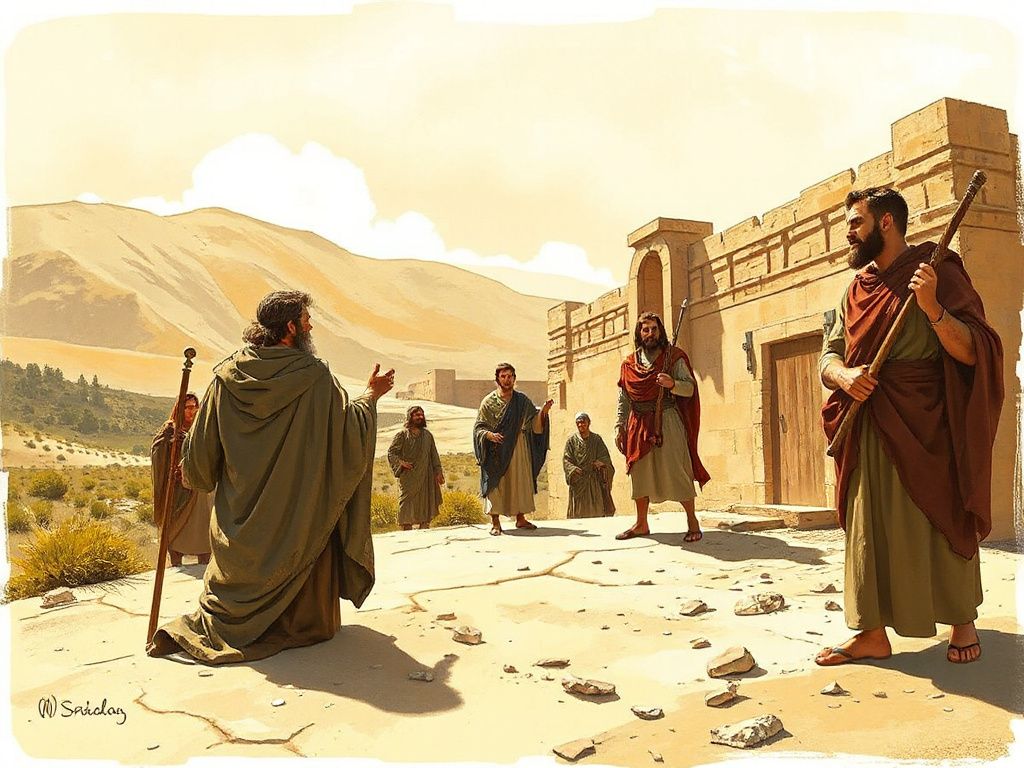
David, surrounded by those who urge him to flee, declares that his refuge is Jehovah, whose eyes test the righteous and whose judgment falls on the wicked who love violence.
Scripture
1For the Chief Musician. A Psalm of David. In Jehovah do I take refuge: How say ye to my soul, Flee as a bird to your mountain;
2For, lo, the wicked bend the bow, They make ready their arrow upon the string, That they may shoot in darkness at the upright in heart;
3If the foundations be destroyed, What can the righteous do?
4Jehovah is in his holy temple; Jehovah, his throne is in heaven; His eyes behold, his eyelids try, the children of men.
5Jehovah trieth the righteous; But the wicked and him that loveth violence his soul hateth.
6Upon the wicked he will rain snares; Fire and brimstone and burning wind shall be the portion of their cup.
7For Jehovah is righteous; He loveth righteousness: The upright shall behold his face.
What this passage means
The psalm opens with a clash of voices: advisers tell David to take flight like a bird, because the wicked have already bent the bow and fitted the arrow to shoot the upright in heart. David's reply is not a defense of strategy but a confession — he has already taken refuge in Jehovah, and that refuge is incompatible with the counsel of fear. The 'foundations destroyed' of verse 3 is the tyrant's argument: order has collapsed, so why bother with righteousness? David answers that the foundations of the world are not finally in the hands of the wicked.
Verses 4-6 relocate the scene from earth to heaven. Jehovah sits in his holy temple; his throne is in heaven, and his eyes and eyelids test the children of men. The test is double: he scrutinizes the righteous (verse 5a) and he hates the wicked person who loves violence (verse 5b). The cup of verse 6 — fire, brimstone, and a burning wind — picks up the language of covenant judgment against the cities of the plain and turns the ungodly's portion into a measured, fitting retribution.
Verse 7 closes the psalm on a note of theology that grounds the rest. Jehovah is righteous; he loves righteousness; therefore the upright will behold his face. 'Seeing his face' is both the present gift of communion and the eschatological hope of those who are clean before him. The psalm thus moves from pressure (vv. 1-3) through divine scrutiny (vv. 4-6) to beholding (v. 7).
Context
The psalm is titled 'For the Chief Musician. A Psalm of David,' using the Hebrew term מְנַצֵּחַ (H5329), the standard superscription directing the song to the director of temple music. David opens with a deliberate contrast: his own act of taking refuge in יהוה (H3068), the covenant name Jehovah, set against the advisers' call to flee. The Hebrew verb חָסָה (H2620), glossed 'take refuge,' is the psalmic vocabulary for confident trust in God under threat.
Verses 2-3 picture open violence: the wicked bend the bow (דָּרַךְ, H1869), fit the arrow on the string (כּוּן, H3559), and shoot in darkness at the upright in heart. The rhetorical question of verse 3 — 'If the foundations be destroyed, what can the righteous do?' — sets up the psalm's hinge. The answer unfolds in verse 4: Jehovah is in his holy temple; his throne is in heaven; his eyes behold and his eyelids test the children of men (cf. Psalms 82:5; Psalms 103:19).
Key words in the original
- H2620 The verb חָסָה (ḥāśâ), 'take refuge,' is the characteristic psalmic word for confident trust in God. David uses it in verse 1 to ground his refusal to flee: the refuge has already been taken in Jehovah, so the advice of the fearful is rejected.
- H3068 יהוה (YHWH), the covenant name of God, is the explicit object of David's refuge. The same name appears again in verse 4 as the enthroned Judge in his holy temple, binding the psalm's confession of trust to its confession of divine rule.
- H5329 The superscription מְנַצֵּחַ (mənaṣṣēaḥ), 'director,' is the standard liturgical note directing the psalm to the chief musician for performance in temple worship.
Related verses
- Psalms 17:15 The closing promise 'The upright shall behold his face' echoes David's prayer in Psalms 17:15 — 'I shall behold thy face in righteousness; I shall be satisfied, when I awake, with beholding thy form' — connecting present communion with eschatological satisfaction.
- Psalms 103:19 The claim that Jehovah's throne is in heaven matches Psalms 103:19 — 'Jehovah hath established his throne in the heavens; and his kingdom ruleth over all' — undergirding the assertion that human schemes of violence do not unsettle the divine rule.
- Revelation 22:4 'The upright shall behold his face' anticipates the new creation's privilege in Revelation 22:4 — 'they shall see his face; and his name shall be on their foreheads' — giving the psalm's final line an eschatological horizon beyond the immediate danger of verses 1-3.
Common questions
Why do the advisers tell David to flee 'as a bird to your mountain'?
The image of a small bird fleeing to the safety of the mountains pictures the panic of those who see the wicked already bending the bow. It is the counsel of expediency — run, save yourself — and David rejects it because he has already taken refuge in Jehovah (verse 1).
What does 'If the foundations be destroyed, what can the righteous do?' mean?
It is the cynic's argument: if the moral order has collapsed, what is the point of righteousness? David answers implicitly in verse 4: Jehovah is enthroned in heaven, so the true foundations are intact even when earthly structures fail (cf. 2 Timothy 2:19).
What is 'the portion of their cup' in verse 6?
The phrase assigns the wicked a measured portion — fire, brimstone, and a burning wind — echoing the covenant judgment on Sodom and Gomorrah (Genesis 19:24). Their own violent schemes become the exact measure of what they receive from God's hand.