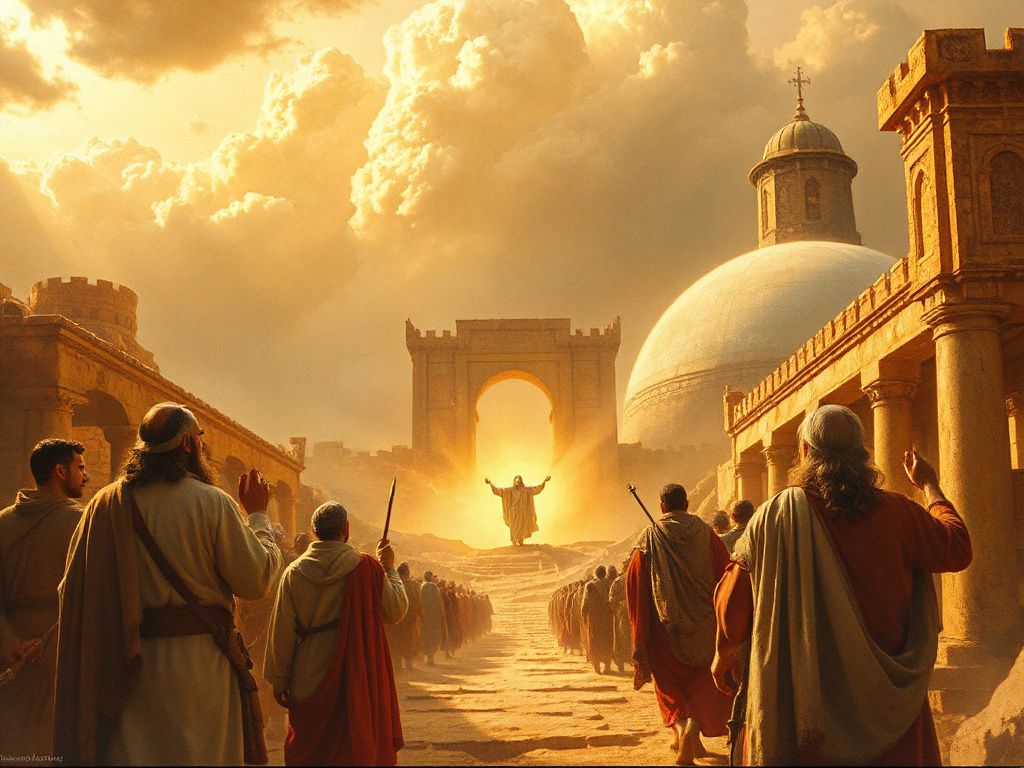
Revelation 21:6 — Alpha and Omega Give Living Water Freely
God declares His words are fulfilled, identifies Himself as Alpha and Omega, and freely offers the water of life to the thirsty.
Scripture
6And he said unto me, They are come to pass. I am the Alpha and the Omega, the beginning and the end. I will give unto him that is athirst of the fountain of the water of life freely.
What this passage means
The verse opens with a divine confirmation: "They are come to pass." The speaker affirms that the prophetic words about the new creation — a new heaven, a new earth, and the end of mourning, death, and tears (21:1–5) — are now certain. The same voice that said "I make all things new" (21:5) now ratifies that nothing further remains unfulfilled.
Next, the speaker self-identifies with the title "the Alpha and the Omega, the beginning and the end." By placing these A-and-Ω claims back to back, the verse identifies the One who makes all things new as the One who originates and concludes all things. Authority over creation and certainty of the prophetic word belong to the same person speaking to John.
The verse then turns from speech about God to an offer from God: to the thirsty He will give "of the fountain of the water of life freely." The word "freely" is striking — the gift costs the recipient nothing, matching the larger scene in which every limitation of the old order (death, mourning, the curse) is removed. What was first announced as a vision is now reframed as an open invitation.
Context
Revelation 21 opens a new section in which John sees a new heaven and a new earth (21:1), with the holy city coming down from God (21:2). The preceding verses set the stage by announcing that God's tabernacle will be with men, that death and tears will be no more, and that the One on the throne declares, "I make all things new" (21:3–5). Verse 6 then ratifies that declaration with the Alpha-and-Omega formula and opens the invitation to receive living water.
The verses that follow immediately sharpen the contrast introduced here: verse 7 extends the promise to "him that overcometh," and verse 8 warns of judgment for the fearful, unbelieving, and immoral. The offer of free living water in verse 6 therefore sits between the certainty of God's accomplished word and the two-sided outcome — inheritance for the faithful, judgment for the rebellious — that defines how readers receive the invitation.
Key words in the original
- G2532 The Greek conjunction καί links the clauses of the verse and joins the declarative statement ("they have come to pass") to the divine self-identification and the offer of living water.
- G3004 The verb εἶπέν (from λέγω) marks a significant speech act: the speaker formally addresses John with a divine declaration, not a casual remark, signaling that the words carry authoritative weight.
- G1096 The perfect-tense form Γέγοναν (from γίνομαι) denotes a completed state with present effect: the prophetic events have already happened and the result stands. This verb form underlines the certainty of the new-creation announcements in 21:1–5.
Related verses
- John 4:10 Just as Jesus offered the Samaritan woman living water that becomes a spring within the believer, here the Alpha and Omega offers the same water of life to the thirsty — a Johannine echo linking the earthly ministry to the consummation.
- John 7:37 Jesus' invitation at the feast — "If any man thirst, let him come unto me and drink" — is paralleled in Revelation 21:6, where the same One who spoke on earth now speaks from the throne and extends the invitation to drink without cost.
- Isaiah 55:1 Isaiah's call, "Ho, every one that thirsteth... wine and milk without money and without price," anticipates the free character of the living water in 21:6; both invitations remove price from the gift of life.
Common questions
Why does the verse say "Alpha and Omega" together with "beginning and end"?
The double designation pairs the Greek alphabet letters with a plain-language equivalent, emphasizing that the One who speaks ranges over the entirety of reality and is therefore able to make and certify that all things are made new.
What does "freely" (or "without price") mean in this context?
The offer of the water of life asks nothing of the recipient in return. Within Revelation 21, this fits the removal of every limitation of the old order — death, mourning, tears, and curse — and aligns with the verb form "they have come to pass," presenting the gift as already certain and fully unearned.
Does "the water of life" point only to a future gift in the new creation?
The verse presents the water as freely available now, since the One who speaks — described here as the Alpha and Omega — is also the one who proclaimed "I make all things new" in the preceding verse and who extends the invitation in the present scene of John's vision.