Related Books
Filter by Era
Exodus 20
Exodus · Ch.20
Exodus 20:1-17 The Ten Commandments
Exodus 16:11
protestant「And Jehovah spake unto Moses, saying,」
Altar of Burnt Offering
allThe bronze altar in the courtyard where burnt offerings and sin offerings were made. Its four horns symbolized atonement and intercession, central to Israel's sacrificial system.
Why is 'You shall not covet' a commandment about inner morality?
The commandment against coveting reveals God's concern for inner motives.
Exodus 3
Exodus · Ch.3
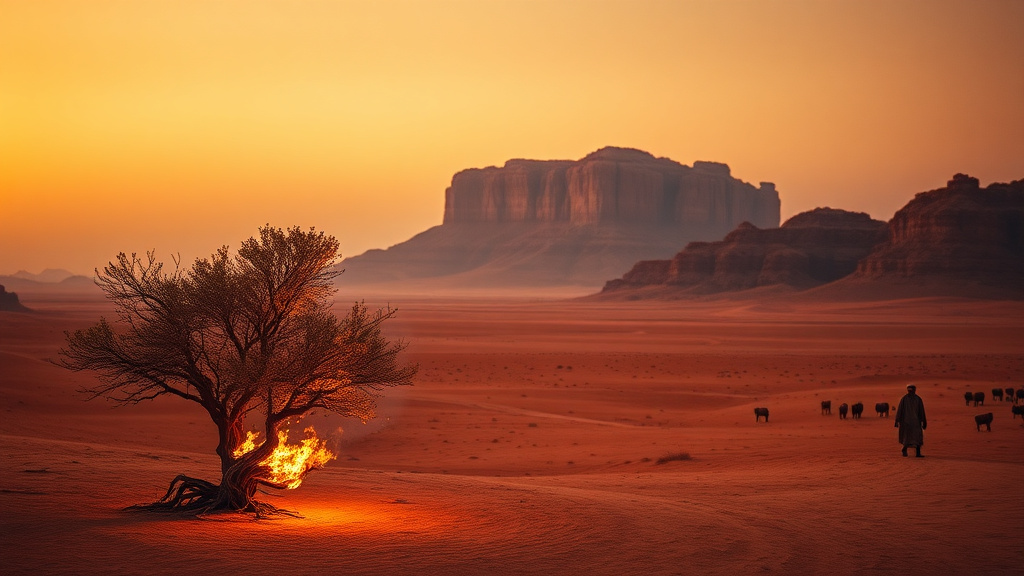
The Burning Bush and the Name
Exodus 17:3
protestant「And the people thirsted there for water; and the people murmured against Moses, and said, Wherefore hast thou brought us up out of Egypt, to kill us and our children and our cattle with thirst?」
Hardening of Pharaoh's Heart
allGod's hardening of Pharaoh's heart to accomplish redemption, revealing divine sovereignty over human rebellion and serving as a key expression of God's judicial authority.
What inner struggles do Moses' excuses before the burning bush reveal?
'I am slow of speech'—humility or fear before divine calling?
Leviticus 16:7
protestant「And he shall take the two goats, and set them before Jehovah at the door of the tent of meeting.」
Tabernacle
allThe portable sanctuary built in the wilderness where God's presence dwelled among Israel. A precursor to the Temple and a type of the Church in Christian theology.
How does Judaism emphasize the commandment to honor parents?
Honoring parents is a foundational ethic in Judaism.
Exodus 10:16
judaism「Pharaoh hurriedly summoned Moses and Aaron and said, “I stand guilty before the ETERNAL your God and before you.」
Massah and Meribah
allPlace names memorializing Israel's striving and tempting of God, becoming enduring symbols of doubt versus divine presence.
Why is 'I am the LORD' in Exodus 20:2 the foundation of the Ten Commandments?
The relationship between knowing God and the order of commandments
Exodus 23:19
protestant「The first of the first-fruits of thy ground thou shalt bring into the house of Jehovah thy God. Thou shalt not boil a kid in it mother's milk.」
Blessing the Lord
allJethro's priestly blessing of YHWH for delivering Israel from Egypt, showing a Gentile priest's recognition of the true God's salvation.
What aspects does the commandment 'You shall not murder' cover?
From literal killing to inner anger, expanded interpretations of not murdering.
Exodus 21:7
protestant「And if a man sell his daughter to be a maid-servant, she shall not go out as the men-servants do.」
Tabernacle
allThe dwelling place God commanded Israel to build so He might dwell among them. Central OT symbol of divine presence, later seen as typological of Christ tabernacling among humanity.
Why did Moses turn aside to look at the burning bush rather than pass it by?
What compelled Moses to pause before a bush that blazed but was not consumed?
Leviticus 10:4
judaism「Moses called Mishael and Elzaphan, sons of Uzziel the uncle of Aaron, and said to them, “Come forward and carry your kinsmen away from the front of the sanctuary to a place outside the camp.”」
Ephod
allThe priestly garment of gold, blue, purple, and scarlet with shoulder pieces bearing memorial stones of Israel's tribes.
What is the contemporary meaning of the Sabbath?
The Sabbath teaching in the Ten Commandments
Exodus 19:16
protestant「And it came to pass on the third day, when it was morning, that there were thunders and lightnings, and a thick cloud upon the mount, and the voice of a trumpet exceeding loud; and all the people that were in the camp trembled.」
Manna
allBread miraculously provided by God from heaven to sustain Israel in the wilderness, prefiguring Christ as the Bread of Life (John 6:31-35).
How did Moses' encounter at the burning bush shape his understanding of God's presence?
The command to remove sandals—how did this moment redefine holy ground for Moses?
Exodus 13:5
judaism「So, when GOD has brought you into the land of the Canaanites, the Hittites, the Amorites, the Hivites, and the Jebusites, which was sworn to your fathers to be given you, a land flowing with milk and honey, you shall observe in this month the following practice:」
Anointing Oil
allSacred oil poured upon the priest's head to consecrate him, signifying divine election and empowerment.
How has Catholic tradition connected the ten plagues of Egypt to the Passion of Christ?
Reading the plagues as typological foreshadowings of Christ's redemptive suffering.
Leviticus 15:16
judaism「When a man has an emission of semen, he shall bathe his whole body in water and remain impure until evening.」
Sabbath
judaismThe seventh day declared a complete holy rest unto GOD. Anyone working on it faces death penalty, and no fire may be kindled, embodying sacred cessation and consecration of time.
What attribute of God does Exodus 33:20 reveal—Moses cannot see His face?
The unseen God reveals Himself to Moses in the most intimate way.
Leviticus 25:19
judaism「the land shall yield its fruit and you shall eat your fill, and you shall live upon it in security.」
Anointing Oil
allSacred perfumed oil used to consecrate the Tabernacle and its furnishings unto holiness, typifying the Holy Spirit's anointing upon Messiah and believers.
How does Catholicism interpret the commandment to keep the Sabbath holy?
The Sabbath rest is transferred to Sunday worship in Catholic tradition.
Exodus 27:13
judaism「For the width of the enclosure on the front, or east side, fifty cubits:」
Breastpiece of Judgment
allA square ornament worn on the high priest's chest, set with twelve tribal stones. It later held the Urim and Thummim for discerning God's will, symbolizing judgment and intercession.
How did Moses' encounter at the burning bush shape his understanding of God's presence?
The command to remove sandals—how did this moment redefine holy ground for Moses?
Exodus 39:4
protestant「They made shoulder-pieces for it, joined together; at the two ends was it joined together.」
Humbling Oneself
allPharaoh's refusal to humble himself before God exemplifies the spiritual danger of pride; humility and submission are prerequisites for receiving divine deliverance.
How does Catholic tradition understand the 'I AM' revelation from the burning bush?
The self-disclosure in the fire—how does it connect to core Christological truth?
Leviticus 11:10
judaism「But anything in the seas or in the streams that has no fins and scales, among all the swarming things of the water and among all the other living creatures that are in the water—they are an abomination for you」
Ark of the Covenant
allThe most sacred Israelite object, containing the tablets of the Ten Commandments, symbolizing God's presence with Israel. Its acacia wood overlaid with pure gold reflects the union of divine and human.
How can "love your neighbor as yourself" be practically lived out today?
A commandment called the summary of the Law—how to embody it now.
Exodus 3:18
protestant「And they shall hearken to thy voice: and thou shalt come, thou and the elders of Israel, unto the king of Egypt, and ye shall say unto him, Jehovah, the God of the Hebrews, hath met with us: and now let us go, we pray thee, three days' journey into the wilderness, that we may sacrifice to Jehovah our God.」
Burnt Offering
allA sacrifice wholly consumed by fire on the altar, signifying total dedication to God and foreshadowing Christ's complete atoning work.
How does Judaism emphasize the commandment to honor parents?
Honoring parents is a foundational ethic in Judaism.
Leviticus 4:17
protestant「and the priest shall dip his finger in the blood, and sprinkle it seven times before Jehovah, before the veil.」
Hardening of the Heart
allGod's hardening of Pharaoh's heart demonstrates divine sovereignty over rebellious rulers, making them resistant so God's power and judgment may be displayed. A central issue in the theology of sovereignty and predestination.
How can "love your neighbor as yourself" be practically lived out today?
A commandment called the summary of the Law—how to embody it now.
Exodus 24:12
judaism「GOD said to Moses, “Come up to Me on the mountain and wait there, and I will give you the stone tablets with the teachings and commandments that I have inscribed to instruct them.”」
Hardening of the Heart
allGod hardens Pharaoh's heart to accomplish redemption, revealing the interplay of divine sovereignty and human resistance, through which God gains glory over His enemies.
What does it mean to love your neighbor as yourself, and where do we draw the line of who counts as a neighbor?
Leviticus 19:18 is short but its implications stretch across centuries and borders.
Exodus 34:13
judaism「No, you must tear down their altars, smash their pillars, and cut down their sacred posts;」
Ephod
allThe priestly shoulder garment set with gemstones engraved with the twelve tribes, representing Israel borne before God in remembrance.
How does rabbinic tradition interpret the theological symbolism of the burning bush?
What spiritual meanings do the rabbis attribute to the bush that burned yet was not consumed?
Exodus 3:14
judaism「And God said to Moses, “Ehyeh-Asher-Ehyeh,” continuing, “Thus shall you say to the Israelites, ‘Ehyeh sent me to you.’”」
God of the Fathers
allGod identifies Himself by His covenant with the patriarchs, declaring Himself the faithful covenant-keeper who fulfills ancestral promises.
Is the commandment 'You shall not murder' absolute in all circumstances?
Examining the application of 'You shall not murder' in contexts of war, capital punishment, and self-defense.
Exodus 22:12
protestant「But if it be stolen from him, he shall make restitution unto the owner thereof.」
Let My People Go
allGod's command through Moses demanding Pharaoh release Israel, the central summons of the Exodus redemption narrative, foreshadowing salvation and deliverance.
How does the prohibition of graven images apply to modern faith?
Exploring forms of idolatry in contemporary society.
Exodus 2:3
protestant「And when she could not longer hide him, she took for him an ark of bulrushes, and daubed it with slime and with pitch; and she put the child therein, and laid it in the flags by the river's brink.」
Ephod
allThe central priestly garment woven with gold, blue, purple, and scarlet threads, symbolizing the priestly office and divine service.
How is the Sabbath commandment understood and lived out today?
Rest, remember, sanctify—an ancient day's modern meaning.
Exodus 26:14
protestant「And thou shalt make a covering for the tent of rams' skins dyed red, and a covering of sealskins above.」
Ark
allSacred chest made of acacia wood containing the testimony, symbolizing God's covenant with Israel and His throne of mercy.
How does Catholic tradition understand the 'I AM' revelation from the burning bush?
The self-disclosure in the fire—how does it connect to core Christological truth?
Leviticus 7:14
protestant「And of it he shall offer one out of each oblation for a heave-offering unto Jehovah; it shall be the priest's that sprinkleth the blood of the peace-offerings.」
Salvation
allIn Moses' Song, Jehovah is proclaimed as Savior. This Hebrew noun is the very root of the name 'Jesus' (Yeshua), symbolizing God's active, personal deliverance of His people.
What aspects does the commandment 'You shall not murder' cover?
From literal killing to inner anger, expanded interpretations of not murdering.
Exodus 36:2
protestant「And Moses called Bezalel and Oholiab, and every wise-hearted man, in whose heart Jehovah had put wisdom, even every one whose heart stirred him up to come unto the work to do it:」
Blood of the Lamb
allThe lamb's blood applied to doorposts as a sign causing the destroyer to pass over; prefigures the atoning and protective power of Christ's blood.
How is 'love your neighbor as yourself' applied practically in Leviticus 19:18?
This commandment goes beyond emotion to include concrete acts of social justice.