Related Books
Filter by Era

Genesis 6
Genesis · Ch.6
The Waters That Washed the World
Genesis 8:20
protestant「And Noah builded an altar unto Jehovah, and took of every clean beast, and of every clean bird, and offered burnt-offerings on the altar.」
Beersheba
allIsaac's dwelling place from which Jacob departed toward Haran, marking the transition from the promised land into exile.
How does rabbinic literature explain the absence of 'evening and morning' on the seventh day?
Why do the first six days have 'evening and morning' but the seventh day does not? How is this read traditionally?
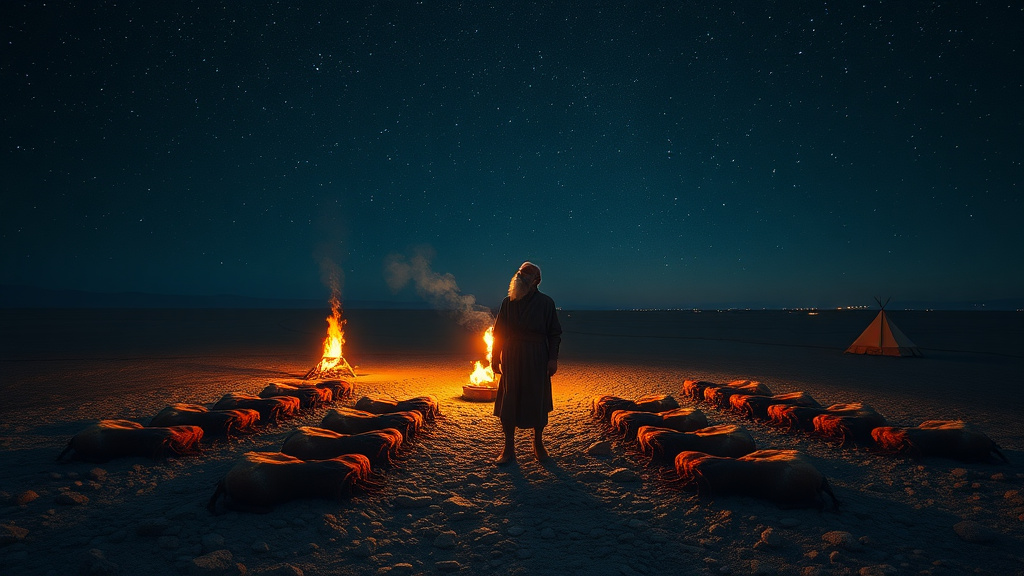
Genesis 15
Genesis · Ch.15
Covenant of Stars
Genesis 31:4
protestant「And Jacob sent and called Rachel and Leah to the field unto his flock,」
Covenant
allGod's first universal covenant, established with Noah, his descendants, and all living creatures, pledging never again to destroy the earth by flood.
How do rabbinic traditions interpret the twin-narrative rivalry between Cain and Abel?
Midrash enriches the Cain and Abel story, exploring the spiritual meaning behind land, sacrifice, and humanity's first murder.
Genesis 2:5
judaism「when no shrub of the field was yet on earth and no grasses of the field had yet sprouted, because the ETERNAL God had not sent rain upon the earth and there were no human beings to till the soil,」
The Eternal God
allThe sacred title Jacob invokes for God, signifying the everlasting and unchanging nature of the One worshipped by Abraham and Isaac throughout the generations.
How does the divine declaration "Let there be light" in Genesis shape our understanding of creative speech?
A single command summons being from void.
Genesis 26:4
protestant「and I will multiply thy seed as the stars of heaven, and will give unto thy seed all these lands; and in thy seed shall all the nations of the earth be blessed;」
Blood
allBlood as the seat of life; prohibition against eating blood and the lex talionis establish the inviolable sanctity of life before God.
What does being created in God's image mean?
Exploring what it means to bear the image of God according to Genesis 1:26 and its implications for human dignity.
Genesis 33:14
judaism「Let my lord go on ahead of his servant, while I travel slowly, at the pace of the cattle before me and at the pace of the children, until I come to my lord in Seir.”」
Vision
allA mode of divine revelation. Abram received God's word in a vision, marking a special revelatory encounter. The term appears frequently in prophetic literature.
Was Joseph wise to report his dreams to his father?
The tension between young Joseph's innocence and family politics.
Genesis 31:16
judaism「Truly, all the wealth that God has taken away from our father belongs to us and to our children. Now then, do just as God has told you.”」
Divine Presence Promise
allGod's personal promise to go down to Egypt with Jacob and bring him back,彰显 God's faithful presence and an unfailing promise.
How do rabbinic traditions interpret the twin-narrative rivalry between Cain and Abel?
Midrash enriches the Cain and Abel story, exploring the spiritual meaning behind land, sacrifice, and humanity's first murder.
Genesis 22:8
judaism「And Abraham said, “It is God who will see to the sheep for this burnt offering, my son.” And the two of them walked on together.」
Stranger and Sojourner
allAbraham's self-designation in Canaan, symbolizing the believer's pilgrim身份 without permanent earthly possession, seeking a heavenly homeland.
What does being created in God's image mean?
Exploring what it means to bear the image of God according to Genesis 1:26 and its implications for human dignity.
Genesis 48:11
protestant「And Israel said unto Joseph, I had not thought to see thy face: and, lo, God hath let me see thy seed also.」
Adoption as Sons
allJacob's act of adopting Joseph's Egyptian-born sons Ephraim and Manasseh as his own, granting them equal inheritance rights among the tribes.
What does it mean that humans are created in God's image?
An ancient declaration that humanity bears God's image—how does this shape our ethics and dignity today?
Genesis 44:5
judaism「It is the very one from which my master drinks and that he uses for divination. It was a wicked thing for you to do!’”」
Dan (Divine Vindication)
allRachel named her son Dan from the root ד-י-נ ('to judge/vindicate'), declaring 'God has vindicated me' — God's justice in hearing the cry of the barren.
Hebrews says Abel offered by faith—in what did that faith specifically show itself?
By faith Abel's offering was more excellent; though dead, his blood still speaks.
Genesis 29:13
protestant「And it came to pass, when Laban heard the tidings of Jacob his sister's son, that he ran to meet him, and embraced him, and kissed him, and brought him to his house. And he told Laban all these things.」
God Almighty (El Shaddai)
allA major divine name emphasizing God's almighty power and sufficiency, closely linked to the covenant God made with the patriarchs Abraham, Isaac, and Jacob.
What is the significance of the name 'Yahweh Yireh' for Abraham and for later generations?
By naming the place, what provision and foresight of God did Abraham proclaim?
Genesis 12:8
judaism「From there he moved on to the hill country east of Bethel and pitched his tent, with Bethel on the west and Ai on the east; and he built there an altar to GOD and invoked GOD by name.」
Divine Sovereignty and Providence
allJoseph repeatedly emphasizes 'God sent me ahead of you,' showing that God orchestrates events—even human evil—to accomplish His saving purpose, demonstrating divine sovereignty and providence.
How does the divine declaration "Let there be light" in Genesis shape our understanding of creative speech?
A single command summons being from void.
Genesis 48:4
judaism「and said to me, ‘I will make you fertile and numerous, making of you a community of peoples; and I will assign this land to your offspring to come for an everlasting possession.’」
Tree of Knowledge of Good and Evil
allThe tree marking the boundary of divine sovereignty; partaking represents overstepping into sin, bringing the fall and death into the world.
How does Catholic tradition understand the symbolic meaning of 'light and darkness' on the first day?
How did the Church Fathers connect the first day's separation of light and darkness with Christ as the Light of the World?
Genesis 36:8
protestant「And Esau dwelt in mount Seir: Esau is Edom.」
Blessing
allThe patriarchal blessing carried prophetic and irrevocable power, conveying God's promise and destiny. Isaac's blessing shaped Jacob's and Esau's futures.
What did God's warning to Cain before he killed Abel actually mean?
Sin crouches at the door waiting—an ancient picture of inner struggle, temptation, and overcoming evil.
Genesis 45:10
judaism「You will dwell in the region of Goshen, where you will be near me—you and your children and your grandchildren, your flocks and herds, and all that is yours.」
Divine Visitation
allGod's active intervention to fulfill His covenant promises. Here God visits Sarah at the appointed time, bringing the promised son to birth.
What can we infer about Isaac's role, awareness, and experience in the binding narrative?
Though Scripture is silent, why did Isaac, as a grown man, not resist?
Genesis 39:3
protestant「And his master saw that Jehovah was with him, and that Jehovah made all that he did to prosper in his hand.」
Lion of Judah
allJacob likened Judah to a lion's whelp, symbolizing valor, dignity, and royal power. The New Testament calls Jesus 'the Lion of the tribe of Judah,' and Revelation names the risen Christ likewise.
Why does Genesis 1:26 use the plural 'Let us make man in our image'?
The singular Creator speaks in plural—an ancient puzzle inviting reflection.
Genesis 15:17
protestant「And it came to pass, that, when the sun went down, and it was dark, behold, a smoking furnace, and a flaming torch that passed between these pieces.」
Seeing the Face of God
allJacob compares reconciliation with Esau to seeing God's face, revealing that human reconciliation manifests divine presence.
Why is circumcision the sign of the covenant?
Interpreting the theological meaning of circumcision as the sign of the Abrahamic covenant in Genesis 17:10-14 from a Jewish perspective.
Genesis 5:6
protestant「And Seth lived a hundred and five years, and begat Enosh:」
Land of Goshen
allThe fertile region in Egypt where Israel settled, preserving their distinct identity and faith while in a foreign land.
What does the institution of Sabbath teach about modern life?
God rested on day seven—is rest the crown of creation, or simply equal to work?
Genesis 8:9
judaism「But the dove could not find a resting place for its foot, and returned to him to the ark, for there was water over all the earth. So putting out his hand, he took it into the ark with him.」
Edom
allMeaning 'red,' the name of Esau and his descendants, becoming the perennial brother-enemy nation in OT history and prophetic oracles.
How does Catholic tradition understand Eden as a type of original holiness and justice?
The garden is viewed as the gift and holy state received at creation.
Genesis 43:7
judaism「They replied, “But the man kept asking about us and our family, saying, ‘Is your father still living? Have you another brother?’ And we answered him accordingly. How were we to know that he would say, ‘Bring your brother here’?”」
Levirate Duty
judaismThe ancient Israelite obligation of a surviving brother to marry his deceased brother's widow to raise up offspring for him, later codified in Deuteronomy.
How does rabbinic tradition interpret the theological significance of separating 'light from darkness' on the first day?
Rabbinic literature often sees the separation of light and darkness as the first foreshadowing of moral discernment.
Genesis 19:14
judaism「So Lot went out and spoke to his in-laws who had married his daughters, and said, “Up, get out of this place, for GOD is about to destroy the city.” But he seemed to his sons-in-law as one who jests.」
Sabbath Rest
judaismThe seventh day on which God rested and sanctified, establishing the Jewish Sabbath and prefiguring the eschatological rest God provides.
Why did God form Adam before entrusting him with the responsibilities of the garden?
The order of events reveals the Creator's trust and commission for the creature.
Genesis 28:3
judaism「May El Shaddai bless you, make you fertile and numerous, so that you become an assembly of peoples.」
Angels of God
allHeavenly messengers entrusted with executing God's purposes. Jacob encounters them en route, confirming God's covenant presence promised at Bethel—His angels guarding the patriarch's journey.
What does Abraham's obedience on Mount Moriah reveal about the nature of faith and trust in God?
When God asked Abraham to sacrifice Isaac, how did he respond, and what does his obedience teach us today?
Genesis 32:12
protestant「And thou saidst, I will surely do thee good, and make thy seed as the sand of the sea, which cannot be numbered for multitude.」
Faith
allHebrew verb 'to believe/trust.' Abram's complete trust in God's promises, listed in Hebrews 11 as exemplary faith. The root aman underlies the concept of faithfulness.
What did God's warning to Cain before he killed Abel actually mean?
Sin crouches at the door waiting—an ancient picture of inner struggle, temptation, and overcoming evil.
Genesis 29:15
judaism「Laban said to Jacob, “Just because you are a kinsman, should you serve me for nothing? Tell me, what shall your wages be?”」
El Shaddai (God Almighty)
allA covenant name of God revealed to the patriarchs, emphasizing His almighty power and faithfulness as the Guarantor who blesses, makes fruitful, and multiplies.
After Cain's punishment, what does it mean that he became a fugitive and wanderer on the earth?
God placed a mark on Cain to protect him from vengeance, yet he bore the cost of rupture from the land and from God's presence.
Genesis 17:17
judaism「Abraham threw himself on his face and laughed, as he said to himself, “Can a child be born to a man a hundred years old, or can Sarah bear a child at ninety?”」
Finding Favor
allחֵן (chen) denotes unmerited favor and grace. Jacob attributes his children to 'the grace God has given your servant,' and compares seeing Esau's face to 'seeing the face of God,' foreshadowing grace running through his line.
What state does 'formless and void' actually describe at the beginning of creation?
The Hebrew tohu wa-bohu has sparked countless interpretations—chaos, potential, or theological statement?